
植物学报 ›› 2019, Vol. 54 ›› Issue (5): 547-549.DOI: 10.11983/CBB19166 cstr: 32102.14.CBB19166
• 热点评 • 下一篇
李伟滔,贺闽,陈学伟( )
)
收稿日期:2019-08-27
接受日期:2019-09-17
出版日期:2019-09-01
发布日期:2019-01-01
通讯作者:
陈学伟
Weitao Li,Min He,Xuewei Chen()
Received:2019-08-27
Accepted:2019-09-17
Online:2019-09-01
Published:2019-01-01
Contact:
Xuewei Chen
摘要: 由真菌Rhizoctonia solani引起的纹枯病严重危害玉米(Zea mays)和水稻(Oryza sativa)等作物的安全生产。R. solani的宿主范围广且抗源少, 加之相关的抗性机制研究有限, 导致纹枯病的危害长期得不到有效控制。近期, 中国科学家通过对318份玉米自交系进行全基因组关联分析, 筛选到1个与纹枯病抗性相关的、编码F-box结构域蛋白的候选基因ZmFBL41 (GRMZM2G109140)。ZmFBL41蛋白是SCF (SKP1-Cullin-F-box) E3泛素连接酶复合体的一员, 能介导复合体对肉桂醇脱氢酶ZmCAD的降解, 从而降低木质素的积累, 使玉米易感纹枯病。玉米抗病自交系Chang7-2中, 蛋白ZmFBL41 Chang7-2因2个关键氨基酸的变异, 不能结合并降解底物ZmCAD, 使木质素含量增加, 从而提高玉米对纹枯病的抗性。该研究率先揭示了SCF复合体可通过降解肉桂醇脱氢酶来调控植物免疫反应的新型分子机制, 为提高玉米及其它作物对纹枯病的抗性提供了重要理论依据和基因资源。
李伟滔, 贺闽, 陈学伟. ZmFBL41 Chang7-2: 玉米抗纹枯病的关键利器. 植物学报, 2019, 54(5): 547-549.
Weitao Li, Min He, Xuewei Chen. Discovery of ZmFBL41 Chang7-2 as A Key Weapon against Banded Leaf and Sheath Blight Resistance in Maize. Chinese Bulletin of Botany, 2019, 54(5): 547-549.
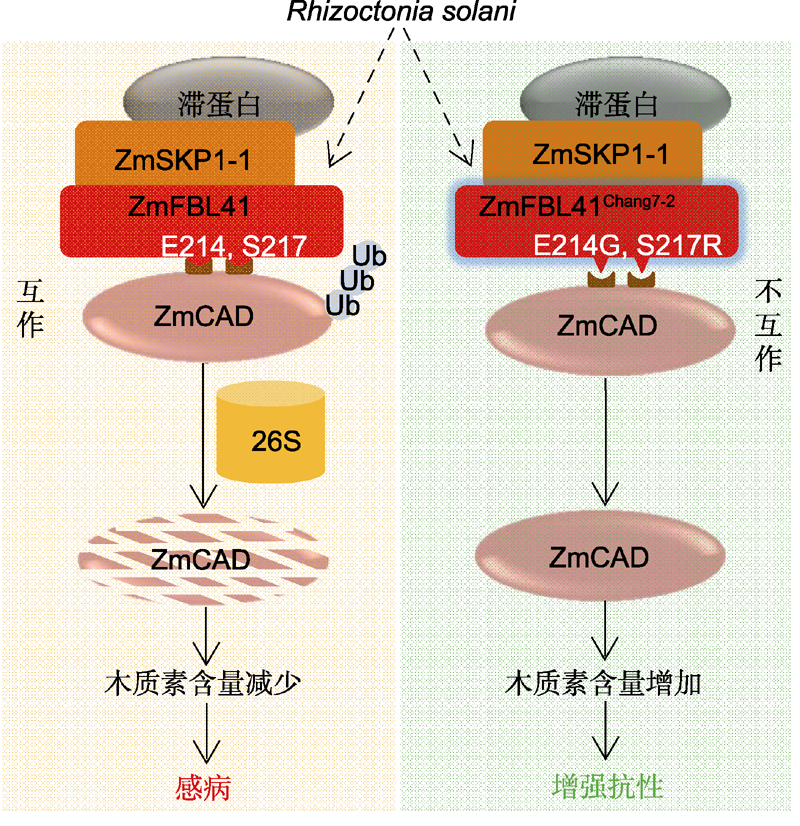
图1 ZmFBL41介导的纹枯病抗性 ZmFBL41与ZmSKP1-1互作形成SCF复合体, 通过26S蛋白酶体降解底物ZmCAD, 减少木质素的积累, 从而使玉米易感纹枯病。而ZmFBL41Chang7-2因其中2个关键氨基酸位点变异(E214G, S217R), 不能结合并降解底物ZmCAD, 从而引起木质素积累, 使玉米对纹枯病的抗性增强。
Figure 1 A model for ZmFBL41-mediated banded leaf and sheath blight (BLSB) resistance ZmFBL41 interacts with ZmSKP1-1 to form the SCF complex, and recruits ZmCAD for 26S proteasome-mediated degradation, resulting in reduced lignin synthesis and increased susceptibility of maize to R. solani. However, in the natural maize resource Chang7-2, the protein ZmFBL41Chang7-2 with two amino acid variations (E214G and S217R) is not able to interact with ZmCAD, leading to failure in degradation of ZmCAD and resulting in accumulation of lignin, which consequently enhances resistance to R. solani.
| 1 | Baruah P, Lal S (1981). Hostrange of Rhizoctonia solani f. sp. sasakii, then incitant of banded sclerotial disease of maize. Indian Phytopath 34, 494-496. |
| 2 | Hooda KS, Khokhar MK, Parmar H, Gogoi R, Joshi D, Sharma SS, Yadav OP (2017). Banded leaf and sheath blight of maize: historical perspectives, current status and future directions. Proc Natl Acad Sci India Sect B Biol Sci 87, 1041-1052. |
| 3 | Li N, Lin B, Wang H, Li X, Yang F, Ding X, Yan J, Chu Z (2019). Natural variation in ZmFBL41 confers banded leaf and sheath blight resistance in maize. Nat Genet 51, 1540-1548. |
| 4 | Li Z, Pinson SRM, Marchetti MA, Stansel JW, Park WD (1995). Characterization of quantitative trait loci (QTLs) in cultivated rice contributing to field resistance to sheath blight ( Rhizoctonia solani). Theor Appl Genet 91, 382-388. |
| 5 | Maeda S, Dubouzet JG, Kondou Y, Jikumaru Y, Seo S, Oda K, Matsui M, Hirochika H, Mori M (2019) The rice CYP78A gene BSR2 confers resistance to Rhizoctonia solani and affects seed size and growth in Arabidopsis and rice. Sci Rep 9, 587. |
| 6 | Ogoshi A (1987). Ecology and pathogenicity of anastomosis and interspecific groups of Rhizoctonia solani Kuhn. Ann Rev Phytopathol 25, 125-143. |
| 7 | Peng X, Wang H, Jang JC, Xiao T, He H, Jiang D, Tang X (2016). OsWRKY80-OsWRKY4 module as a positive regulatory circuit in rice resistance against Rhizoctonia solani. Rice 9, 63. |
| 8 | Richa K, Tiwari IM, Devanna BN, Botella JR, Sharma V, Sharma TR (2017). Novel chitinase gene LOC_Os 11g47510 from indica rice Tetep provides enhanced resistance against sheath blight pathogen Rhizoctonia solani in rice. Front Plant Sci 8, 596. |
| 9 | Sharma RC, Srinivas P, Batsa BK (2002). Banded leaf and sheath blight of maize its epidemiology and management. In: Rajbhandari NP, Ransom JK, Adhikari K, Palmer AFE, eds. Proceedings of a Maize Symposium Held. Kathmandu: NARC and CIMMYT. pp. 108-112. |
| 10 | Sharma RR, Gour HN, Rathore RS (2004). Etiology of banded leaf and sheath blight symptoms on maize. J Mycol Plant Pathol 34, 56-59. |
| 11 | Singh BM, Sharma YR (1976). Evaluation of maize germplasm to banded sclerotial disease and assessment of yield loss. Indian Phytopath 29, 129-132. |
| 12 | Wang H, Meng J, Peng X, Tang X, Zhou P, Xiang J, Deng X (2015). Rice WRKY4 acts as a transcriptional activator mediating defense responses toward Rhizoctonia solani, the causing agent of rice sheath blight. Plant Mol Biol 89, 157-171. |
| [1] | 阳锦华, 王冰. 独脚金内酯受体精准改造助力水稻抗病毒“防卫战”[J]. 植物学报, 2026, 61(3): 357-368. |
| [2] | 李月琪, 麻仲花, 刘威帆, 苏明, 万猛虎, 李清云, 张丹, 刘吉利, 吴娜. 垂直深旋耕配施有机肥对盐碱地玉米叶片衰老特性及产量的影响[J]. 植物生态学报, 2026, 50(1): 222-236. |
| [3] | 林淼. 玉米雄穗分枝数的激素“密码”[J]. 植物学报, 2026, 61(1): 157-169. |
| [4] | 樊月玲, 蒋正德, 叶佳舒, 郑立臣, 陈欣. 2005-2015年下辽河平原农田长期观测样地主要农作物收获期性状和产量数据集[J]. 植物生态学报, 2025, 49(8): 1271-1282. |
| [5] | 朱喜, 何志斌, 杜明武, 赵丽雯, 吴丹丹. 2004-2010年河西走廊中段绿洲农田生态系统长期监测样地作物性状和产量数据集[J]. 植物生态学报, 2025, 49(8): 1312-1320. |
| [6] | 王志波, 刘文胜, 吴瑞俊, 王国梁. 2018-2023年黄土高原丘陵沟壑区川台地农田长期监测样地作物收获期性状和产量数据集[J]. 植物生态学报, 2025, 49(8): 1301-1311. |
| [7] | 王立龙, 冯静, 苏娜, 刘新平, 潘成臣, 李玉强. 2005-2015年科尔沁沙地典型农田生态系统长期监测样地玉米收获期性状和产量数据集[J]. 植物生态学报, 2025, 49(8): 1293-1300. |
| [8] | 徐羽丰, 周冕. 植物免疫的转录后调控[J]. 植物学报, 2025, 60(5): 704-721. |
| [9] | 王笑, 徐昌文, 钱虹萍, 李思博, 林金星, 崔亚宁. 植物细胞壁参与免疫反应的机制及其原位非标记成像方法[J]. 植物学报, 2025, 60(5): 773-785. |
| [10] | 肖银燕, 于华, 万里. 植物免疫研究: 机制突破和应用创新[J]. 植物学报, 2025, 60(5): 693-703. |
| [11] | 江亚楠, 徐雨青, 魏毅铤, 陈钧, 张容菀, 赵蓓蓓, 林宇翔, 饶玉春. 水稻抗病调控机制研究进展[J]. 植物学报, 2025, 60(5): 734-748. |
| [12] | 陈钧, 徐江民, 周逸楠, 江亚楠, 胡程翔, 金芊芸, 赵蓓蓓, 朱哲楠, 徐雨青, 张璐怡, 刘笑妍, 刘隽, 李三峰, 王跃星, 饶玉春. 水稻白叶枯病抗性QTL的挖掘与候选基因分析[J]. 植物学报, 2025, 60(5): 831-845. |
| [13] | 刘德水, 岳宁, 刘玉乐. 植物免疫机制新突破[J]. 植物学报, 2025, 60(5): 669-678. |
| [14] | 叶灿, 姚林波, 金莹, 高蓉, 谭琪, 李旭映, 张艳军, 陈析丰, 马伯军, 章薇, 张可伟. 水稻水杨酸代谢突变体高通量筛选方法的建立与应用[J]. 植物学报, 2025, 60(4): 586-596. |
| [15] | 赵凌, 管菊, 梁文化, 张勇, 路凯, 赵春芳, 李余生, 张亚东. 基于高密度Bin图谱的水稻苗期耐热性QTL定位[J]. 植物学报, 2025, 60(3): 342-353. |
| 阅读次数 | ||||||
|
全文 |
|
|||||
|
摘要 |
|
|||||
 首页
首页