
植物学报 ›› 2021, Vol. 56 ›› Issue (1): 44-49.DOI: 10.11983/CBB20203 cstr: 32102.14.CBB20203
谢先荣, 曾栋昌, 谭健韬, 祝钦泷, 刘耀光*( )
)
收稿日期:2020-12-11
接受日期:2021-02-25
出版日期:2021-01-01
发布日期:2021-02-25
通讯作者:
刘耀光
作者简介:E-mail: ygliu@scau.edu.cn基金资助:
Xianrong Xie, Dongchang Zeng, Jiantao Tan, Qinlong Zhu, Yaoguang Liu*()
Received:2020-12-11
Accepted:2021-02-25
Online:2021-01-01
Published:2021-02-25
Contact:
Yaoguang Liu
摘要: 基于CRISPR/Cas9系统的基因组编辑技术已成为基因功能研究和遗传修饰的重要工具。在引导RNA的引导下, Cas9蛋白对基因组靶位点进行精准切割产生DNA双链断裂(DSB), 借助细胞内的DSB修复机制, 可实现基因组靶位点碱基的缺失、插入或者替换, 甚至发生片段删除。该文介绍了基于CRISPR/Cas9基因组编辑系统的DSB微同源末端连接修复方式(MMEJ)提高基因组DNA片段删除效率的方法, 主要从靶点设计和突变检测方面展开详细描述。
谢先荣, 曾栋昌, 谭健韬, 祝钦泷, 刘耀光. 基于CRISPR编辑系统的DNA片段删除技术. 植物学报, 2021, 56(1): 44-49.
Xianrong Xie, Dongchang Zeng, Jiantao Tan, Qinlong Zhu, Yaoguang Liu. CRISPR-based DNA Fragment Deletion in Plants. Chinese Bulletin of Botany, 2021, 56(1): 44-49.
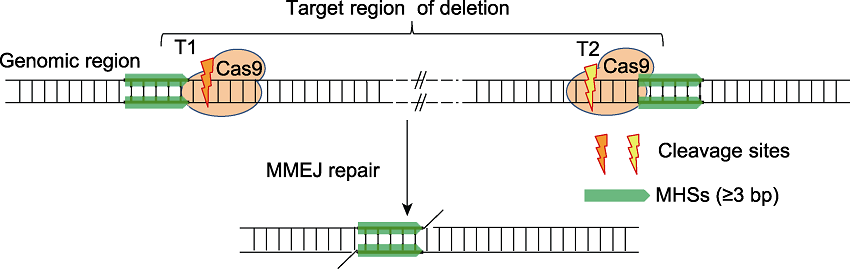
图1 利用微同源介导的末端连接(MMEJ)修复进行DNA片段删除的原理(改自Xie et al., 2020) MHS: 微同源序列
Figure 1 The principle for microhomology-mediated end joining (MMEJ)-based DNA fragment deletion(modified from Xie et al., 2020) MHS: Microhomologous sequence
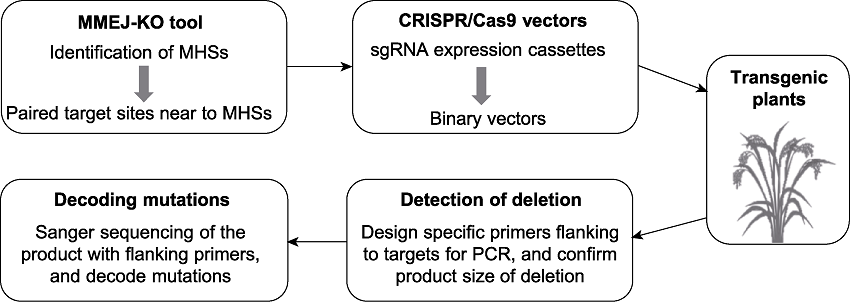
图2 基于微同源介导的末端连接(MMEJ)介导DNA片段删除的实验流程
Figure 2 The experimental workflow for microhomology-mediated end joining (MMEJ)-mediated DNA fragment deletion
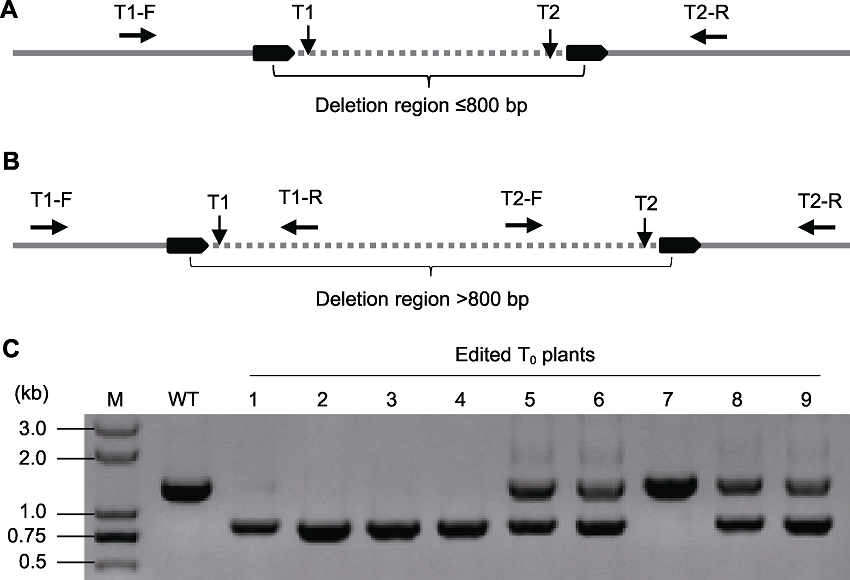
图3 再生植株突变体突变类型的鉴定策略 (A) 如果删除片段小于或约等于800 bp, 在靶点1 (T1)的上游和靶点2 (T2)的下游设计正向引物(T1-F)和反向引物(T2-R)进行PCR扩增; (B) 如果删除片段大于800 bp, 合成4条引物(使以下各扩增产物长度相互有约70-100 bp的差别), 设3组PCR反应(T1-F/T1-R、T2-F/T2-R和T1-F/T2-R), 也可以在同一个PCR反应使用4条引物(如果只扩增出T1-F/T1-R片段和T2-F/T2-R片段而扩增不出T1-F/T2-R小片段, 表明没有发生片段删除; 如果只扩增出T1-F/T2-R小片段而没有扩增出T1-F/T1-R片段和T2-F/T2-R片段, 表明2个等位序列都产生了片段删除; 如果3个片段都被扩增出, 表明一个等位序列产生了片段删除而另一等位序列没有片段删除); (C) 按策略(A)的引物设计的PCR扩增电泳检测图。WT: 未编辑的野生型; 1-9为T0编辑植株, 其中植株1-4的2个等位序列都发生了片段删除; 植株5、6、8、9有1个等位序列发生了片段删除, 植株7未发生片段删除。
Figure 3 The strategy for identification of the mutant types in transgenic plants (A) Amplification of the target region using the forward primer (T1-F) upstream the T1 and reverse primer (T2-R) downstream T2 if the length of desirable deleted fragment is less than 800 bp; (B) Four primers (with the length of the following amplification products is about 70-100 bp different from each other) with three combinations (T1-F/T1-R, T2-F/T2-R, and T1-F/T2-R) or pooled in an amplification are suggested if the length of desirable deleted fragment is more than 800 bp (there is no deletion of the target region if the resulting bands are produced with primer groups (T1-F/T1-R and T2-F/T2-R) but not T1-F/T2-R; both alleles had fragment deletion if the resulting bands are produced with primer group T1-F/T2-R but not T1-F/T1-R and T2-F/T2-R; one allele had fragment deletion and the other allele had no fragment deletion if all three fragments were produced; (C) The example of gel electrophoresis according to the detection method of (A). WT: Wild type; 1-9 indicate edited T0 plants in which 1-4 with biallelic fragment deletion, 5, 6, 8 and 9 with heterozygous deletion and 7 with no deletion.
| [1] | 苏钺凯, 邱镜仁, 张晗, 宋振巧, 王建华 (2019). CRISPR/ Cas9系统在植物基因组编辑中技术改进与创新的研究进展. 植物学报 54, 385-395. |
| [2] | 曾栋昌, 马兴亮, 谢先荣, 祝钦泷, 刘耀光 (2018). 植物CRISPR/Cas9多基因编辑载体构建和突变分析的操作方法. 中国科学: 生命科学 48, 783-794. |
| [3] |
Burgess DG, Xu J, Freeling M (2015). Advances in understanding cis regulation of the plant gene with an emphasis on comparative genomics. Curr Opin Plant Biol 27, 141-147.
DOI URL |
| [4] |
Canver MC, Bauer DE, Dass A, Yien YY, Chung J, Masuda T, Maeda T, Paw BH, Orkin SH (2014). Characterization of genomic deletion efficiency mediated by clustered regularly interspaced palindromic repeats (CRIS- PR)/Cas9 nuclease system in mammalian cells. J Biol Chem 289, 21312-21324.
DOI URL PMID |
| [5] | Liu WZ, Xie XR, Ma XL, Li J, Chen JH, Liu YG (2015). DSDecode: a web-based tool for decoding of sequencing chromatograms for genotyping of targeted mutations. Mol Plant 8, 1431-1433. |
| [6] |
Ma XL, Zhang QY, Zhu QL, Liu W, Chen Y, Qiu R, Wang B, Yang ZF, Li HY, Lin YR, Xie YY, Shen RX, Chen SF, Wang Z, Chen YL, Guo JX, Chen LT, Zhao XC, Dong ZC, Liu YG (2015). A robust CRISPR/Cas9 system for convenient, high-efficiency multiplex genome editing in monocot and dicot plants. Mol Plant 8, 1274-1284.
URL PMID |
| [7] |
Ma XL, Zhu QL, Chen YL, Liu YG (2016). CRISPR/Cas9 platforms for genome editing in plants: developments and applications. Mol Plant 9, 961-974.
URL PMID |
| [8] |
Manova V, Gruszka D (2015). DNA damage and repair in plants-from models to crops. Front Plant Sci 6, 885.
URL PMID |
| [9] | Owens DDG, Caulder A, Frontera V, Harman JR, Allan AJ, Bucakci A, Greder L, Codner GF, Hublitz P, McHugh PJ, Teboul L, de Bruijn MFTR (2019). Microhomologies are prevalent at Cas9-induced larger deletions. Nucleic Acids Res 47, 7402-7417. |
| [10] |
Tan JT, Zhao YC, Wang B, Hao Y, Wang YX, Li YY, Luo WN, Zong WB, Li GS, Chen SF, Ma K, Xie XR, Chen LT, Liu YG, Zhu QL (2020). Efficient CRISPR/Cas9-based plant genomic fragment deletions by microhomology- mediated end joining. Plant Biotechnol J 18, 2161-2163.
DOI URL PMID |
| [11] |
Tuladhar R, Yeu Y, Piazza JT, Tan ZP, Clemenceau JR, Wu XF, Barrett Q, Herbert J, Mathews DH, Kim J, Hwang TH, Lum L (2019). CRISPR-Cas9-based mu- tagenesis frequently provokes on-target mRNA misregulation. Nat Commun 10, 4056.
URL PMID |
| [12] |
Xie XR, Liu WZ, Dong G, Zhu QH, Liu YG (2020). MMEJ-KO: a web tool for designing paired CRISPR guide RNAs for microhomology-mediated end joining fragment deletion. Sci China Life Sci doi: 10.1007/s11427-020-1797-3.
URL PMID |
| [13] |
Xie XR, Ma XL, Zhu QL, Zeng DC, Li GS, Liu YG (2017). CRISPR-GE: a convenient software toolkit for CRISPR- based genome editing. Mol Plant 10, 1246-1249.
DOI URL PMID |
| [14] | Zhang Y, Massel K, Godwin ID, Gao CX (2018). Applications and potential of genome editing in crop improvement. Genome Biol 19, 210. |
| [1] | 陈龙浩, 杨瑞娟, 苑筱一, 邢思年, 臧云, 吴凡, 张吉宇, 秦晓春, 刘文文, 付春祥. 白花草木樨毛状根高效基因组编辑体系的建立[J]. 植物学报, 2026, 61(1): 102-113. |
| [2] | 张强, 赵振宇, 李平华. 基因编辑技术在玉米中的研究进展[J]. 植物学报, 2024, 59(6): 978-998. |
| [3] | 胡丹玲, 孙永伟. 病毒介导的植物基因组编辑技术研究进展[J]. 植物学报, 2024, 59(3): 452-462. |
| [4] | 苗春妍, 李铭铭, 左鑫, 丁宁, 杜家方, 李娟, 张重义, 王丰青. 湖北地黄CRISPR/Cas9基因编辑体系的建立[J]. 植物学报, 2023, 58(6): 905-916. |
| [5] | 何晓玲, 刘鹏程, 马伯军, 陈析丰. 基于CRISPR/Cas9的基因编辑技术研究进展及其在植物中的应用[J]. 植物学报, 2022, 57(4): 508-531. |
| [6] | 谭禄宾, 孙传清. 四倍体野生稻快速驯化: 启动人类新农业文明[J]. 植物学报, 2021, 56(2): 134-137. |
| [7] | 凡惠金, 金康鸣, 卓仁英, 乔桂荣. 毛竹不同截短U3启动子的克隆及表达分析[J]. 植物学报, 2020, 55(3): 299-307. |
| [8] | 苏钺凯,邱镜仁,张晗,宋振巧,王建华. CRISPR/Cas9系统在植物基因组编辑中技术改进与创新的研究进展[J]. 植物学报, 2019, 54(3): 385-395. |
| [9] | 王影, 李相敢, 邱丽娟. CRISPR/Cas9基因组定点编辑中脱靶现象的研究进展[J]. 植物学报, 2018, 53(4): 528-541. |
| 阅读次数 | ||||||
|
全文 |
|
|||||
|
摘要 |
|
|||||
 首页
首页