
植物学报 ›› 2025, Vol. 60 ›› Issue (6): 875-887.DOI: 10.11983/CBB24150 cstr: 32102.14.CBB24150
窦淋琳1, 朱钰1, 刘翠翠1, 臧运平2, 陶正国3, 包满珠1, 何燕红1,*( )
)
收稿日期:2024-10-02
接受日期:2025-01-20
出版日期:2025-11-10
发布日期:2025-01-21
通讯作者:
*何燕红, 1982年10月生, 江苏常州人, 现为华中农业大学园艺林学学院园林系副教授。2005-2010年华中农业大学博士毕业后留校任教, 2015年在佛罗里达大学访学1年。长期从事万寿菊、月季和百合等花卉的遗传育种研究。主持国家重点研发计划子课题、国家自然科学基金等项目近10项; 荣获湖北省科技进步一等奖1项(2013年, 第二完成人), 广东省科技进步二等奖1项(2019年, 第6完成人); 审定或授权新品种5个; 申请专利6项; 制定标准3项; 主编或副主编教材和专著3部; 在Horticulture Research、Plant Science、BMC Plant Biology及《中国农业科学》和《植物学报》等期刊发表科研论文30余篇。E-mail: hyh2010@mail.hzau.edu.cn
基金资助:
Linlin Dou1, Yu Zhu1, Cuicui Liu1, Yunping Zang2, Zhengguo Tao3, Manzhu Bao1, Yanhong He1,*()
Received:2024-10-02
Accepted:2025-01-20
Online:2025-11-10
Published:2025-01-21
Contact:
*E-mail: hyh2010@mail.hzau.edu.cn
摘要: 为建立万寿菊(Tagetes erecta)花冠高效瞬时转化体系并探究花器官对称性形成关键调控基因TeCYC2c的启动子活性, 将CaMV35S启动子与GUS基因的融合表达载体瞬时转化万寿菊花冠, 探究菌株类型、菌液浓度、侵染时间和共培养时间对GUS基因瞬时转化效率的影响。结果显示, GV3101菌株的侵染效率最高; 菌液浓度OD600=1.0时转化效率最高; 侵染时间对瞬时转化效率无显著影响; 共培养1天为最佳培养时间。基于建立的万寿菊花冠瞬时转化体系, 对TeCYC2c基因的启动子活性进行探究。克隆了TeCYC2c基因上游1 735 bp序列, 并通过PlantCARE预测的元件分布位置及数量构建了4个启动子缺失表达载体, 以GUS基因为报告基因, 瞬时转化万寿菊花冠进行不同长度启动子活性研究。结果显示, 启动子核心区域位于ATG上游-650 - -1 bp, 推测该区域内的光响应元件正调控下游基因的表达, 而pTeCYC2c (-1 735)和pTeCYC2c (-1 406)所特有的植物激素响应和逆境响应元件可能具有抑制启动子驱动下游基因表达的功能。结合万寿菊花冠瞬时转化体系的建立和TeCYC2c启动子活性分析, 可为进一步快速解析花发育相关基因的功能奠定技术基础。
窦淋琳, 朱钰, 刘翠翠, 臧运平, 陶正国, 包满珠, 何燕红. 万寿菊花冠高效瞬时转化体系的建立及TeCYC2c基因启动子活性分析. 植物学报, 2025, 60(6): 875-887.
Linlin Dou, Yu Zhu, Cuicui Liu, Yunping Zang, Zhengguo Tao, Manzhu Bao, Yanhong He. Establishment of an Efficient Transient Transformation System for Tagetes erecta Corollas and Analysis on the Promoter Activity of TeCYC2c Gene. Chinese Bulletin of Botany, 2025, 60(6): 875-887.
| Primer name | Sequences (5′→3′) | Function |
|---|---|---|
| pTeCYC2c-F (-1735) | ACGACAATGAAGTTTGAAGACACAG | Promoter cloning |
| pTeCYC2c-F (-1406) | ATTTGAAGTTGCAACTCTGTCATAAAT | Promoter deletion fragments cloning |
| pTeCYC2c-F (-1000) | AACCATTAGGGCCGTGTCG | Promoter deletion fragments cloning |
| pTeCYC2c-F (-650) | GGTGTCTTGGTAATTTTAAAAAAACG | Promoter deletion fragments cloning |
| pTeCYC2c-R | TGTATTTTGGAATTGAAATGTGAAATAA | Promoter deletion fragments cloning |
表1 引物序列
Table 1 Primer sequences
| Primer name | Sequences (5′→3′) | Function |
|---|---|---|
| pTeCYC2c-F (-1735) | ACGACAATGAAGTTTGAAGACACAG | Promoter cloning |
| pTeCYC2c-F (-1406) | ATTTGAAGTTGCAACTCTGTCATAAAT | Promoter deletion fragments cloning |
| pTeCYC2c-F (-1000) | AACCATTAGGGCCGTGTCG | Promoter deletion fragments cloning |
| pTeCYC2c-F (-650) | GGTGTCTTGGTAATTTTAAAAAAACG | Promoter deletion fragments cloning |
| pTeCYC2c-R | TGTATTTTGGAATTGAAATGTGAAATAA | Promoter deletion fragments cloning |
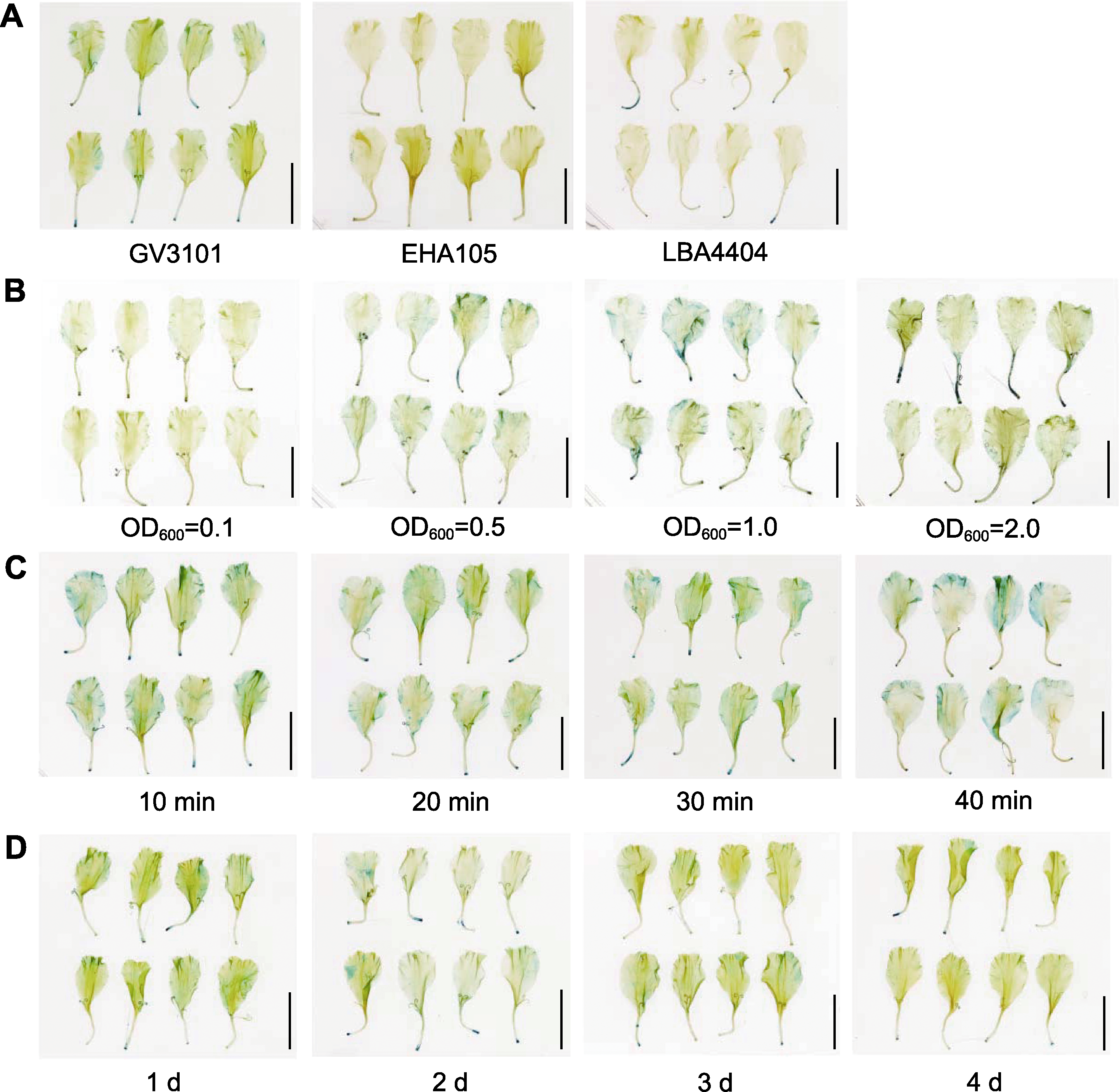
图1 不同瞬时转化条件下的万寿菊花冠GUS染色 (A) 3种不同菌株侵染万寿菊花冠的GUS染色; (B) 4种菌液浓度(OD600)侵染条件下的GUS染色; (C) 4种侵染时间条件下的GUS染色; (D) 4种共培养时间条件下的GUS染色。(A)-(D) Bars=1 cm
Figure 1 GUS staining of marigold (Tagetes erecta) corollas under different transient transformation conditions (A) GUS staining of marigold corollas infected by three different bacterial strains; (B) GUS staining under four different concentrations (OD600) of bacterial suspension; (C) GUS staining under four different infection duration; (D) GUS staining under four different co-culture time. (A)-(D) Bars=1 cm
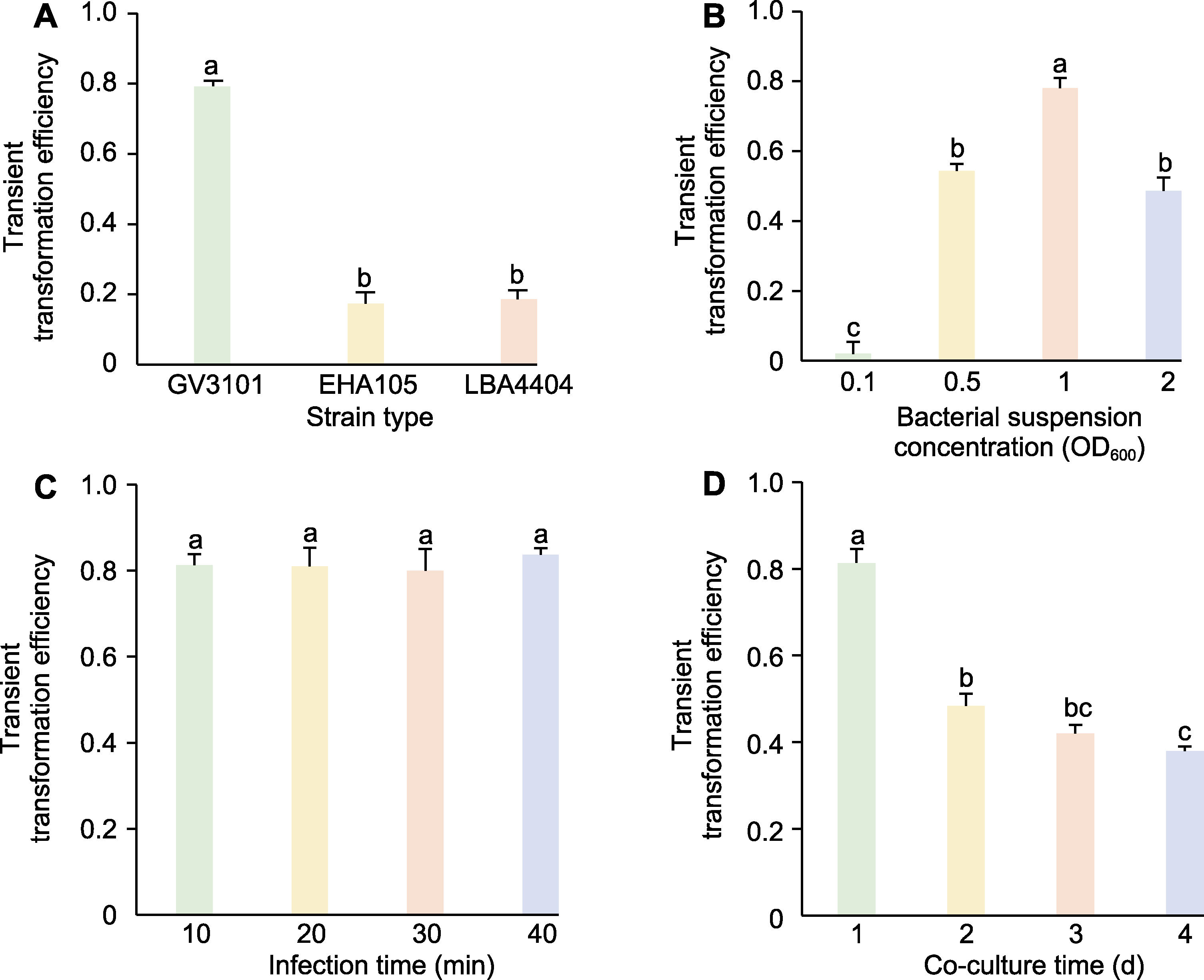
图2 菌株类型(A)、菌液浓度(B)、侵染时间(C)和共培养时间(D)对万寿菊花冠瞬时转化效率的影响柱形图上不同小写字母表示在P<0.05水平差异显著。
Figure 2 The influence of strain type (A), bacterial suspension concentration (B), infection time (C), and co-culture time (D) on the transient transformation efficiency of Tagetes erecta corollas Different lowercase letters on the histogram indicate significant differences at the P<0.05 level.
| Cis-regulatory elements | Sequences and position | Number | Description |
|---|---|---|---|
| ARE | AAACCA: -1359, -1296 | 2 | Cis-acting regulatory element essential for the anaerobic induction |
| LAMP-element | CTTTATCA: -1661 | 1 | Part of a light responsive element |
| MBS | CAACTG: -1712 | 1 | MYB binding site involved in drought-inducibility |
| TCT-motif | TCTTAC: -603 | 1 | Part of a light responsive element |
| Box 4 | ATTAAT: -1420, -429, -413, -409 | 4 | Part of a conserved DNA module involved in light responsiveness |
| ACE | CTAACGTATT: -630 | 1 | Cis-acting element involved in light responsiveness |
| CGTCA-motif | CGTCA: -1690, -1347, -1235, -797, -713 | 5 | Cis-acting regulatory element involved in the MeJA- responsiveness |
| MBSI | aaaAaaC(G/C)GTTA: -633 | 1 | MYB binding site involved in flavonoid biosynthetic genes regulation |
| GT1-motif | GGTTAA: -1002, -67 | 2 | Light responsive element |
| ABRE | ACGTG: -1349 | 1 | Cis-acting element involved in the abscisic acid responsiveness |
| TATC-box | TATCCCA: -1708 | 1 | Cis-acting element involved in gibberellin-responsiveness |
| G-box | CACGAC: -1655, -1504 | 2 | Cis-acting regulatory element involved in light responsiveness |
| O2-site | GATGATGTGG: -981 | 1 | Cis-acting regulatory element involved in zein metabolism regulation |
| AE-box | AGAAACAA: -74 | 1 | Part of a module for light response |
| LTR | CCGAAA: -1496 | 1 | Cis-acting element involved in low-temperature responsiveness |
表2 TeCYC2c启动子顺式作用元件分析
Table 2 Analysis of the cis-acting elements in the TeCYC2c promoter
| Cis-regulatory elements | Sequences and position | Number | Description |
|---|---|---|---|
| ARE | AAACCA: -1359, -1296 | 2 | Cis-acting regulatory element essential for the anaerobic induction |
| LAMP-element | CTTTATCA: -1661 | 1 | Part of a light responsive element |
| MBS | CAACTG: -1712 | 1 | MYB binding site involved in drought-inducibility |
| TCT-motif | TCTTAC: -603 | 1 | Part of a light responsive element |
| Box 4 | ATTAAT: -1420, -429, -413, -409 | 4 | Part of a conserved DNA module involved in light responsiveness |
| ACE | CTAACGTATT: -630 | 1 | Cis-acting element involved in light responsiveness |
| CGTCA-motif | CGTCA: -1690, -1347, -1235, -797, -713 | 5 | Cis-acting regulatory element involved in the MeJA- responsiveness |
| MBSI | aaaAaaC(G/C)GTTA: -633 | 1 | MYB binding site involved in flavonoid biosynthetic genes regulation |
| GT1-motif | GGTTAA: -1002, -67 | 2 | Light responsive element |
| ABRE | ACGTG: -1349 | 1 | Cis-acting element involved in the abscisic acid responsiveness |
| TATC-box | TATCCCA: -1708 | 1 | Cis-acting element involved in gibberellin-responsiveness |
| G-box | CACGAC: -1655, -1504 | 2 | Cis-acting regulatory element involved in light responsiveness |
| O2-site | GATGATGTGG: -981 | 1 | Cis-acting regulatory element involved in zein metabolism regulation |
| AE-box | AGAAACAA: -74 | 1 | Part of a module for light response |
| LTR | CCGAAA: -1496 | 1 | Cis-acting element involved in low-temperature responsiveness |
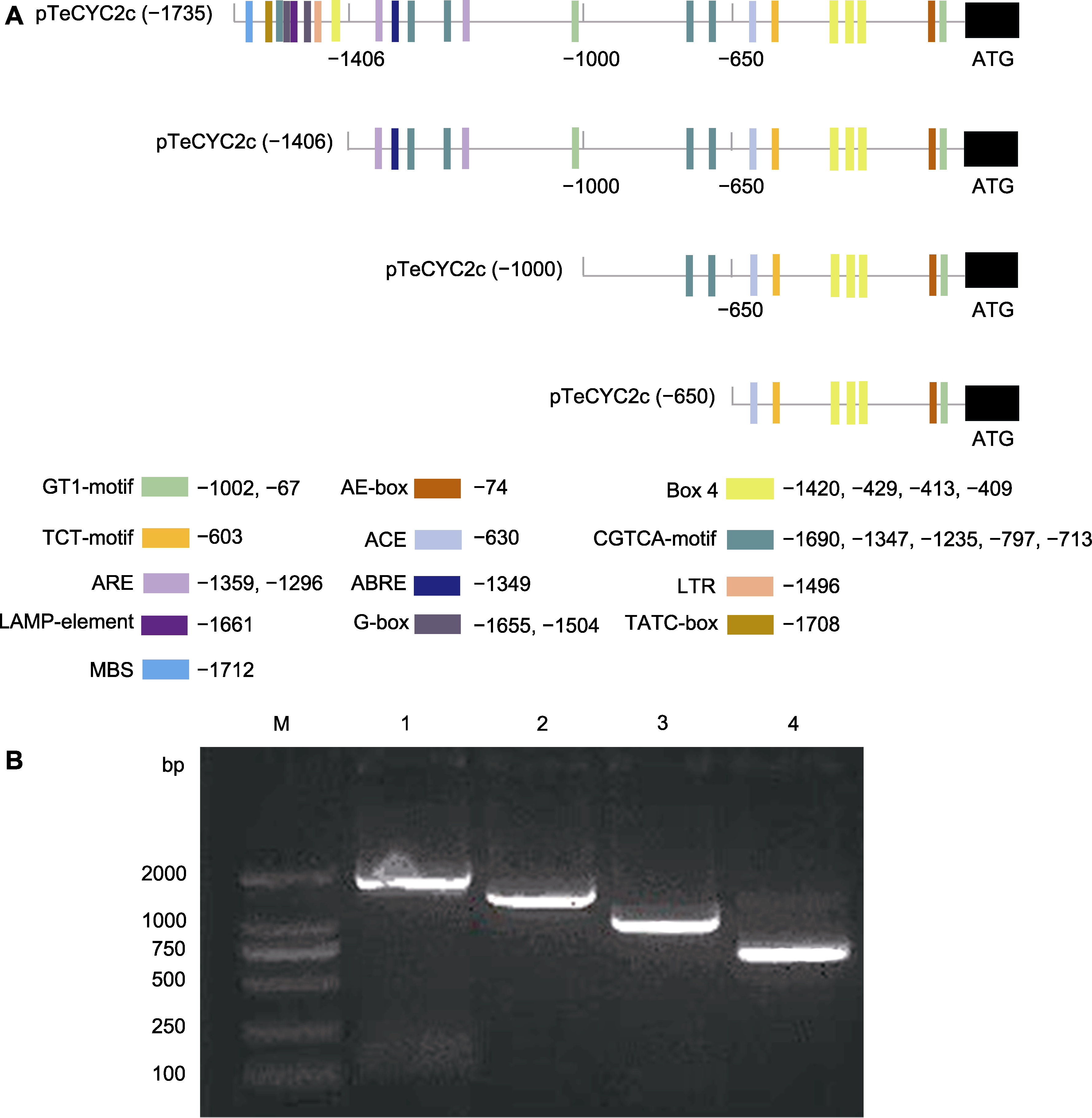
图3 TeCYC2c基因启动子缺失片段设计示意图及启动子不同长度片段克隆 (A) TeCYC2c基因启动子缺失片段设计示意图(Box 4: 光响应元件; ACE: 光响应元件; TCT-motif: 光响应元件; GT1-motif: 光响应元件; AE-box: 光响应元件; ARE: 厌氧诱导元件; MBS: 干旱诱导元件; CGTCA-motif: MeJA响应元件; ABRE: ABA响应元件; TATC-box: GA响应元件; LTR: 低温响应元件; 图中数值单位为bp); (B) TeCYC2c基因启动子不同长度片段克隆(M: DL2000 marker; 1-4: 分别代表pTeCYC2c (-1 735)、pTeCYC2c (-1 406)、pTeCYC2c (-1 000)和pTeCYC2c (-650))。
Figure 3 Schematic diagram of the design of TeCYC2c gene promoter deletion fragments and cloning of different length fragments of the promoter (A) Schematic diagram of the design of TeCYC2c gene promoter deletion fragments (Box 4: Light-responsive element; ACE: Light-responsive element; TCT-motif: Light-responsive element; GT1-motif: Light-responsive element; AE-box: Light-responsive element; ARE: Anaerobic induction element; MBS: Drought induction element; CGTCA-motif: MeJA-responsive element; ABRE: ABA-responsive element; TATC-box: GA-responsive element; LTR: Low-temperature responsive element; the numerical values in the figure are in bp); (B) Cloning of different length fragments of the TeCYC2c gene promoter (M: DL2000 marker; 1-4: Representing pTeCYC2c (-1 735), pTeCYC2c (-1 406), pTeCYC2c (-1 000), and pTeCYC2c (-650), respectively).
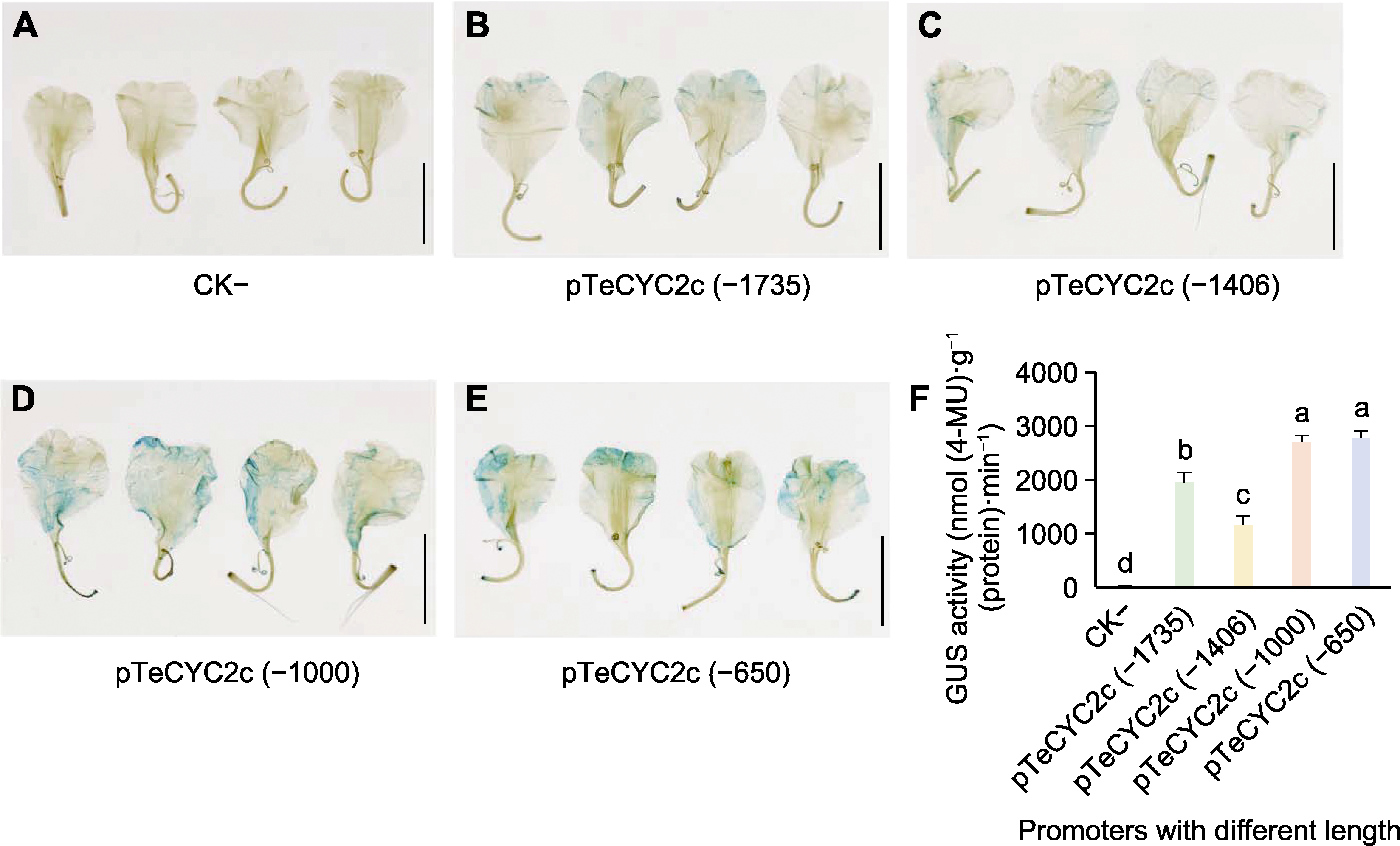
图4 不同长度启动子作用下的GUS染色及GUS活性测定 (A) 阴性对照; (B) pTeCYC2c (-1 735)作用下的GUS染色; (C) pTeCYC2c (-1 406)作用下的GUS染色; (D) pTeCYC2c (-1 000)作用下的GUS染色; (E) pTeCYC2c (-650)作用下的GUS染色; (F) 不同长度启动子作用下的GUS活性测定。柱形图上不同小写字母表示在P<0.05水平差异显著。(A)-(E) Bars=1 cm
Figure 4 GUS staining and GUS activity assay driven by the promoters with different lengths (A) Negative control; (B) GUS staining under the influence of pTeCYC2c (-1 735); (C) GUS staining under the influence of pTeCYC2c (-1 406); (D) GUS staining under the influence of pTeCYC2c (-1 000); (E) GUS staining under the influence of pTeCYC2c (-650); (F) Determination of GUS activity driven by the promoters with different length. Different lowercase letters on the bar graph indicate significant differences at the P<0.05 level. (A)-(E) Bars=1 cm
| [1] | Ai Y, Zhang QH, Wang WN, Zhang CL, Cao Z, Bao MZ, He YH (2016). Transcriptomic analysis of differentially expressed genes during flower organ development in genetic male sterile and male fertile Tagetes erecta by digital gene-expression profiling. PLoS One 11, e0150892. |
| [2] |
Broholm SK, Tähtiharju S, Laitinen RAE, Albert VA, Teeri TH, Elomaa P (2008). A TCP domain transcription factor controls flower type specification along the radial axis of the Gerbera (Asteraceae) inflorescence. Proc Natl Acad Sci USA 105, 9117-9122.
DOI PMID |
| [3] |
Fambrini M, Pugliesi C (2017). Mobilization of the Tetu1 transposable element of Helianthus annuus: evidence for excision in different developmental stages. Biol Plant 61, 55-63.
DOI URL |
| [4] |
Fukuda N, Ajima C, Yukawa T, Olsen JE (2016). Antagonistic action of blue and red light on shoot elongation in petunia depends on gibberellin, but the effects on flowering are not generally linked to gibberellin. Environ Exp Bot 121, 102-111.
DOI URL |
| [5] |
Godoy-Hernández G, Berzunza EA, Concha LC, de Lourdes Miranda-Ham M (2006). Agrobacterium-mediated transient transformation of marigold (Tagetes erecta). Plant Cell Tissue Organ Cult 84, 365-368.
DOI URL |
| [6] | Goto N, Pharis RP (1999). Role of gibberellins in the development of floral organs of the gibberellin-deficient mutant, ga1-1, of Arabidopsis thaliana. Can J Bot 77, 944-954. |
| [7] | He YH (2010). Genetic Analysis of the Male Sterility of Tagetes erecta and Its Application in Breeding. Doctoral dissertation. Wuhan: Huazhong Agricultural University. pp. 148. (in Chinese) |
| 何燕红 (2010). 万寿菊雄性不育性状的遗传分析及其育种应用. 博士论文. 武汉: 华中农业大学. pp. 148. | |
| [8] |
Hileman LC (2014). Bilateral flower symmetry-how, when and why? Curr Opin Plant Biol 17, 146-152.
DOI PMID |
| [9] |
Howarth DG, Donoghue MJ (2006). Phylogenetic analysis of the “ECE” (CYC/TB1) clade reveals duplications predating the core eudicots. Proc Natl Acad Sci USA 103, 9101-9106.
DOI URL |
| [10] |
Hu JH, Mitchum MG, Barnaby N, Ayele BT, Ogawa M, Nam E, Lai WC, Hanada A, Alonso JM, Ecker JR, Swain SM, Yamaguchi S, Kamiya Y, Sun TP (2008). Potential sites of bioactive gibberellin production during reproductive growth in Arabidopsis. Plant Cell 20, 320-336.
DOI URL |
| [11] |
Huang D, Li XW, Sun M, Zhang TX, Pan HT, Cheng TR, Wang J, Zhang QX (2016). Identification and characterization of CYC-like genes in regulation of ray floret development in Chrysanthemum morifolium. Front Plant Sci 7, 1633.
PMID |
| [12] |
Ishiguro S, Kawai-Oda A, Ueda J, Nishida I, Okada K (2001). The DEFECTIVE IN ANTHER DEHISCENCE1 gene encodes a novel phospholipase A1 catalyzing the initial step of jasmonic acid biosynthesis, which synchronizes pollen maturation, anther dehiscence, and flower opening in Arabidopsis. Plant Cell 13, 2191-2209.
DOI PMID |
| [13] |
Jefferson RA, Kavanagh TA, Bevan MW (1987). GUS fusions: β-glucuronidase as a sensitive and versatile gene fusion marker in higher plants. EMBO J 6, 3901-3907.
DOI PMID |
| [14] |
Juntheikki-Palovaara I, Tähtiharju S, Lan TY, Broholm SK, Rijpkema AS, Ruonala R, Kale L, Albert VA, Teeri TH, Elomaa P (2014). Functional diversification of duplicated CYC2 clade genes in regulation of inflorescence development in Gerbera hybrida (Asteraceae). Plant J 79, 783-796.
DOI URL |
| [15] | Moënne-Loccoz Y, Mavingui P, Combes C, Normand P, Steinberg C (2015). Microorganisms and biotic interactions. In: Bertrand JC, Caumette P, Lebaron P, Matheron R, Normand P, Sime-Ngando T, eds. Environmental Microbiology: Fundamentals and Applications. Dordrecht: Springer. pp. 395-444. |
| [16] |
Rieu I, Ruiz-Rivero O, Fernandez-Garcia N, Griffiths J, Powers SJ, Gong F, Linhartova T, Eriksson S, Nilsson O, Thomas SG, Phillips AL, Hedden P (2008). The gibberellin biosynthetic genes AtGA20ox1 and AtGA20ox2 act, partially redundantly, to promote growth and development throughout the Arabidopsis life cycle. Plant J 53, 488-504.
DOI PMID |
| [17] |
Su WR, Huang KL, Shen RS, Chen WS (2002). Abscisic acid affects floral initiation in Polianthes tuberosa. J Plant Physiol 159, 557-559.
DOI URL |
| [18] | Sun M, Yang HH, Wang AQ, Zhang YJ, Da XW, Zhang J, Sun K, Wu JP, Feng HQ (2023). Effects of different vectors and Agrobacterium tumefaciens on transient expression of alfalfa. Bull Bot Res 43, 835-845. (in Chinese) |
|
孙敏, 杨红红, 王安琪, 张悦婧, 达晓伟, 张继, 孙坤, 吴建平, 冯汉青 (2023). 不同载体和农杆菌对苜蓿瞬时表达影响的研究. 植物研究 43, 835-845.
DOI |
|
| [19] |
Tahtiharju S, Rijpkema AS, Vetterli A, Albert VA, Teeri TH, Elomaa P (2012). Evolution and diversification of the CYC/TB1 gene family in Asteraceae—a comparative study in gerbera (Mutisieae) and sunflower (Heliantheae). Mol Biol Evol 29, 1155-1166.
DOI URL |
| [20] |
Tanimoto S, Miyazaki A, Harada H (1985). Regulation by abscisic acid of in vitro flower formation in Torenia stem segments. Plant Cell Physiol 26, 675-682.
DOI URL |
| [21] |
Tong Z, Wang T, Xu Y (1990). Evidence for involvement of phytochrome regulation in male sterility of a mutant of Oryza sativa L. Photochem Photobiol 52, 161-164.
DOI URL |
| [22] |
van der Meer IM, Spelt CE, Mol JNM, Stuitje AR (1990). Promoter analysis of the chalcone synthase (chsA) gene of Petunia hybrida: a 67 bp promoter region directs flower- specific expression. Plant Mol Biol 15, 95-109.
PMID |
| [23] | Wang RP, Liu Q, Yang ZQ, Zhang BK, Huang Z, Niu XL (2023). Cloning and analysis of carotene hydroxylase gene TeCHYE in Tagetes erecta L. J Hefei Univ Technol (Nat Sci) 46, 535-540. (in Chinese) |
| 王瑞鹏, 刘茜, 杨智强, 张博昆, 黄姿, 牛向丽 (2023). 万寿菊胡萝卜素羟化酶基因TeCHYE克隆与分析. 合肥工业大学学报(自然科学版) 46, 535-540. | |
| [24] | Wang WJ, Zhu Y, Zhang HM, Wei LD, Yi QP, Yu XM, Liu YH, Zhang LX, Cheng WH, He YH (2023). Morphological identification and development of linkage markers for lobed ray floret mutants in marigold (Tagetes erecta). Chin Bull Bot 58, 893-904. (in Chinese) |
|
王文静, 朱钰, 张洪铭, 韦陆丹, 易庆平, 余晓敏, 刘雨菡, 张莉雪, 程文翰, 何燕红 (2023). 万寿菊舌状花花冠裂片突变体的形态鉴定及连锁标记开发. 植物学报 58, 893-904.
DOI |
|
| [25] | Wang YQ, Wei LD, Wang WJ, Liu BJ, Zhang CL, Zhang JW, He YH (2020). The establishment and optimization of a regeneration system for marigold (Tagetes erecta). Chin Bull Bot 55, 749-759. (in Chinese) |
| 王亚琴, 韦陆丹, 王文静, 刘宝骏, 张春玲, 张俊卫, 何燕红 (2020). 万寿菊再生体系的建立及优化. 植物学报 55, 749-759. | |
| [26] | Wen Y, Li B, Zhao DG, Zhao YC (2020). Cloning and expression analysis of the promoter of glycosyltransferase gene in Eucommia ulmoides. J Agr Biotechnol 28, 223-231. (in Chinese) |
| 文永, 李彪, 赵德刚, 赵懿琛 (2020). 杜仲糖基转移酶基因的启动子克隆及表达分析. 农业生物技术学报 28, 223-231. | |
| [27] | Yang F (2011). Establishment of PSY Plant Expression Vector Harboring Two T-DNAs and Agrobacterium-mediated Transformation System and Optimization in SSR- PCR Reaction System for Tagetes erecta L. Master’s thesis. Shanghai: Shanghai Jiao Tong University. pp. 58. (in Chinese) |
| 杨帆 (2011). 色素万寿菊PSY双边界载体及遗传转化体系建立和SSR-PCR体系的优化. 硕士论文. 上海: 上海交通大学. pp. 58. | |
| [28] | Yu XM, Wang YQ, Liu YH, Yi QP, Cheng WH, Zhu Y, Duan F, Zhang LX, He YH (2023). Establishment of Agrobacterium tumefaciens-mediated genetic transformation system of marigold (Tagetes erecta). Chin Bull Bot 58, 760-769. (in Chinese) |
|
余晓敏, 王亚琴, 刘雨菡, 易庆平, 程文翰, 朱钰, 段枫, 张莉雪, 何燕红 (2023). 根癌农杆菌介导万寿菊遗传转化体系的建立. 植物学报 58, 760-769.
DOI |
|
| [29] |
Yuan CQ, Huang D, Yang Y, Sun M, Cheng TR, Wang J, Pan HT, Zhang QX (2020). CmCYC2-like transcription factors may interact with each other or bind to the promoter to regulate floral symmetry development in Chrysanthemum morifolium. Plant Mol Biol 103, 159-171.
DOI |
| [30] | Zhang B (2012). The Study of Karyotype on Genus Tagetes L. and Factors in the Genetic Transformation System of psy Gene for Tagetes erecta L. Master’s thesis. Shanghai: Shanghai Jiao Tong University. pp. 64. (in Chinese) |
| 张嫔 (2012). 万寿菊属植物染色体核型分析及万寿菊psy基因遗传转化体系影响因素的研究. 硕士论文. 上海: 上海交通大学. pp. 64. | |
| [31] |
Zheng L, Liu GF, Meng XN, Li YB, Wang YC (2012). A versatile Agrobacterium-mediated transient gene expression system for herbaceous plants and trees. Biochem Genet 50, 761-769.
DOI PMID |
| [32] |
Zhu Y, Liu YH, Wang WJ, Li H, Liu CC, Dou LL, Wei LD, Cheng WH, Bao MZ, Yi QP, He YH (2023). Identification and characterization of CYC2-like genes related to floral symmetric development in Tagetes erecta (Asteraceae). Gene 889, 147804.
DOI URL |
| [1] | 宋想, 王璐瑶, 富博晓, 李双达, 魏媛媛, 洪艳, 戴思兰. 高等植物启动子元件鉴定与合成研究进展[J]. 植物学报, 2024, 59(5): 691-708. |
| [2] | 王文静, 朱钰, 张洪铭, 韦陆丹, 易庆平, 余晓敏, 刘雨菡, 张莉雪, 程文翰, 何燕红. 万寿菊舌状花花冠裂片突变体的形态鉴定及连锁标记开发[J]. 植物学报, 2023, 58(6): 893-904. |
| [3] | 余晓敏, 王亚琴, 刘雨菡, 易庆平, 程文翰, 朱钰, 段枫, 张莉雪, 何燕红. 根癌农杆菌介导万寿菊遗传转化体系的建立[J]. 植物学报, 2023, 58(5): 760-769. |
| [4] | 张玉琴, 吴嘉诚, 何萌, 刘仁义, 朱晓玥. 铁观音原生质体高效瞬时转化方法的建立[J]. 植物学报, 2022, 57(3): 340-349. |
| [5] | 赵菲, 党刘毅, 魏敏惠, 刘春莹, 冷伟, 尚琛晶. 黄瓜苋科凝集素基因的表达分析与逆境调控[J]. 植物学报, 2021, 56(2): 183-190. |
| [6] | 王亚琴, 韦陆丹, 王文静, 刘宝骏, 张春玲, 张俊卫, 何燕红. 万寿菊再生体系的建立及优化[J]. 植物学报, 2020, 55(6): 749-759. |
| [7] | 凡惠金, 金康鸣, 卓仁英, 乔桂荣. 毛竹不同截短U3启动子的克隆及表达分析[J]. 植物学报, 2020, 55(3): 299-307. |
| [8] | 于少帅, 林彩丽, 王圣洁, 张文鑫, 田国忠. 植原体tuf基因与其上游部分基因结构和相关基因启动子保守区域特征及活性分析[J]. 生物多样性, 2018, 26(7): 738-748. |
| [9] | 胡添源, 王睿, 陈上, 马宝伟, 高伟, 黄璐琦. 雷公藤悬浮细胞原生质体的制备及瞬时转化体系的建立[J]. 植物学报, 2017, 52(6): 774-782. |
| [10] | 昝新丽, 高英, 陈玉玲, 赵开军. 病原菌诱导型启动子顺式作用元件及其互作的转录因子[J]. 植物学报, 2013, 48(2): 219-229. |
| [11] | 刘伟伟, 张海磊, 刘财丰, 葛晓春. 一种受抗生素诱导的启动子的构建及活性分析[J]. 植物学报, 2011, 46(5): 560-568. |
| [12] | 刘宣雨, 王青云, 刘树君, 宋松泉. 高粱遗传转化研究进展[J]. 植物学报, 2011, 46(2): 216-223. |
| [13] | 秦小波;高继海;徐莺*;张金平;邵彩霞;林莎;张淑文;江璐玎;李月琴;陈放. 麻疯树curcin 启动子的分离及其在转基因烟草中的功能分析[J]. 植物学报, 2008, 25(04): 407-414. |
| [14] | 谢伟 乐超银 郭政宏 戴志鹏 刘敏 姚伟. 不同调控序列作用下GUS基因在烟草中瞬时表达活性的研究[J]. 植物学报, 2007, 24(04): 452-458. |
| [15] | 刘晓娜 付畅 黄永芬. 种子特异性启动子研究进展[J]. 植物学报, 2007, 24(02): 218-225. |
| 阅读次数 | ||||||
|
全文 |
|
|||||
|
摘要 |
|
|||||
 首页
首页