
植物学报 ›› 2023, Vol. 58 ›› Issue (6): 857-860.DOI: 10.11983/CBB23138 cstr: 32102.14.CBB23138
所属专题: 大食物观
• 热点评述 • 下一篇
于熙婷, 黄学辉*( )
)
收稿日期:2023-10-10
接受日期:2023-10-17
出版日期:2023-11-01
发布日期:2023-12-01
通讯作者:
* E-mail: xhhuang@shnu.edu.cn
基金资助:
Xiting Yu, Xuehui Huang*()
Received:2023-10-10
Accepted:2023-10-17
Online:2023-11-01
Published:2023-12-01
Contact:
* E-mail: xhhuang@shnu.edu.cn
摘要: 农作物驯化推动了农业文明的出现和繁荣, 是人类历史上的重大事件。玉米(Zea mays)作为全球范围内的重要粮食作物, 其驯化起源一直备受生物学和历史学界的关注。之前, 现代玉米起源自小颖大刍草亚种(Z. mays subsp. parviglumis)的观点一直占主流地位。近期, 严建兵与其合作团队系统收集并梳理了玉米各种类型野生种和栽培种资源, 综合运用基因组学、群体遗传学和数量遗传学方法及考古学成果, 发现现代玉米也存在墨西哥高原亚种(Z. mays subsp. mexicana)的杂交渐渗, 并影响了诸多农艺性状, 进而提出现代玉米起源的新模型。
于熙婷, 黄学辉. 现代玉米起源新见解——两类大刍草的混血. 植物学报, 2023, 58(6): 857-860.
Xiting Yu, Xuehui Huang. New Insights Into the Origin of Modern Maize-hybridization of Two Teosintes. Chinese Bulletin of Botany, 2023, 58(6): 857-860.
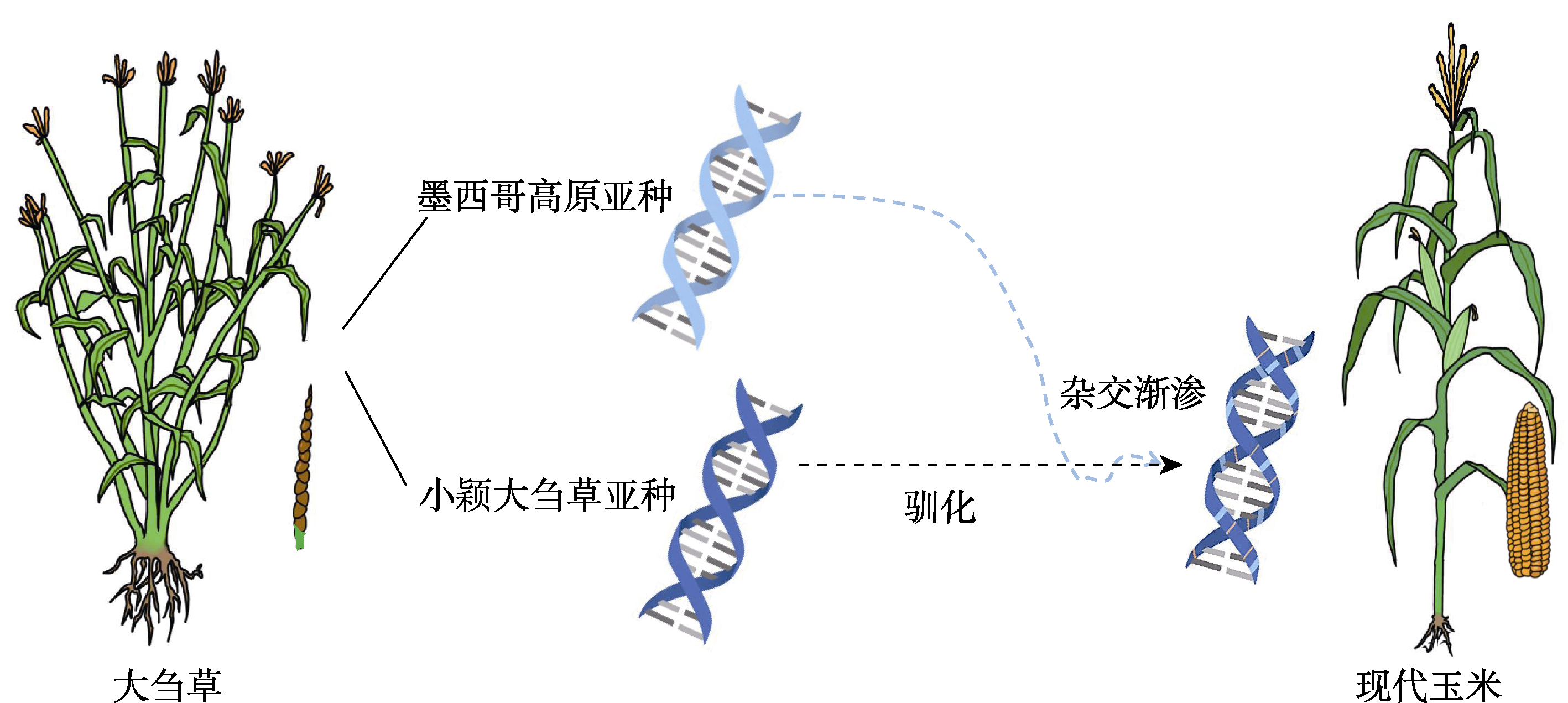
图1 现代玉米起源过程简图 研究人员推测, 现代玉米(Zea mays)首先起源于墨西哥平原地区的小颖大刍草亚种(Z. mays subsp. parviglumis), 而后与墨西哥高原地区的墨西哥高原亚种(Z. mays subsp. mexicana)发生杂交渐渗。DNA双螺旋中深蓝、浅蓝和橙色分别示意小颖大刍草亚种单倍型、墨西哥高原亚种单倍型和驯化改良产生的新变异。
Figure 1 A simplified diagram of the origin process of modern maize Researchers speculate that modern maize first originated from the parviglumis type of teosinte in the Mexican lowlands, and then introgression with the mexicana type of teosinte in the Mexican highlands occurred. The deep blue, light blue, and orange colors in the DNA double helix represent the haplotypes of parviglumis-type teosinte, mexicana-type teosinte, and new allelic variation during domestication, respectively.
| [1] |
Calfee E, Gates D, Lorant A, Perkins MT, Coop G, Ross-Ibarra J (2021). Selective sorting of ancestral introgression in maize and teosinte along an elevational cline. PLoS Genet 17, e1009810.
DOI URL |
| [2] |
Doebley JF, Gaut BS, Smith BD (2006). The molecular genetics of crop domestication. Cell 127, 1309-1321.
DOI PMID |
| [3] |
Huang XH, Huang SW, Han B, Li JY (2022a). The integrated genomics of crop domestication and breeding. Cell 185, 2828-2839.
DOI URL |
| [4] |
Huang XH, Kurata N, Wei XH, Wang ZX, Wang AH, Zhao Q, Zhao Y, Liu KY, Lu HY, Li WJ, Guo YL, Lu YQ, Zhou CC, Fan DL, Weng QJ, Zhu CR, Huang T, Zhang L, Wang YC, Feng L, Furuumi H, Kubo T, Miyabayashi T, Yuan XP, Xu Q, Dong GJ, Zhan QL, Li CY, Fujiyama A, Toyoda A, Lu TT, Feng Q, Qian Q, Li JY, Han B (2012). A map of rice genome variation reveals the origin of cultivated rice. Nature 490, 497-501.
DOI |
| [5] | Huang YC, Wang HH, Zhu YD, Huang X, Li S, Wu XG, Zhao Y, Bao ZG, Qin L, Jin YB, Cui YH, Ma GJ, Xiao Q, Wang Q, Wang JC, Yang XR, Liu HJ, Lu XD, Larkins BA, Wang WQ, Wu YR (2022b). THP9 enhances seed protein content and nitrogen-use efficiency in maize. Nature 612, 292-300. |
| [6] |
Hufford MB, Lubinksy P, Pyhäjärvi T, Devengenzo MT, Ellstrand NC, Ross-Ibarra J (2013). The genomic signature of crop-wild introgression in maize. PLoS Genet 9, e1003477.
DOI URL |
| [7] |
Jing CY, Zhang FM, Wang XH, Wang MX, Zhou L, Cai Z, Han JD, Geng MF, Yu WH, Jiao ZH, Huang L, Liu R, Zheng XM, Meng QL, Ren NN, Zhang HX, Du YS, Wang X, Qiang CG, Zou XH, Gaut BS, Ge S (2023). Multiple domestications of Asian rice. Nat Plants 9, 1221-1235.
DOI |
| [8] |
Li CB, Zhou AL, Sang T (2006). Rice domestication by reducing shattering. Science 311, 1936-1939.
DOI PMID |
| [9] |
Matsuoka Y, Vigouroux Y, Goodman MM, Sanchez GJ, Buckler E, Doebley J (2002). A single domestication for maize shown by multilocus microsatellite genotyping. Proc Natl Acad Sci USA 99, 6080-6084.
DOI PMID |
| [10] |
Pääbo S (2015). The diverse origins of the human gene pool. Nat Rev Genet 16, 313-314.
DOI PMID |
| [11] |
Wang H, Studer AJ, Zhao Q, Meeley R, Doebley JF (2015). Evidence that the origin of naked kernels during maize domestication was caused by a single amino acid substitution in tga1. Genetics 200, 965-974.
DOI |
| [12] | Yang N, Wang YB, Liu XG, Jin ML, Vallebueno-Estrada M, Calfee E, Chen L, Dilkes BP, Gui ST, Fan XM, Harper TK, Kennett DJ, Li WQ, Lu YL, Luo JY, Mambak-kam S, Menon M, Snodgrass S, Veller C, Wu SS, Wu SY, Xiao YJ, Yang XH, Stitzer MC, Runcie D, Yan JB, Ross-Ibarra J (2023). Two teosintes made modern maize. Science doi: 10.1126/science.adg8940 |
| [13] |
Yu H, Lin T, Meng XB, Du HL, Zhang JK, Liu GF, Chen ML, Jing YH, Kou LQ, Li XX, Gao Q, Liang Y, Liu XD, Fan ZL, Liang YT, Cheng ZK, Chen MS, Tian ZX, Wang YH, Chu CC, Zuo JR, Wan JM, Qian Q, Han B, Zuccolo A, Wing RA, Gao CX, Liang CZ, Li JY (2021). A route to de novo domestication of wild allotetraploid rice. Cell 184, 1156-1170.
DOI URL |
| [1] | 王创新, 李建琪, 张颖, 韩栋, 房静, 赵恩光, 黄华, 达玲玲, 张继. 智能育种:从高通量表型到基因组选择的整合与应用[J]. 植物学报, 2026, 61(4): 1-0. |
| [2] | 林淼. 玉米雄穗分枝数的激素“密码”[J]. 植物学报, 2026, 61(1): 157-169. |
| [3] | 李月琪, 麻仲花, 刘威帆, 苏明, 万猛虎, 李清云, 张丹, 刘吉利, 吴娜. 垂直深旋耕配施有机肥对盐碱地玉米叶片衰老特性及产量的影响[J]. 植物生态学报, 2026, 50(1): 222-236. |
| [4] | 陈龙浩, 杨瑞娟, 苑筱一, 邢思年, 臧云, 吴凡, 张吉宇, 秦晓春, 刘文文, 付春祥. 白花草木樨毛状根高效基因组编辑体系的建立[J]. 植物学报, 2026, 61(1): 102-113. |
| [5] | 洪欣艺, 蔡易朗, 方嘉乐, 姚可侃, 李佳乐, 王懿祥, 白尚斌, 王楠, 周秀梅. 西溪湿地土壤病毒多样性及其碳代谢基因解析[J]. 生物多样性, 2025, 33(9): 25190-. |
| [6] | 旦增尼玛, 孙伟, 李聪, 张纾意, 赵竹楠, 许永强, 普布卓玛, 罗诗琦, 达娃, 周欣. 西藏吉隆沟地区开花植物叶绿体基因组数据集[J]. 生物多样性, 2025, 33(9): 25270-. |
| [7] | 彭欣, 刘传, 黄晓磊. 基于GenBank数据库的真核生物遗传数据时空格局分析[J]. 生物多样性, 2025, 33(8): 25184-. |
| [8] | 薛瑞翔, 马雪蓉, 吴炯文, 刘爱君, 张细权, 季从亮, 殷颖珊, 朱炜健, 罗庆斌. 中山麻鸭群体遗传多样性与遗传结构[J]. 生物多样性, 2025, 33(8): 24592-. |
| [9] | 王凤英, 吴增源, 崔涵, 李垠蕾, 邓莉娟, 王红, 刘杰. 第三极荨麻属麻叶荨麻分支的物种界限[J]. 生物多样性, 2025, 33(8): 25138-. |
| [10] | 王立龙, 冯静, 苏娜, 刘新平, 潘成臣, 李玉强. 2005-2015年科尔沁沙地典型农田生态系统长期监测样地玉米收获期性状和产量数据集[J]. 植物生态学报, 2025, 49(8): 1293-1300. |
| [11] | 王志波, 刘文胜, 吴瑞俊, 王国梁. 2018-2023年黄土高原丘陵沟壑区川台地农田长期监测样地作物收获期性状和产量数据集[J]. 植物生态学报, 2025, 49(8): 1301-1311. |
| [12] | 朱喜, 何志斌, 杜明武, 赵丽雯, 吴丹丹. 2004-2010年河西走廊中段绿洲农田生态系统长期监测样地作物性状和产量数据集[J]. 植物生态学报, 2025, 49(8): 1312-1320. |
| [13] | 李慧霞, 李玉, 宁馨, 李晓晨, 王天瑞, 宋以刚, 戴锡玲, 郑斯斯, 钟鑫. 基于叶绿体基因组的江南牡丹草遗传多样性与遗传结构[J]. 生物多样性, 2025, 33(8): 25149-. |
| [14] | 樊月玲, 蒋正德, 叶佳舒, 郑立臣, 陈欣. 2005-2015年下辽河平原农田长期观测样地主要农作物收获期性状和产量数据集[J]. 植物生态学报, 2025, 49(8): 1271-1282. |
| [15] | 虎灵, 沈泽昊. 地理基因组学: 研究方法与进展[J]. 生物多样性, 2025, 33(7): 25010-. |
| 阅读次数 | ||||||
|
全文 |
|
|||||
|
摘要 |
|
|||||
 首页
首页