
植物学报 ›› 2022, Vol. 57 ›› Issue (3): 320-326.DOI: 10.11983/CBB22043 cstr: 32102.14.CBB22043
胡海涛, 钱婷婷, 杨玲( )
)
收稿日期:2022-03-10
接受日期:2022-05-11
出版日期:2022-05-01
发布日期:2022-05-18
通讯作者:
杨玲
作者简介:* E-mail: yangl@zjnu.cn基金资助:
Haitao Hu, Tingting Qian, Ling Yang()
Received:2022-03-10
Accepted:2022-05-11
Online:2022-05-01
Published:2022-05-18
Contact:
Ling Yang
摘要: 活性氧(reactive oxygen species, ROS)是植物体内的一把“双刃剑”。ROS作为信号分子在植物生命活动中发挥关键作用, 但ROS过量积累会对生物大分子造成氧化损伤。准确测定ROS含量对于评估植物细胞内的氧化还原状态至关重要。由于植物体内ROS各组分半衰期短且反应活性强, 定性定量检测较为困难。因此, 选择合适的检测方法以提高检测的时空准确性非常重要。目前, 荧光分析法因其具有灵敏度高、选择性好、检出限低和直观性强等优点, 受到研究人员的广泛关注。该文详细描述基于流式细胞仪和激光共聚焦显微镜, 利用2′,7′-二氯二氢荧光素二乙酸酯(H2DCFDA)荧光探针检测水稻(Oryza sativa)体内ROS水平和时空分布的操作流程及注意事项。该技术也可用于直接检测拟南芥(Arabidopsis thaliana)、玉米(Zea mays)和大豆(Glycine max)等模式植物组织中ROS的水平和分布。
胡海涛, 钱婷婷, 杨玲. 基于H2DCFDA荧光探针的植物活性氧检测方法. 植物学报, 2022, 57(3): 320-326.
Haitao Hu, Tingting Qian, Ling Yang. Detection of Reactive Oxygen Species Using H2DCFDA Probe in Plant. Chinese Bulletin of Botany, 2022, 57(3): 320-326.
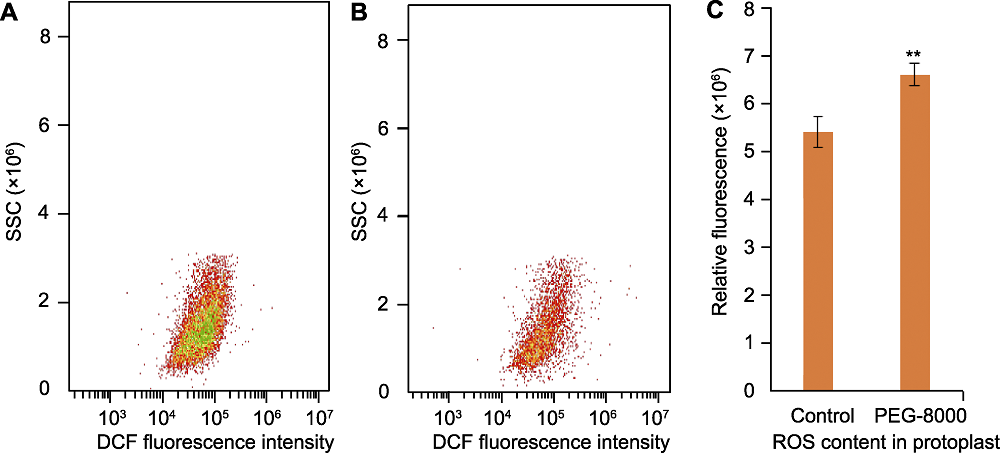
图1 基于2′,7′-二氯荧光素(DCF)的流式细胞仪检测水稻叶片原生质体活性氧含量 (A) 正常生长水稻叶片中的活性氧(ROS)荧光强度; (B) PEG-8000处理组水稻叶片中的ROS荧光强度; (C) 对照和处理组水稻叶片中的ROS相对荧光强度, 其值用于评估ROS含量。n=3; **表示经Student’s t检验在P<0.01水平差异显著。SSC: 侧向散射光
Figure 1 Reactive oxygen species (ROS) evaluation in rice protoplasts using 2′,7′-dichlorofluorescein (DCF)-based flow cytometry (A) ROS fluorescence intensity in rice leaves under normal growth conditions; (B) ROS fluorescence intensity in rice leaves under PEG-8000 treatment conditions; (C) The relative fluorescence intensity in treatment and control groups was determined to assess the ROS content. n=3; ** indicates significant difference at P<0.01 level by Student’s t test. SSC: Side scatter
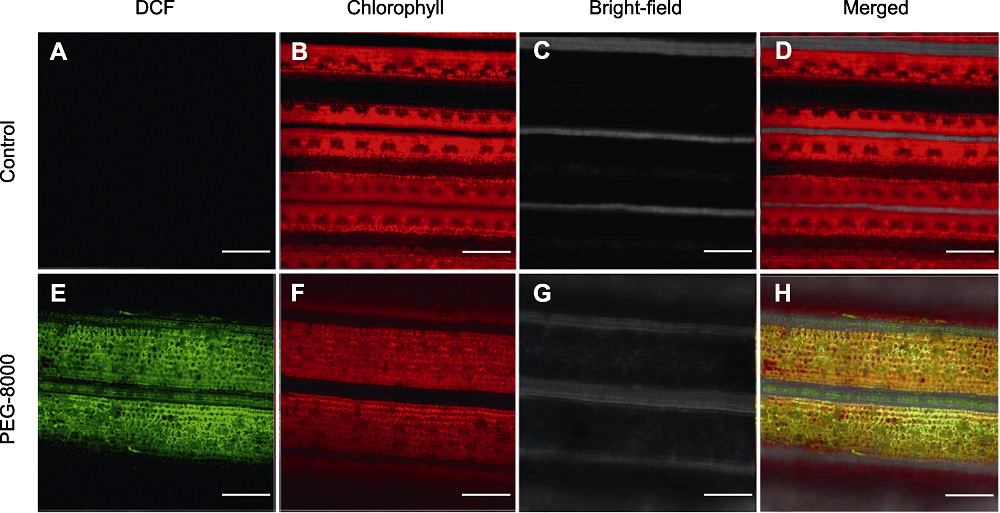
图2 正常生长(A)-(D)和PEG-8000处理(E)-(H)的水稻叶片共聚焦荧光成像图 红色为叶绿素的自发荧光, 绿色为2′,7′-二氯二氢荧光素二乙酸酯(H2DCFDA)氧化产生的2′,7′-二氯荧光素(DCF)荧光。Bars=100 µm
Figure 2 Confocal imaging analysis of rice leaves under normal growth (A)-(D) and PEG-8000 treatment (E)-(H) Red is the spontaneous fluorescence of chlorophyll, and green is the fluorescence of 2′,7′-dichlorofluorescein (DCF) generated by 2′,7′-dichlorodi-hydrofluorescein diacetate (H2DCFDA) oxidation. Bars=100 µm
| [1] |
Akter S, Khan MS, Smith EN, Flashman E (2021). Measuring ROS and redox markers in plant cells. RSC Chem Biol 2, 1384-1401.
DOI URL |
| [2] |
Anjum NA, Amreen N, Tantray AY, Khan NA, Ahmad A (2020). Reactive oxygen species detection-approaches in plants: insights into genetically encoded FRET-based sen- sors. J Biotechnol 308, 108-117.
DOI URL |
| [3] |
Apel K, Hirt H (2004). REACTIVE OXYGEN SPECIES: metabolism, oxidative stress, and signal transduction. Annu Rev Plant Biol 55, 373-399.
DOI URL |
| [4] |
Castro B, Citterico M, Kimura S, Stevens DM, Wrzaczek M, Coaker G (2021). Stress-induced reactive oxygen species compartmentalization, perception and signaling. Nat Plants 7, 403-412.
DOI PMID |
| [5] | Chan ZL, Yokawa K, Kim WY, Song CP (2016). Editorial: ROS regulation during plant abiotic stress responses. Front Plant Sci 7, 1536. |
| [6] |
Choudhury FK, Rivero RM, Blumwald E, Mittler R (2017). Reactive oxygen species, abiotic stress and stress combination. Plant J 90, 856-867.
DOI URL |
| [7] |
Considine MJ, Foyer CH (2021a). Oxygen and reactive oxygen species-dependent regulation of plant growth and development. Plant Physiol 186, 79-92.
DOI URL |
| [8] |
Considine MJ, Foyer CH (2021b). Stress effects on the reactive oxygen species-dependent regulation of plant growth and development. J Exp Bot 72, 5795-5806.
DOI URL |
| [9] |
Duanghathaipornsuk S, Farrell EJ, Alba-Rubio AC, Zelenay P, Kim DS (2021). Detection technologies for reactive oxygen species: fluorescence and electrochemical methods and their applications. Biosensors 11, 30.
DOI URL |
| [10] |
Eruslanov E, Kusmartsev S (2010). Identification of ROS using oxidized DCFDA and flow-cytometry. Methods Mol Biol 594, 57-72.
DOI PMID |
| [11] |
Fichman Y, Miller G, Mittler R (2019). Whole-plant live imaging of reactive oxygen species. Mol Plant 12, 1203- 1210.
DOI PMID |
| [12] |
Gomes A, Fernandes E, Lima JLFC (2005). Fluorescence probes used for detection of reactive oxygen species. J Biochem Biophys Methods 65, 45-80.
PMID |
| [13] |
Hasanuzzaman M, Bhuyan MHMB, Zulfiqar F, Raza A, Mohsin SM, Mahmud JA, Fujita M, Fotopoulos V (2020). Reactive oxygen species and antioxidant defense in plants under abiotic stress: revisiting the crucial role of a universal defense regulator. Antioxidants 9, 681.
DOI URL |
| [14] |
Hu HT, Ren DY, Hu J, Jiang HZ, Chen P, Zeng DL, Qian Q, Guo LB (2021). WHITE AND LESION-MIMIC LEAF1, encoding a lumazine synthase, affects reactive oxygen species balance and chloroplast development in rice. Plant J 108, 1690-1703.
DOI URL |
| [15] |
Kristiansen KA, Jensen PE, Møller IM, Schulz A (2009). Monitoring reactive oxygen species formation and localisation in living cells by use of the fluorescent probe CM- H2DCFDA and confocal laser microscopy. Physiol Plant 136, 369-383.
DOI PMID |
| [16] |
Li HX, Liu Y, Qin HH, Lin XL, Tang D, Wu ZJ, Luo W, Shen Y, Dong FQ, Wang YL, Feng TT, Wang LL, Li LY, Chen DD, Zhang Y, Murray JD, Chao DY, Chong K, Cheng ZK, Meng Z (2020). A rice chloroplast-localized ABC transporter ARG1 modulates cobalt and nickel homeostasis and contributes to photosynthetic capacity. New Phytol 228, 163-178.
DOI URL |
| [17] |
Liu XY, Zhang ZG (2022). A double-edged sword: reactive oxygen species (ROS) during the rice blast fungus and host interaction. FEBS J doi:10.1111/febs.16171
DOI |
| [18] |
Maulucci G, Bačić G, Bridal L, Schmidt HH, Tavitian B, Viel T, Utsumi H, Yalçın AS, De Spirito M (2016). Imaging reactive oxygen species-induced modifications in living systems. Antioxid Redox Signal 24, 939-958.
DOI URL |
| [19] | Mhamdi A, van Breusegem F (2018). Reactive oxygen species in plant development. Development 145, dev164376. |
| [20] |
Oparka M, Walczak J, Malinska D, van Oppen LMPE, Szczepanowska J, Koopman WJH, Wieckowski MR (2016). Quantifying ROS levels using CM-H2DCFDA and HyPer. Methods 109, 3-11.
DOI URL |
| [21] |
Ortega-Villasante C, Burén S, Barón-Sola Á, Martínez F, Hernández LE (2016). In vivo ROS and redox potential fluorescent detection in plants: present approaches and future perspectives. Methods 109, 92-104.
DOI PMID |
| [22] |
Ortega-Villasante C, Burén S, Blázquez-Castro A, Barón- Sola Á, Hernández LE (2018). Fluorescent in vivo imaging of reactive oxygen species and redox potential in plants. Free Radic Biol Med 122, 202-220.
DOI URL |
| [23] |
Qi JS, Song CP, Wang BS, Zhou JM, Kangasjärvi J, Zhu JK, Gong ZZ (2018). Reactive oxygen species signaling and stomatal movement in plant responses to drought stress and pathogen attack. J Integr Plant Biol 60, 805- 826.
DOI URL |
| [24] |
Rajneesh, Pathak J, Chatterjee A, Singh SP, Sinha RP (2017). Detection of reactive oxygen species (ROS) in cyanobacteria using the oxidant-sensing probe 2′,7′-dichlorodihydrofluorescein diacetate (DCFH-DA). Bio Protoc 7, e2545.
DOI PMID |
| [25] | Robles V, Riesco MF, Martínez-Vázquez JM, Valcarce DG (2021). Flow cytometry and confocal microscopy for ROS evaluation in fish and human spermatozoa. Methods Mol Biol 2202, 93-102. |
| [26] |
Tripathy BC, Oelmüller R (2012). Reactive oxygen species generation and signaling in plants. Plant Signal Behav 7, 1621-1633.
DOI URL |
| [27] |
Waszczak C, Carmody M, Kangasjärvi J (2018). Reactive oxygen species in plant signaling. Annu Rev Plant Biol 69, 209-236.
DOI PMID |
| [28] |
Xia SS, Liu H, Cui YJ, Yu HP, Rao YC, Yan YP, Zeng DL, Hu J, Zhang GH, Gao ZY, Zhu L, Shen L, Zhang Q, Li Q, Dong GJ, Guo LB, Qian Q, Ren DY (2022). UDP-N-acetylglucosamine pyrophosphorylase enhances rice survival at high temperature. New Phytol 233, 344- 359.
DOI URL |
| [29] |
Xiong HY, Yu JP, Miao JL, Li JJ, Zhang HL, Wang X, Liu PL, Zhao Y, Jiang CH, Yin ZG, Li Y, Guo Y, Fu BY, Wang WS, Li ZK, Ali J, Li ZC (2018). Natural variation in OsLG3 increases drought tolerance in rice by inducing ROS scavenging. Plant Physiol 178, 451-467.
DOI URL |
| [1] | 肖治术, 范宗骥, 于桂清, 范明亮. 油麻藤属(Mucuna)植物的传粉和种子传播研究进展: 现状与展望[J]. , 2027, 51(动植物互作): 0-. |
| [2] | 刘志祥, 黎凤兰, 黄晓磊. 昆虫虫瘿生态系统的复杂性及成瘿机制研究进展[J]. , 2027, 51(动植物互作): 0-. |
| [3] | 曹伊菲, 苏涛, 曹敏, 汪海燕, 杨洁. 新生代被子植物叶脉密度演化的驱动因素研究:气候适应与植食压力[J]. , 2027, 51(动植物互作): 0-. |
| [4] | 柯嘉雯, 程张浩, 高雪夷, 徐云剑, 王毅. 镉污染下的植物响应:从吸收、转运到应答与缓解机制[J]. 植物生态学报, 2026, 50(预发表): 1-. |
| [5] | 何青, 袁旭东, 任博申, 冯治洋, 鲁梦珍, 林巧玲, 姜庆虎, 杨林森, 余辉亮, 姚辉, 杨敬元, 刘峰, 江明喜. 一年蓬(Erigeron annuus)入侵对亚高山泥炭湿地植物群落结构与多样性的影响[J]. 植物生态学报, 2026, 50(预发表): 0-. |
| [6] | 胡光明, 欧旭, 龙文兴. 热带云雾林宿主树皮粗糙度对附生维管植物多样性与孢子定殖的影响[J]. 植物生态学报, 2026, 50(预发表): 1-. |
| [7] | 段建林, 孟晟, 陈仁利, 熊林峰, 卢春洋, 席念勋. 全球变化因子多样性对菌根植物性状的影响[J]. , 2026, 50(预发表): 0-. |
| [8] | 杨梅花, 张子嘉, 乔栋, 冯俊娜, 庞子杰, 钱龙, 刘志晖, 蔡娜娜, 胡中民, 杨国姣. 海南热带森林乔木群落调查和多样性数据集[J]. 植物生态学报, 2026, 50(预发表): 0-. |
| [9] | 陈欣蕊, 宋维峰, 王燚, 王浩, 孙诗瑶, 王彩江, 蔡世鹏, 任红, 何玉陶, 潘珉, 曹光秀, 严毅, 谢志勇, 王行. 滇池湖滨带典型挺水植物氮磷重吸收特征及其适应策略[J]. , 2026, 50(预发表): 0-. |
| [10] | 赵掷艺, 黄伟权, 胡婧妍, 王义越, 虞梦婕, 吴玉环. 泥炭沼泽湿地植物残体分解及微生物作用机理研究进展[J]. , 2026, 50(预发表): 0-. |
| [11] | 郭蓉, 吴旭东, 张雨, 康瑞红, 王一凡, 王占军, 蒋齐, 俞鸿千, 马琨. 荒漠草原土壤丛枝菌根真菌群落对降水变化的响应[J]. 生物多样性, 2026, 34(5): 26028-. |
| [12] | 郝晨阳, 高少羽, 程跃华, 扎西尼玛, 徐波, 杨扬. 横断山区高山冰缘植物毡毛雪莲紧实深色头状花序的生态功能[J]. 生物多样性, 2026, 34(5): 25489-. |
| [13] | 陈先圣, 王雨晨, 张洪亮, 彭博, 王英力, 黄远. 植物可穿戴传感器在园艺作物生理生化信息感知领域的研究进展[J]. 植物学报, 2026, 61(4): 1-0. |
| [14] | 张晋越, 卞宝乐, 唐泰然, 农文豪, 朱书峰, 卢新民. 植物-根际微生物互作及对昆虫胁迫的响应[J]. 生物多样性, 2026, 34(4): 25334-. |
| [15] | 尹翔正, 姜海燕, 张俊, 罗春生, 张元明. 极端干旱区荒漠灌木叶际细菌群落多样性特征[J]. 生物多样性, 2026, 34(4): 25485-. |
| 阅读次数 | ||||||
|
全文 |
|
|||||
|
摘要 |
|
|||||
 首页
首页