
植物学报 ›› 2020, Vol. 55 ›› Issue (1): 76-82.DOI: 10.11983/CBB19208 cstr: 32102.14.CBB19208
朱丹,曹汉威,李媛,任东涛( )
)
收稿日期:2019-10-24
接受日期:2019-12-31
出版日期:2020-01-01
发布日期:2020-01-03
通讯作者:
任东涛
基金资助:
Dan Zhu,Hanwei Cao,Yuan Li,Dongtao Ren()
Received:2019-10-24
Accepted:2019-12-31
Online:2020-01-01
Published:2020-01-03
Contact:
Dongtao Ren
摘要: 蛋白磷酸化是一种重要的蛋白质翻译后修饰方式, 几乎参与植物所有生命过程的调节。蛋白磷酸化过程主要指在蛋白激酶的催化作用下, 将三磷酸腺苷(ATP)上的γ位磷酸基团转移到底物蛋白特定氨基酸残基上的过程。底物蛋白上被磷酸化的常见氨基酸有丝氨酸、苏氨酸及酪氨酸, 磷酸基团与氨基酸中的羟基通过酯键连接。该文详细描述了几种常用的蛋白质体外及体内磷酸化的检测方法及注意事项。
朱丹,曹汉威,李媛,任东涛. 植物蛋白磷酸化的检测方法. 植物学报, 2020, 55(1): 76-82.
Dan Zhu,Hanwei Cao,Yuan Li,Dongtao Ren. Protocols for Analyzing Plant Phospho-proteins. Chinese Bulletin of Botany, 2020, 55(1): 76-82.
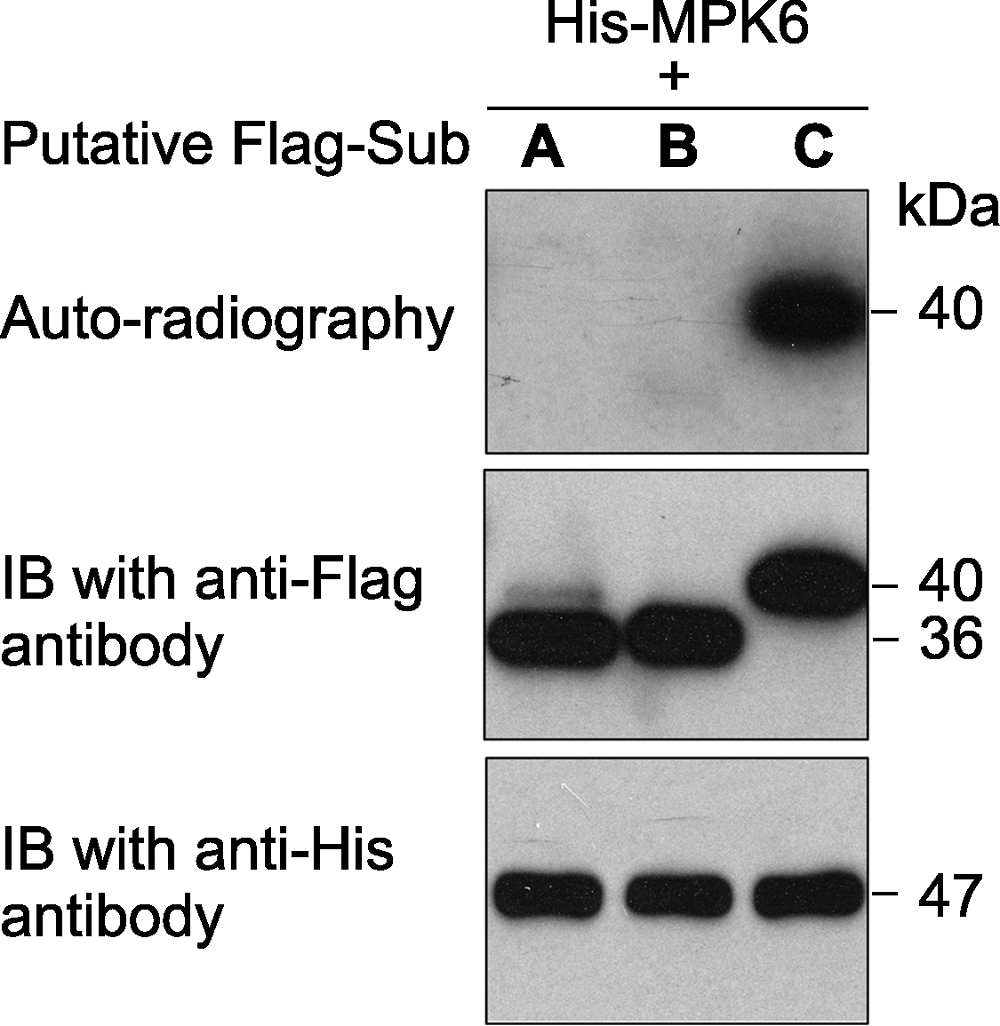
图1 原核表达的拟南芥激酶MPK6对3个推测底物的体外磷酸分析 激酶(MPK6)连接有6×His标签、推测的底物蛋白(A、B和C)连接有Flag标签。体外磷酸化反应完成后, 反应体系中的蛋白用SDS-PAGE gel分离。然后进行磷酸化底物的放射自显影分析(上图)。底物蛋白(中图)和激酶(下图)的免疫印迹分析显示底物、激酶各自在磷酸化反应中的蛋白使用量基本一致。
Figure 1 An in vitro phosphorylation assay of 3 putative substrate proteins by MPK6 in Arabidopsis thaliana MPK6 was fused with the 6×His tag and the 3 putative substrates were fused with the Flag tag. After phosphorylation reaction, the proteins in the mixture were separated on a SDS- PAGE gel. The gel was dried and exposed to X-ray film (top). Immunoblotting with anti-His and anti-Flag antibodies were used to show the levels of the substrate (middle) and kinase (bottom) proteins in the reactions.
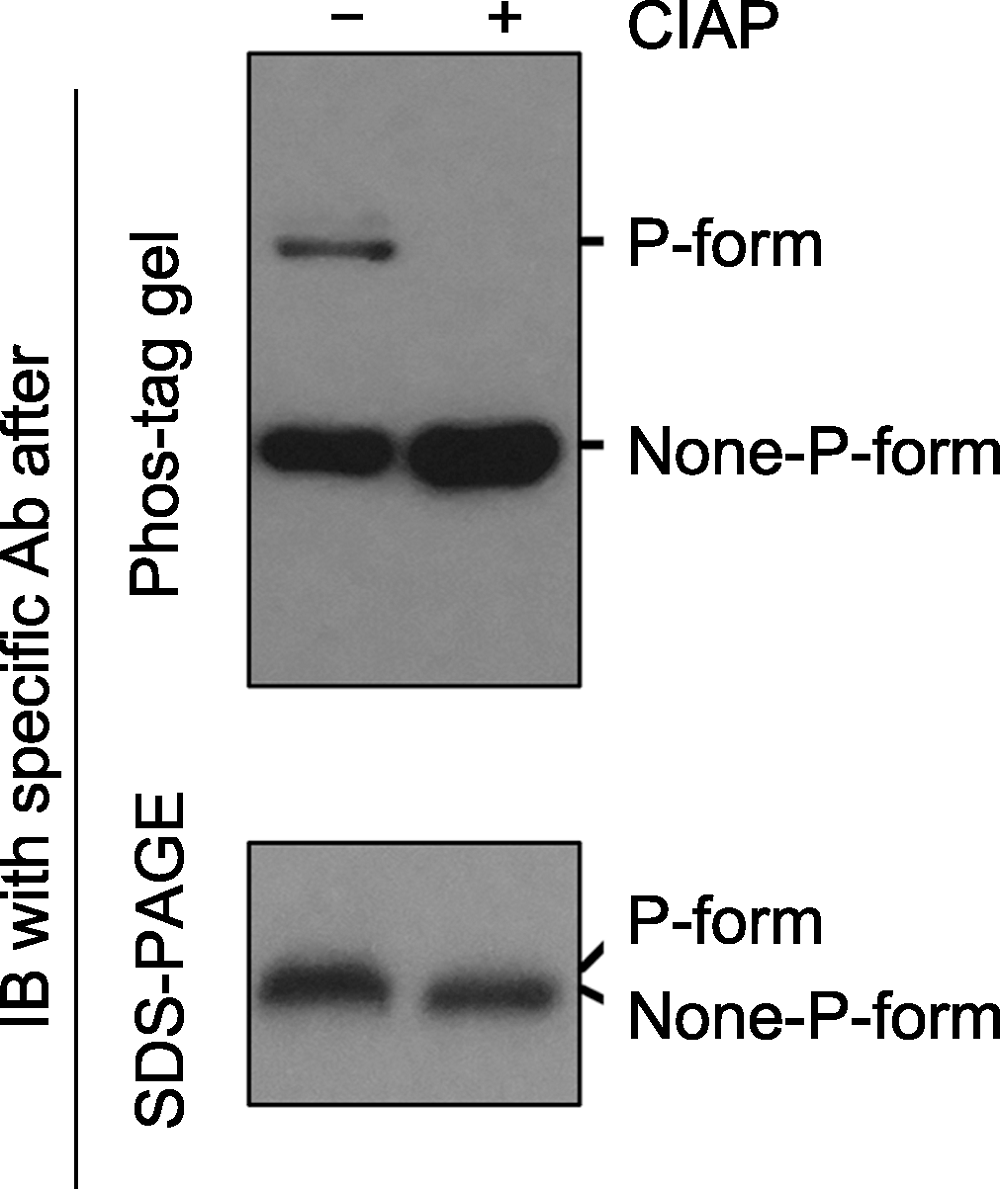
图2 Phos-tag gel和SDS-PAGE gel电泳后, 免疫印迹检测磷酸化蛋白的对比分析 磷酸酶(如Calf intestine alkaline phosphatase, CIAP)可去除磷酸化蛋白上的磷酸基团。同一样品在CIAP处理前(-)、后(+), 磷酸化和非磷酸化形式的蛋白经Phos-tag gel (上图)和SDS- PAGE gel (下图)电泳后的免疫印迹分析结果。经Phos-tag gel电泳, 未加CIAP的样品中特定蛋白的磷酸化(P-form)和非磷酸化形式(None-P-form)被清晰地分开(上图); 加CIAP后磷酸化形式消失而非磷酸化形式条带增强。经SDS-PAGE gel电泳, 未加和加CIAP处理的样品中, 特定蛋白的磷酸化和非磷酸化形式分开不明显(下图)。
Figure 2 Immunoblotting detection of phospho-proteins in samples after Phos-tag gel and SDS-PAGE gel separation Phospho-proteins can be dephosphorylated by phosphatases (e.g. Calf intestine alkaline phosphatase, CIAP). Protein samples treated with (+) or without (-) CIAP were separated by Phos-tag (top) and SDS-PAGE (bottom) gels, and the specific protein was further detected by immunoblotting. The P-form and None-P-form of the protein were separated clearly by a Phos-tag gel (top), while the two forms were not separated by a SDS-PAGE gel (bottom). The missing of the upper band and the increasing of the bottom band after Phos-tag gel separation indicated that P-form protein was completely dephosphorylated by CIAP treatment.
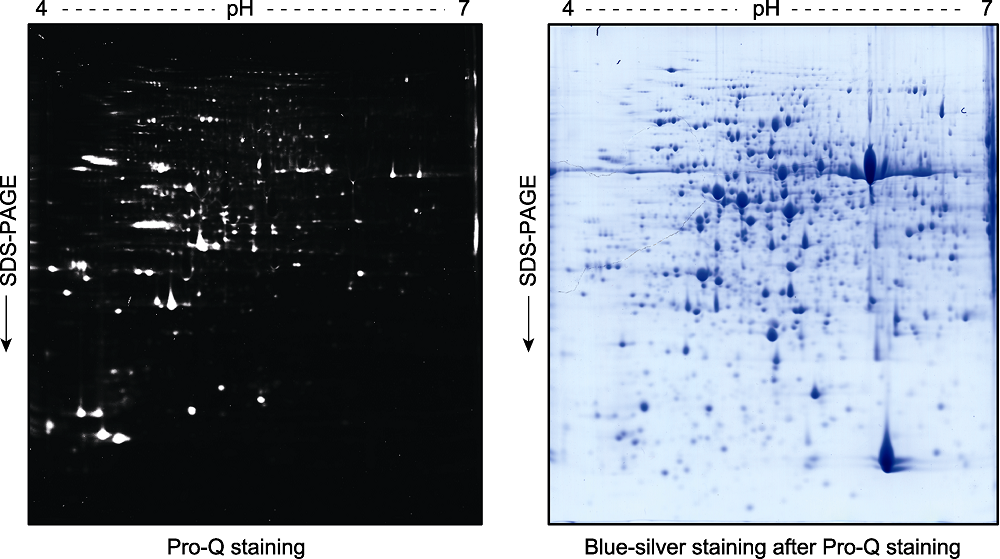
图3 拟南芥幼苗总蛋白双向凝胶电泳后的磷酸化蛋白Pro-Q Diamond染色检测分析 2周龄拟南芥幼苗总蛋白提取液经双向凝胶电泳分离后, 用Pro-Q Diamond试剂对磷酸化蛋白进行染色(左图)。荧光扫描后的凝胶再进行考马斯亮蓝染色(blue-silver staining) (右图)。
Figure 3 Pro-Q staining assay of the phospho-proteins in total proteins extracted from Arabidopsis thaliana seedlings and separated by a 2D gel Two-week-old Arabidopsis thaliana seedlings were used for total protein extraction. The total proteins were separated by a 2D gel and the phospho-proteins were stained by Pro-Q (left). The gel was scanned with a Typhoon 9410 fluorescence scanner, and then stained with blue-silver to visualize the proteins (right).
| [1] | Agrawal GK, Thelen JJ (2005). Development of a simplified, economical polyacrylamide gel staining protocol for phosphoproteins. Proteomics 5, 4684-4688. |
| [2] | Agrawal GK, Thelen JJ (2006). Large scale identification and quantitative profiling of phosphoproteins expressed during seed filling in oilseed rape. Mol Cell Proteomics 5, 2044-2059. |
| [3] | Blom N, Sicheritz-Pontén T, Gupta R, Gammeltoft S, Brunak S (2004). Prediction of post-translational glycosylation and phosphorylation of proteins from the amino acid sequence. Proteomics 4, 1633-1649. |
| [4] | Candiano G, Bruschi M, Musante L, Santucci L, Ghiggeri GM, Carnemolla B, Orecchia P, Zardi L, Righetti PG (2004). Blue silver: a very sensitive colloidal Coomassie G-250 staining for proteome analysis. Electrophoresis 25, 1327-1333. |
| [5] | Chao Q, Liu XY, Mei YC, Gao ZF, Chen YB, Qian CR, Hao YB, Wang BC (2014). Light-regulated phosphorylation of maize phosphoenolpyruvate carboxykinase plays a vital role in its activity. Plant Mol Biol 85, 95-105. |
| [6] | Chen MJ, Dixon JE, Manning G (2017). Genomics and evolution of protein phosphatases. Sci Signal 10, eaag1796. |
| [7] | de la Fuente van Bentem S, Hirt H (2007). Using phosphoproteomics to reveal signaling dynamics in plants. Trends Plant Sci 12, 404-411. |
| [8] | Ficarro SB, McCleland ML, Stukenberg PT, Burke DJ, Ross MM, Shabanowitz J, Hunt DF, White FM (2002). Phosphoproteome analysis by mass spectrometry and its application to Saccharomyces cerevisiae. Nat Biotechnol 20, 301-305. |
| [9] | Fischer EH, Krebs EG (1955). Conversion of phosphorylase B to phosphorylase A in muscle extracts. J Biol Chem 216, 121-132. |
| [10] | Frost DC, Li LJ (2014). Recent advances in mass spectrometry-based glycoproteomics. Adv Protein Chem Struct Biol 95, 71-123. |
| [11] | Hubbard MJ, Cohen P (1993). On target with a new mechanism for the regulation of protein phosphorylation. Trends Biochem Sci 18, 172-177. |
| [12] | Ke YQ, Han GQ, He HQ, Li JX (2009). Differential regulation of proteins and phosphoproteins in rice under drought stress. Biochem Biophys Res Commun 379, 133-138. |
| [13] | Khan M, Takasaki H, Komatsu S (2005). Comprehensive phosphoproteome analysis in rice and identification of phosphoproteins responsive to different hormones/stresses. J Proteome Res 4, 1592-1599. |
| [14] | Kim HS, Fernandes G, Lee CW (2016). Protein phosphatases involved in regulating mitosis: facts and hypotheses. Mol Cell 39, 654-662. |
| [15] | Kinoshita E, Kinoshita-Kikuta E, Koike T (2007). Specific recognition and detection of phosphorylated proteins using characteristics of metal ion. Yakugaku Zasshi 127, 1897-1913. |
| [16] | Kosako H, Nagano K (2011). Quantitative phosphoproteomics strategies for understanding protein kinase-mediated signal transduction pathways. Expert Rev Proteomics 8, 81-94. |
| [17] | Krupa A, Preethi G, Srinivasan N (2004). Structural modes of stabilization of permissive phosphorylation sites in protein kinases: distinct strategies in Ser/Thr and Tyr kinases. J Mol Biol 339, 1025-1039. |
| [18] | Laemmli UK (1970). Cleavage of structural proteins during the assembly of the head of bacteriophage T4. Nature 227, 680-685. |
| [19] | Laugesen S, Bergoin A, Rossignol M (2004). Deciphering the plant phosphoproteome: tools and strategies for a challenging task. Plant Physiol Biochem 42, 929-936. |
| [20] | Peck SC (2003). Early phosphorylation events in biotic stress. Curr Opin Plant Biol 6, 334-338. |
| [21] | Prak S, Hem S, Boudet J, Viennois G, Sommerer N, Rossignol M, Maurel C, Santoni V (2008). Multiple phosphorylations in the C-terminal tail of plant plasma membrane aquaporins: role in subcellular trafficking of AtPIP2;1 in response to salt stress. Mol Cell Proteomics 7, 1019-1030. |
| [22] | Wang PC, Zhao Y, Li ZP, Hsu CC, Liu X, Fu LW, Hou YJ, Du YY, Xie SJ, Zhang CG, Gao JH, Cao MJ, Huang XS, Zhu YF, Tang K, Wang XG, Tao WA, Xiong Y, Zhu JK (2018). Reciprocal regulation of the TOR kinase and ABA receptor balances plant growth and stress response. Mol Cell 69, 100-112. |
| [23] | Whiteman SA, Nühse TS, Ashford DA, Sanders D, Maathuis FJ (2008). A proteomic and phosphoproteomic analysis of Oryza sativa plasma membrane and vacuolar membrane. Plant J 56, 146-156. |
| [24] | Wu CF, Wang RN, Liang QJ, Liang JJ, Li WK, Jung SY, Qin J, Lin SH, Kuang J (2010). Dissecting the M phase- specific phosphorylation of serine-proline or threonine- proline motifs. Mol Biol Cell 21, 1470-1481. |
| [25] | Yang C, Wang ZG, Zhu PF (2004). Recent advances of protein phosphorylation in proteome. Prog Physiol Sci 35, 119-124. |
| [26] | Yin XJ, Wang X, Komatsu S (2018). Phosphoproteomics: protein phosphorylation in regulation of seed germination and plant growth. Curr Protein Pept Sci 19, 401-412. |
| [27] | Zhang X, Cui YN, Yu M, Su BD, Gong W, Baluška F, Komis G, Samaj J, Shan XY, Lin JX (2019). Phosphorylation-mediated dynamics of nitrate transceptor NRT1.1 regulate auxin flux and nitrate signaling in lateral root growth. Plant Physiol 181, 480-498. |
| [28] | Zhu WG (2017). Regulation of p53 acetylation. Sci China Life Sci 60, 321-323. |
| [1] | 肖治术, 范宗骥, 于桂清, 范明亮. 油麻藤属(Mucuna)植物的传粉和种子传播研究进展: 现状与展望[J]. , 2027, 51(动植物互作): 0-. |
| [2] | 刘志祥, 黎凤兰, 黄晓磊. 昆虫虫瘿生态系统的复杂性及成瘿机制研究进展[J]. , 2027, 51(动植物互作): 0-. |
| [3] | 曹伊菲, 苏涛, 曹敏, 汪海燕, 杨洁. 新生代被子植物叶脉密度演化的驱动因素研究:气候适应与植食压力[J]. , 2027, 51(动植物互作): 0-. |
| [4] | 陈欣蕊, 宋维峰, 王燚, 王浩, 孙诗瑶, 王彩江, 蔡世鹏, 任红, 何玉陶, 潘珉, 曹光秀, 严毅, 谢志勇, 王行. 滇池湖滨带典型挺水植物氮磷重吸收特征及其适应策略[J]. , 2026, 50(预发表): 0-. |
| [5] | 柯嘉雯, 程张浩, 高雪夷, 徐云剑, 王毅. 镉污染下的植物响应:从吸收、转运到应答与缓解机制[J]. 植物生态学报, 2026, 50(预发表): 1-. |
| [6] | 胡光明, 欧旭, 龙文兴. 热带云雾林宿主树皮粗糙度对附生维管植物多样性与孢子定殖的影响[J]. 植物生态学报, 2026, 50(预发表): 1-. |
| [7] | 段建林, 孟晟, 陈仁利, 熊林峰, 卢春洋, 席念勋. 全球变化因子多样性对菌根植物性状的影响[J]. , 2026, 50(预发表): 0-. |
| [8] | 杨梅花, 张子嘉, 乔栋, 冯俊娜, 庞子杰, 钱龙, 刘志晖, 蔡娜娜, 胡中民, 杨国姣. 海南热带森林乔木群落调查和多样性数据集[J]. 植物生态学报, 2026, 50(预发表): 0-. |
| [9] | 赵掷艺, 黄伟权, 胡婧妍, 王义越, 虞梦婕, 吴玉环. 泥炭沼泽湿地植物残体分解及微生物作用机理研究进展[J]. , 2026, 50(预发表): 0-. |
| [10] | 何青, 袁旭东, 任博申, 冯治洋, 鲁梦珍, 林巧玲, 姜庆虎, 杨林森, 余辉亮, 姚辉, 杨敬元, 刘峰, 江明喜. 一年蓬(Erigeron annuus)入侵对亚高山泥炭湿地植物群落结构与多样性的影响[J]. 植物生态学报, 2026, 50(预发表): 0-. |
| [11] | 郭蓉, 吴旭东, 张雨, 康瑞红, 王一凡, 王占军, 蒋齐, 俞鸿千, 马琨. 荒漠草原土壤丛枝菌根真菌群落对降水变化的响应[J]. 生物多样性, 2026, 34(5): 26028-. |
| [12] | 郝晨阳, 高少羽, 程跃华, 扎西尼玛, 徐波, 杨扬. 横断山区高山冰缘植物毡毛雪莲紧实深色头状花序的生态功能[J]. 生物多样性, 2026, 34(5): 25489-. |
| [13] | 陈先圣, 王雨晨, 张洪亮, 彭博, 王英力, 黄远. 植物可穿戴传感器在园艺作物生理生化信息感知领域的研究进展[J]. 植物学报, 2026, 61(4): 1-0. |
| [14] | 张晋越, 卞宝乐, 唐泰然, 农文豪, 朱书峰, 卢新民. 植物-根际微生物互作及对昆虫胁迫的响应[J]. 生物多样性, 2026, 34(4): 25334-. |
| [15] | 白玫, 张荣京, 梁祥修, 刘自强. AI赋能与农林特色融合: 以能力为导向的教学改革探索与实践[J]. 植物学报, 2026, 61(4): 1-10. |
| 阅读次数 | ||||||
|
全文 |
|
|||||
|
摘要 |
|
|||||
 首页
首页