
Chinese Bulletin of Botany ›› 2016, Vol. 51 ›› Issue (2): 202-209.DOI: 10.11983/CBB15088 cstr: 32102.14.CBB15088
• EXPERIMENTAL COMMUNICATIONS • Previous Articles Next Articles
Dongmei Li1, Luya Wang1, Lanyue Zhang2, Ziyang Tie2, Huiping Mao1,*( )
)
Received:2015-05-18
Accepted:2015-09-04
Online:2016-03-01
Published:2016-03-31
Contact:
E-mail: Dongmei Li, Luya Wang, Lanyue Zhang, Ziyang Tie, Huiping Mao. Mechanism of Arabidopsis Short Peptide Hormones PROPEP Gene Family in the Root Growth[J]. Chinese Bulletin of Botany, 2016, 51(2): 202-209.
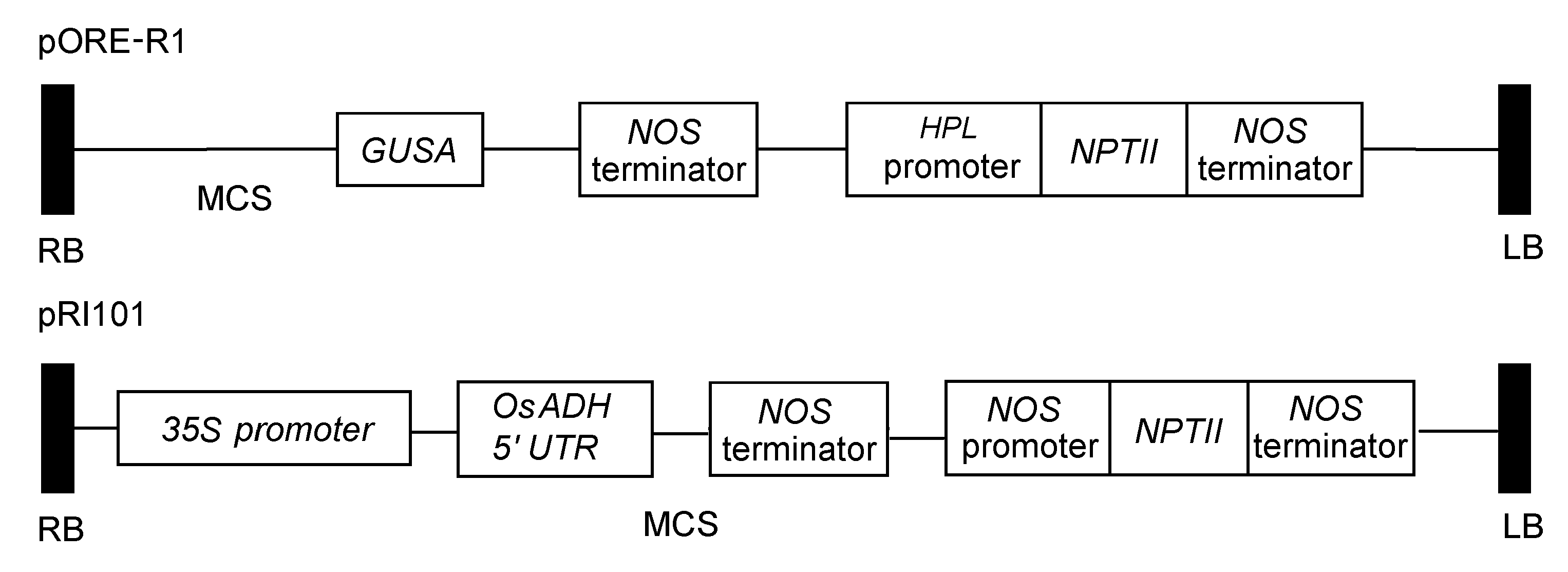
Figure 1 Expression vector
| Primer name | Sequences (5'-3') | Function |
|---|---|---|
| AtPROPEP1_PF-HindIII AtPROPEP1_PR-BamHI AtPROPEP2_PF-HindIII AtPROPEP2_PR-BamHI AtPROPEP3_PF-BamHI AtPROPEP3_PR-NotI AtPROPEP4_PF-HindIII AtPROPEP4_PR-EcoRI AtPROPEP5_PF-HindIII AtPROPEP5_PR-BamHI AtPROPEP6_PF-XhoI AtPROPEP6_PR-EcoRI | CCCAAGCTTGTAAATTATAGTGAAAGGTACGG GCGGATCCTGAGATCTGATAAGACAGAGG CCCAAGCTTCGCATTCGCTTTTTTCTTTTTG GCGGATCCTGAAATCCAATAGTTTGTGAG GCGGATCCTATTTTAACAGTCAACAGCTATTTGG TTGCGGCCGCCGTTGACTTCTTAATCTTTTTTTG CCCAAGCTTAATAAGGATGAATAAAAAGTTTGGG CCGGAATTCGTTTTTCTTCAATTCTGCTTCGTG CCCAAGCTTTACTTAATTTCTTGTGAGAAACTTG GCGGATCCCTTCGCTATCTTCTAAGTTCCTC CCCTCGAGTGATATCTAAGTCCAACTTGGTG CCGGAATTCGTTTTTTGTTTTCTTTCTCTTCTT | AtPROPEP1 promoter clone AtPROPEP2 promoter clone AtPROPEP3 promoter clone AtPROPEP4 promoter clone AtPROPEP5 promoter clone AtPROPEP6 promoter clone |
Table 1 Sequences of AtPROPEPs promoter clone primers
| Primer name | Sequences (5'-3') | Function |
|---|---|---|
| AtPROPEP1_PF-HindIII AtPROPEP1_PR-BamHI AtPROPEP2_PF-HindIII AtPROPEP2_PR-BamHI AtPROPEP3_PF-BamHI AtPROPEP3_PR-NotI AtPROPEP4_PF-HindIII AtPROPEP4_PR-EcoRI AtPROPEP5_PF-HindIII AtPROPEP5_PR-BamHI AtPROPEP6_PF-XhoI AtPROPEP6_PR-EcoRI | CCCAAGCTTGTAAATTATAGTGAAAGGTACGG GCGGATCCTGAGATCTGATAAGACAGAGG CCCAAGCTTCGCATTCGCTTTTTTCTTTTTG GCGGATCCTGAAATCCAATAGTTTGTGAG GCGGATCCTATTTTAACAGTCAACAGCTATTTGG TTGCGGCCGCCGTTGACTTCTTAATCTTTTTTTG CCCAAGCTTAATAAGGATGAATAAAAAGTTTGGG CCGGAATTCGTTTTTCTTCAATTCTGCTTCGTG CCCAAGCTTTACTTAATTTCTTGTGAGAAACTTG GCGGATCCCTTCGCTATCTTCTAAGTTCCTC CCCTCGAGTGATATCTAAGTCCAACTTGGTG CCGGAATTCGTTTTTTGTTTTCTTTCTCTTCTT | AtPROPEP1 promoter clone AtPROPEP2 promoter clone AtPROPEP3 promoter clone AtPROPEP4 promoter clone AtPROPEP5 promoter clone AtPROPEP6 promoter clone |
| Primer name | Sequences (5'-3') | Function |
|---|---|---|
| AtPROPEP3_CDSF-SalI AtPROPEP3_CDSR-BamHI AtPROPEP4_CDSF-SalI AtPROPEP4_CDSR-EcoRI | GCGTCGACATGGAGAATCTCAGAAATGG CGGGATCCCTAATTGTGTTTGCCTCCTT GCGTCGACATGGAGAGAGGAGTTTCTTA CGGAATTCCTAAAACGGCTTCTTGTTGG | AtPROPEP3 coding sequence clone AtPROPEP4 coding sequence clone |
Table 2 Sequences of AtPROPEP3 and AtPROPEP4 clone primers
| Primer name | Sequences (5'-3') | Function |
|---|---|---|
| AtPROPEP3_CDSF-SalI AtPROPEP3_CDSR-BamHI AtPROPEP4_CDSF-SalI AtPROPEP4_CDSR-EcoRI | GCGTCGACATGGAGAATCTCAGAAATGG CGGGATCCCTAATTGTGTTTGCCTCCTT GCGTCGACATGGAGAGAGGAGTTTCTTA CGGAATTCCTAAAACGGCTTCTTGTTGG | AtPROPEP3 coding sequence clone AtPROPEP4 coding sequence clone |
| Primer name | Sequences (5'-3') |
|---|---|
| AtPROPEP2F AtPROPEP2R AtPROPEP3F AtPROPEP3R AtPROPEP4F AtPROPEP4R AtPROPEP5F AtPROPEP5R AtPROPEP6F AtPROPEP6R ACTINF ACTINR | CTCGACCAAGCTCTCATAGCTG CACAACGACATCATCGTCTTTC TCTTCTTCTTGCGATCTTTCGTCAT CTGAACTTGGCGTAGGCTTAGTC CTCAAGCTTCTCGGTTTGCGATC ACTTTCTCTCGACTTCTTTAGTAC GAGATTGTTGCAAGCTCATGCCTC AGTTGAAGTTTCGATAGATGAAGGT TGAAGTGTCTTGGTCTTGAGTC TGGTCTCCTTCTTAACACTGCTG ACGGTAACATTGTGCTCAGTGGTG CTTGGAGATCCACATCTGCTGGA |
Table 3 Primers used for quantitative RT-PCR
| Primer name | Sequences (5'-3') |
|---|---|
| AtPROPEP2F AtPROPEP2R AtPROPEP3F AtPROPEP3R AtPROPEP4F AtPROPEP4R AtPROPEP5F AtPROPEP5R AtPROPEP6F AtPROPEP6R ACTINF ACTINR | CTCGACCAAGCTCTCATAGCTG CACAACGACATCATCGTCTTTC TCTTCTTCTTGCGATCTTTCGTCAT CTGAACTTGGCGTAGGCTTAGTC CTCAAGCTTCTCGGTTTGCGATC ACTTTCTCTCGACTTCTTTAGTAC GAGATTGTTGCAAGCTCATGCCTC AGTTGAAGTTTCGATAGATGAAGGT TGAAGTGTCTTGGTCTTGAGTC TGGTCTCCTTCTTAACACTGCTG ACGGTAACATTGTGCTCAGTGGTG CTTGGAGATCCACATCTGCTGGA |
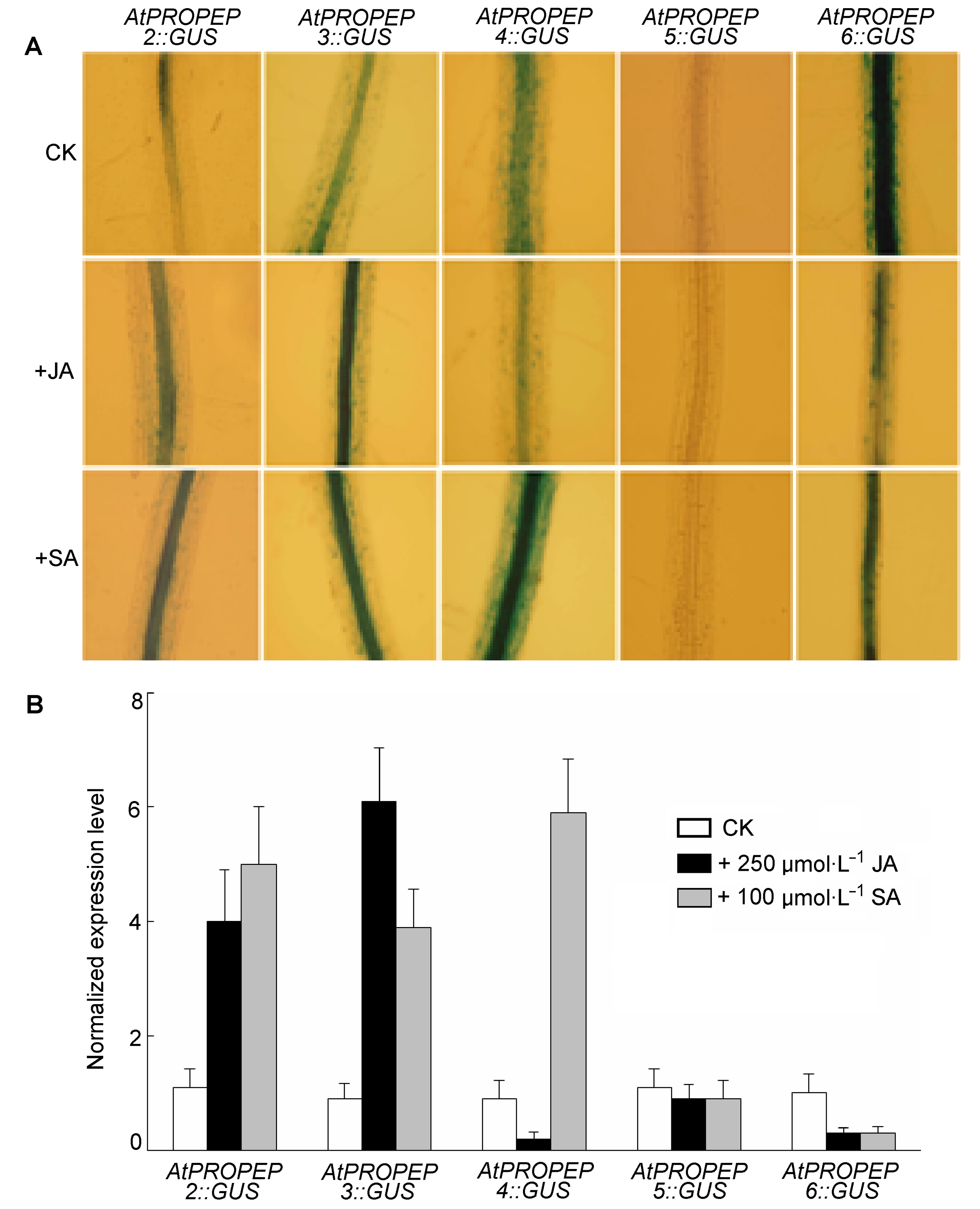
Figure 2 Response of AtPROPEP2,3−6 promoter to jasmonic acid (JA) and salicylic acid (SA) (A) GUS staining of transgenic seedlings harboring AtPROPEP2,3−6::GUS construct under 250 µmol∙L−1 JA and 100 µmol∙L−1 SA; (B) Quantitative RT-PCR analysis of AtPROPEP2,3−6 expression level under JA and SA treatments
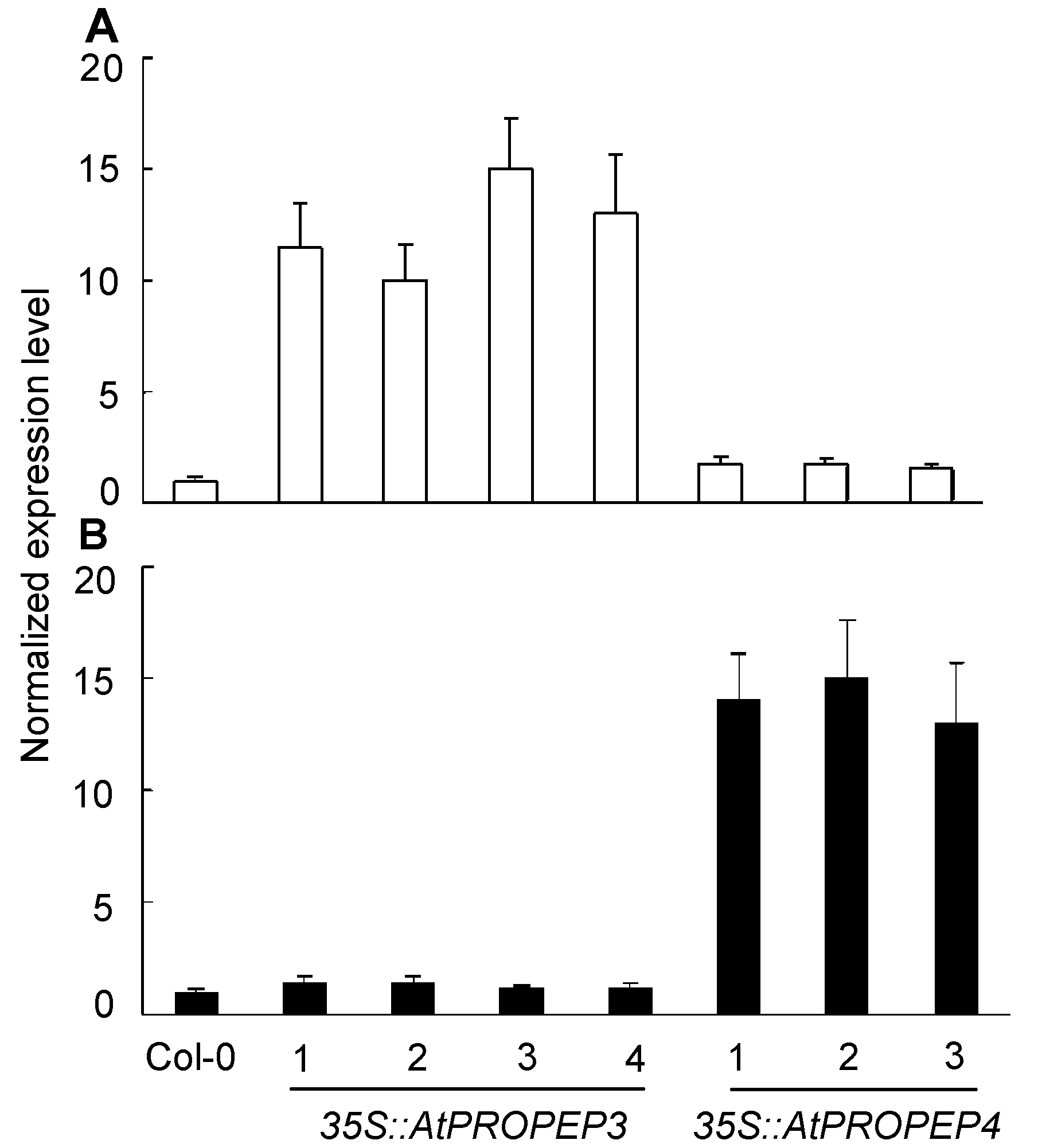
Figure 3 Quantitative RT-PCR analysis of Arabidopsis over- expressing lines (A) 35S::AtPROPEP3; (B) 35S::AtPROPEP4
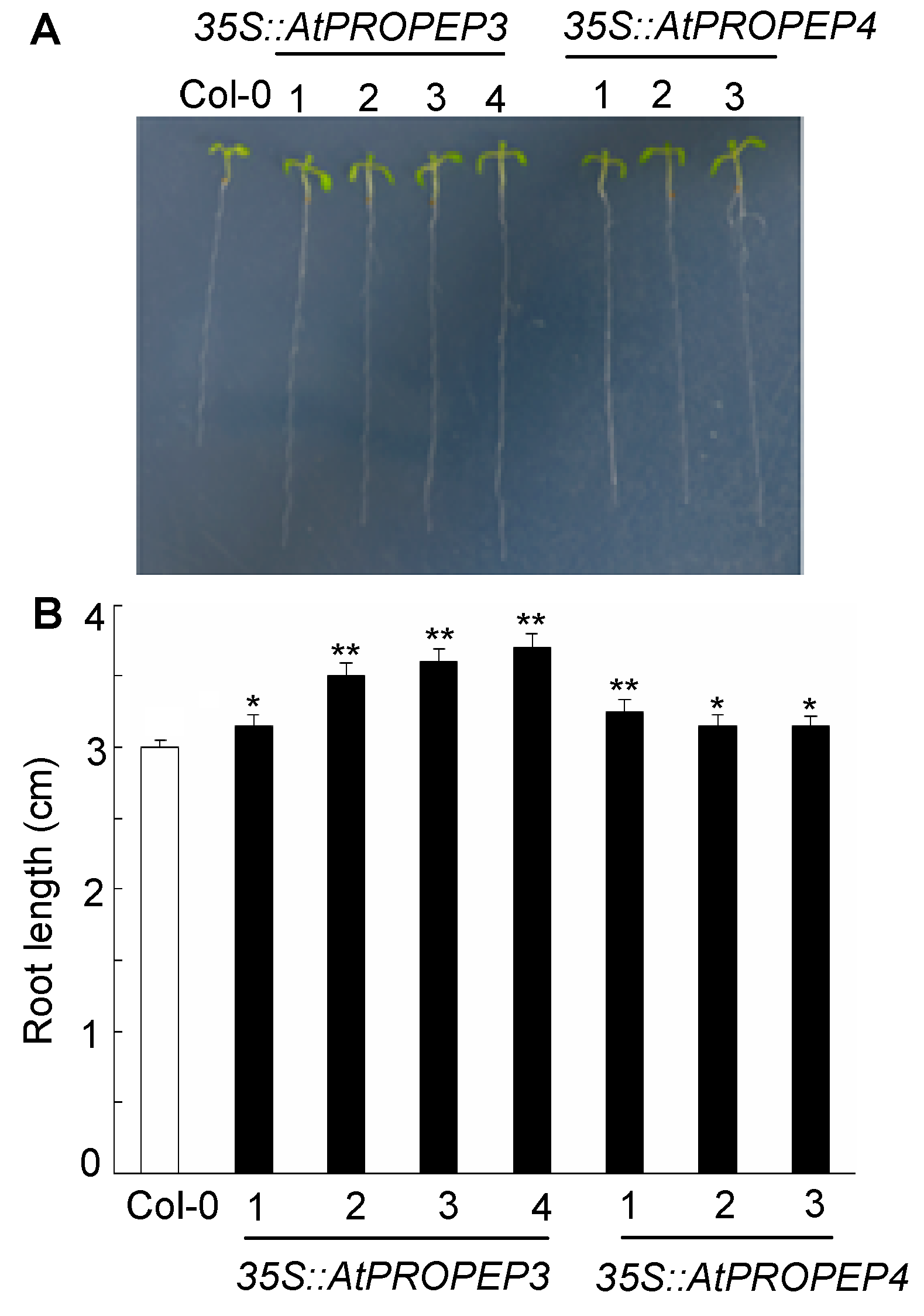
Figure 4 Arabidopsis plants overexpressing AtPROPEP3 and AtPROPEP4 exhibit longer root than that of wild type (A) Seedlings of Col-0 and transgenic seedlings grown on CK medium; (B) Measurement of root growth under CK medium (**P<0.01; * P<0.05)
| [1] | 李新锋, 赵淑清 (2004). 转基因植物中报告基因GUS的活性检测及其应用. 生命的化学 24, 71-74. |
| [2] | Bartels S, Lori M, Mbengue M, van Verk M, Klauser D, Hander T, Böni R, Robatzek S, Boller T (2013). The family of Peps and their precursors in Arabidopsis: dif- ferential expression and localization but similar induction of pattern-triggered immune responses. J Exp Bot 64, 5309-5321. |
| [3] | Gijrlach J, Volrath S, Knauf-Beiter G, Hengy G, Beckhove U, Kogel KH, Oostendorp M, Staub T, Ward E, Kessmann H, Ryals J (1996). Bekothiadiazdle, a novel class of inducers of systemic acquired resistance, activates gene expression and disease resistance in wheat. Plant Cell 8, 629-643. |
| [4] |
Huffaker A, Pearce G, Ryan CA (2006). An endogenous peptide signal in Arabidopsis activates components of the innate immune response. Proc Natl Acad Sci USA 103, 10098-10103.
DOI PMID |
| [5] |
Huffaker A, Ryan CA (2007). Endogenous peptide defense signals in Arabidopsis differentially amplify signaling for the innate immune response. Proc Natl Acad Sci USA 104, 10732-10736.
DOI PMID |
| [6] | Kuc J (1982). Induced immunity to plant disease. Bioscience 32, 854-860. |
| [7] | Ma C, Guo J, Kang Y, Doman K, Bryan AC, Tax FE, Yamaguchi Y, Qi Z (2014). AtPEPTIDE RECEPTOR2 mediates the AtPEPTIDE1 induced cytosolic Ca2+ rise which is required for the suppression of Glutamate Dumper gene expression in Arabidopsis roots. J Integr Plant Biol 56, 684-694. |
| [8] | Pearce G, Moura DS, Stratmann J, Ryan CA (2001). Production of multiple plant hormones from a single polyprotein precursor. Nature 411, 817-820. |
| [9] |
Ross AF (1961). Systemic acquired resistance induced by localized virus infections in plants. Virology 14, 340-358.
PMID |
| [10] |
Uknes S, Mauch-Mani B, Moyer M, Potter S, Williams S, Dincher S, Chandler D, Slusarenko A, Ward E, Ryals J (1992). Acquired resistance in Arabidopsis. Plant Cell 4, 645-656.
DOI PMID |
| [11] | Van Loon LC, Van Kammen A (1970). Polyacrylamide disc electrophoresis of the soluble proteins from Nicotiene tabacum var. samsun and Samnkun NN. II. Changes in protein constitution after infection with tobacco mosaic virus. Virology 40, 199-211. |
| [12] |
Vijayan P, Shockey J, Lévesque CA, Cook RJ, Browse J (1998). A role for jasmonate in pathogen defense of Arabidopsis. Proc Natl Acad Sci USA 95, 7209-7214.
DOI PMID |
| [13] | Ward ER, Uknes SJ, Williams SC, Dincher SS, Wiederhold DL, Alexander DC, Ahl-Goy P, Metraux JP, Ryals JA (1991). Co-ordinate gene activity in response to agents that induce systemic acquired resistance. Plant Cell 3, 1085-1094. |
| [14] | Yamaguchi Y, Huffaker A, Bryan AC, Tax FE, Ryan CA (2010). PEPR2 is a second receptor for the Pep1 and Pep2 peptides and contributes to defense responses in Arabidopsis. Plant Cell 22, 508-522. |
| [15] | Zhang X, Henriques R, Lin SS, Niu QW, Chua NH (2006). Agrobacterium-mediated transformation of Arabidopsis thaliana using the floral dip methods. Nature Protocols 1, 641-646. |
| [16] |
Zimmerli L, Stein M, Lipka V, Schulze-Lefert P, Some- rville S (2004). Host and non-host pathogens elicit differ- ent jasmonate/ethylene responses in Arabidopsis. Plant J 40, 633-646.
DOI PMID |
| [1] | Fang Bo, Gao Shuqin, Duan Shiming, Ma Huimin, Zhao Honglong, Jiang Hao, Yang Yanmin, Long Long, He Zuguang, Zhang Yucheng, Zheng Congcong. AI4Root: Advances in AI-Driven Plant Root Research [J]. Chinese Bulletin of Botany, 2026, 61(4): 1-0. |
| [2] | Shengfei Yang, Yuye Deng, Shiyun Cai, Yafei Liu, Yin Peng, Yuanjie Ding. Establishment of a Regeneration System for Changnienia amoena [J]. Chinese Bulletin of Botany, 2026, 61(3): 496-505. |
| [3] | QIN Fei-Fei, TANG Zhao-Hui, SI Tong, CI Dun-Wei. Response mechanisms of growth and rhizosphere soil properties in salt-tolerant and salt-sensitive peanut (Arachis hypogaea) to arbuscular mycorrhizal fungi [J]. Chin J Plant Ecol, 2026, 50(3): 742-759. |
| [4] | WEI Li, WANG Peng-Sen, LIU Shan, FAN Rui, HUANG Nan, ZHANG Jian-Guo, Qimeilamu , GOU Yang, LIU Mo-Han, HUANG Ting, ZHOU Ji-Qiong. Arbuscular mycorrhizal fungi influence nutrient uptake along vertical niches in legume-grass mixtures [J]. Chin J Plant Ecol, 2026, 50(3): 760-773. |
| [5] | ZHANG Cheng-Hang, WEI Xing, WU Chun-Ze, WANG Yu-Yao, LI Hao-Nan. Growth response of mycorrhizal Fraxinus mandshurica and Larix gmelinii seedlings to dry and wet deposition of atmospheric reduced nitrogen [J]. Chin J Plant Ecol, 2026, 50(3): 649-659. |
| [6] | Gaier Yang, Xuan Zhang, Jiadong Wang, Bo Zhang, Linyuan Duan, Xiang Li. Comparative Analysis of Transcriptome of Adventitious Roots Under Different Hydroponic Conditions of Lycium barbarum [J]. Chinese Bulletin of Botany, 2026, 61(3): 462-474. |
| [7] | Xuya Gu, Zhangman Lin, Siyuan Hu, Xuening Li, Xiaolin Qin, Zhengxi Wu, Nuo Li, Mingyin Feng, Ruihua Huang. Function of WRI1 in Heat Stress of Arabidopsis Seedlings [J]. Chinese Bulletin of Botany, 2026, 61(3): 428-436. |
| [8] | Congcong Yi, Dan Li, Yanjie Li, Xiuwen Lin, Yingshuai Lu, Xiaopeng Chen. Effect of Salt Stress on Carbohydrate Secretion by the Root System of Thinopyrum ponticum [J]. Chinese Bulletin of Botany, 2026, 61(3): 437-448. |
| [9] | LIU Run-Hong, YANG Liu-Rong, LIANG Hui-Ting, SHEN Wei-Jun. Research progress and prospect on phosphorus acquisition and utilization strategies of arbuscular mycorrhizal and ectomycorrhizal plants [J]. Chin J Plant Ecol, 2026, 50(3): 566-583. |
| [10] | HOU Xiao-Fan, MA Chen-Han, SUN Yu-Qian, GAO Yu-Han, LI Pin. Differential ecological stoichiometry of leaf and fine root litter decomposition under ozone stress [J]. Chin J Plant Ecol, 2026, 50(2): 268-278. |
| [11] | ZHANG Jing-Wen, LI Jing, WANG Ru-Miao, WANG He-Nian, CUI Li-Juan. Ecological stoichiometry characteristics and homeostasis analysis of plant roots and soil in coastal wetlands at different latitudes [J]. Chin J Plant Ecol, 2026, 50(2): 461-473. |
| [12] | WANG Meng-Xue, HU Ming-Yan, CHU Cheng-Jin, CHEN Yang, LUO Wen-Qi, MA Zi-Long. C, N, P stoichiometric characteristics of leaves and fine roots in different mycorrhizal tree species in subtropical forests [J]. Chin J Plant Ecol, 2026, 50(2): 334-343. |
| [13] | YU Jiang-Shan, XU Hao, GUO Yong-Zhong, HOU Ji-Hua. Important role of organ age in variation and coordination of stoichiometry in Pinus tabuliformis leaves, twigs and roots [J]. Chin J Plant Ecol, 2026, 50(2): 306-317. |
| [14] | WANG Shuang, CHEN Ya-Xuan, CHEN Yan-Mei, WANG Jia-Le, LIU Qian-Yuan. Root resource-acquisition strategies of Ziziphus jujuba in different habitats in typical areas of Taihang Mountains [J]. Chin J Plant Ecol, 2026, 50(2): 374-387. |
| [15] | LIANG Tian-Hao, WU Fan, HUANG Jin-Xue, JING Chen-Hong, FU He-Jing, YANG Zhi-Jie, XIONG De-Cheng. Effects of soil warming on fine root growth and morphology of Castanopsis kawakamii in mid-subtropical forests [J]. Chin J Plant Ecol, 2026, 50(1): 94-106. |
| Viewed | ||||||
|
Full text |
|
|||||
|
Abstract |
|
|||||
 Home
Home