
植物学报 ›› 2025, Vol. 60 ›› Issue (6): 944-956.DOI: 10.11983/CBB24190 cstr: 32102.14.CBB24190
葛晓青1, 李梦瑶2, 黄衡宇1,*( ), 张爱丽1,*()
收稿日期:2024-12-07
接受日期:2025-02-09
出版日期:2025-11-10
发布日期:2025-02-08
通讯作者:
*黄衡宇, 云南中医药大学教授。从事植物繁育生物学教学和研究工作30年, 发表本领域论文100余篇, 其中在SCI收录的期刊发表论文45篇。张爱丽, 云南中医药大学副教授, 云南省“兴滇英才支持计划”——青年人才, 云南省现代农业产业技术体系——中药材体系岗位专家, 云南省“科技特派员”。聚焦云南道地濒危药材的保护工作及中药资源的开发与利用研究, 开展云南道地珍稀濒危中药材高效快速繁殖体系的建立, 并构建其遗传转化体系及基因编辑体系。研究成果在《中草药》和《中药材》等中文核心期刊以及Environmental and Experimental Botany和Applications in Plant Sciences等SCI收录期刊发表。E-mail: hhyhhy96@163.com;E-mail: zhangailibb@126.com
基金资助:
Xiaoqing Ge1, Mengyao Li2, Hengyu Huang1,*(), Aili Zhang1,*()
Received:2024-12-07
Accepted:2025-02-09
Online:2025-11-10
Published:2025-02-08
Contact:
*E-mail: hhyhhy96@163.com;E-mail: zhangailibb@126.com
摘要: 为加强野生蕨类植物的保护与开发, 优化星蕨(Microsorum punctatum)孢子萌发方法和条件, 比较分析了不同因素对原叶体增殖、孢子体诱导、绿色球状小体(GGBs)诱导及其发育为幼孢子体的影响, 建立人工高效快繁技术体系。以成熟孢子为材料, 分别以MS、1/2MS、1/3MS和1/4MS为基本培养基在无菌条件下萌发; 通过L9(34)正交试验, 研究无机盐浓度、植物生长调节剂及其质量浓度对原叶体发生和增殖的影响。当原叶体增殖到一定数量时, 再以MS、1/2MS、1/3MS和1/4MS为基本培养基筛选适宜诱导孢子体的培养基; 随后, 以幼孢子体为材料诱导GGBs发育为新的幼孢子体并炼苗移栽。适宜孢子萌发的培养基为1/2MS, 原叶体在MS+0.3 mg·L-1 6-BA+1.5 mg·L-1 NAA培养基中大量增殖, 60天后增殖系数约为9.6; 将原叶体切割后接入1/4MS培养基, 加无菌水培养90天后, 幼孢子体发生系数约为10.0; 幼孢子体在1/2MS+1.5 mg·L-1 6-BA+0.1 mg·L-1 NAA培养基中可诱导出GGBs, 诱导率达93.3%, GGBs在此培养基中的增殖系数达32.0; 在1/2MS培养基中GGBs的分化成苗率较高, 最高约为92%; 试管苗经炼苗移栽成活率在90%以上。该研究建立了原叶体-受精-孢子体和幼孢子体-GGBs-幼孢子体2个技术体系, 尤其是GGBs的产生, 极大缩短了植株的再生周期。研究结果可为优质种苗及其它蕨类植物的人工繁育提供技术支撑。
葛晓青, 李梦瑶, 黄衡宇, 张爱丽. 星蕨体外快繁技术. 植物学报, 2025, 60(6): 944-956.
Xiaoqing Ge, Mengyao Li, Hengyu Huang, Aili Zhang. Rapid Propagation Technology of Microsorum punctatum in Vitro. Chinese Bulletin of Botany, 2025, 60(6): 944-956.
| Levels | Factors | ||
|---|---|---|---|
| A (basic medium) | B (mg·L-1 6-BA) | C (mg·L-1 NAA) | |
| 1 | MS | 0.3 | 0.5 |
| 2 | 1/2MS | 0.6 | 1.0 |
| 3 | 1/4MS | 1.2 | 1.5 |
表1 原叶体增殖L9(34)正交试验
Table 1 The orthogonal design L9(34) of prothallus proliferation
| Levels | Factors | ||
|---|---|---|---|
| A (basic medium) | B (mg·L-1 6-BA) | C (mg·L-1 NAA) | |
| 1 | MS | 0.3 | 0.5 |
| 2 | 1/2MS | 0.6 | 1.0 |
| 3 | 1/4MS | 1.2 | 1.5 |
| Basic medium | Disinfection time (min) | Contamination rate (%) | Growth situation |
|---|---|---|---|
| MS | 5 | 100.00±0.00 a | The spore germination time was second only to 1/2MS, and the green flaky bodies were partially aggregated on the surface of the medium, and some were sparsely distributed or even blank |
| 8 | 74.67±0.04 b | ||
| 10 | 55.33±0.02 c | ||
| 12 | 32.00±0.02 d | ||
| 1/2MS | 5 | 100.00±0.00 a | The flaky bodies appeared first and were widely distributed on the surface of the medium. Some of them gathered into pieces, which were green in color and stretched out in shape |
| 8 | 74.67±0.04 b | ||
| 10 | 50.67±0.02 c | ||
| 12 | 22.00±0.03 d | ||
| 1/3MS | 5 | 100.00±0.00 a | The flaky bodies were sparsely distributed on the surface of the medium |
| 8 | 80.67±0.04 b | ||
| 10 | 50.67±0.04 c | ||
| 12 | 18.67±0.02 d | ||
| 1/4MS | 5 | 100.00±0.00 a | Green spots appeared at the latest, and the flakes were scattered on the surface of the me- dium |
| 8 | 72.00±0.11 b | ||
| 10 | 53.33±0.05 b | ||
| 12 | 21.33±0.05 c |
表2 孢子萌发及其生长状况
Table 2 Spore germination and growth status
| Basic medium | Disinfection time (min) | Contamination rate (%) | Growth situation |
|---|---|---|---|
| MS | 5 | 100.00±0.00 a | The spore germination time was second only to 1/2MS, and the green flaky bodies were partially aggregated on the surface of the medium, and some were sparsely distributed or even blank |
| 8 | 74.67±0.04 b | ||
| 10 | 55.33±0.02 c | ||
| 12 | 32.00±0.02 d | ||
| 1/2MS | 5 | 100.00±0.00 a | The flaky bodies appeared first and were widely distributed on the surface of the medium. Some of them gathered into pieces, which were green in color and stretched out in shape |
| 8 | 74.67±0.04 b | ||
| 10 | 50.67±0.02 c | ||
| 12 | 22.00±0.03 d | ||
| 1/3MS | 5 | 100.00±0.00 a | The flaky bodies were sparsely distributed on the surface of the medium |
| 8 | 80.67±0.04 b | ||
| 10 | 50.67±0.04 c | ||
| 12 | 18.67±0.02 d | ||
| 1/4MS | 5 | 100.00±0.00 a | Green spots appeared at the latest, and the flakes were scattered on the surface of the me- dium |
| 8 | 72.00±0.11 b | ||
| 10 | 53.33±0.05 b | ||
| 12 | 21.33±0.05 c |
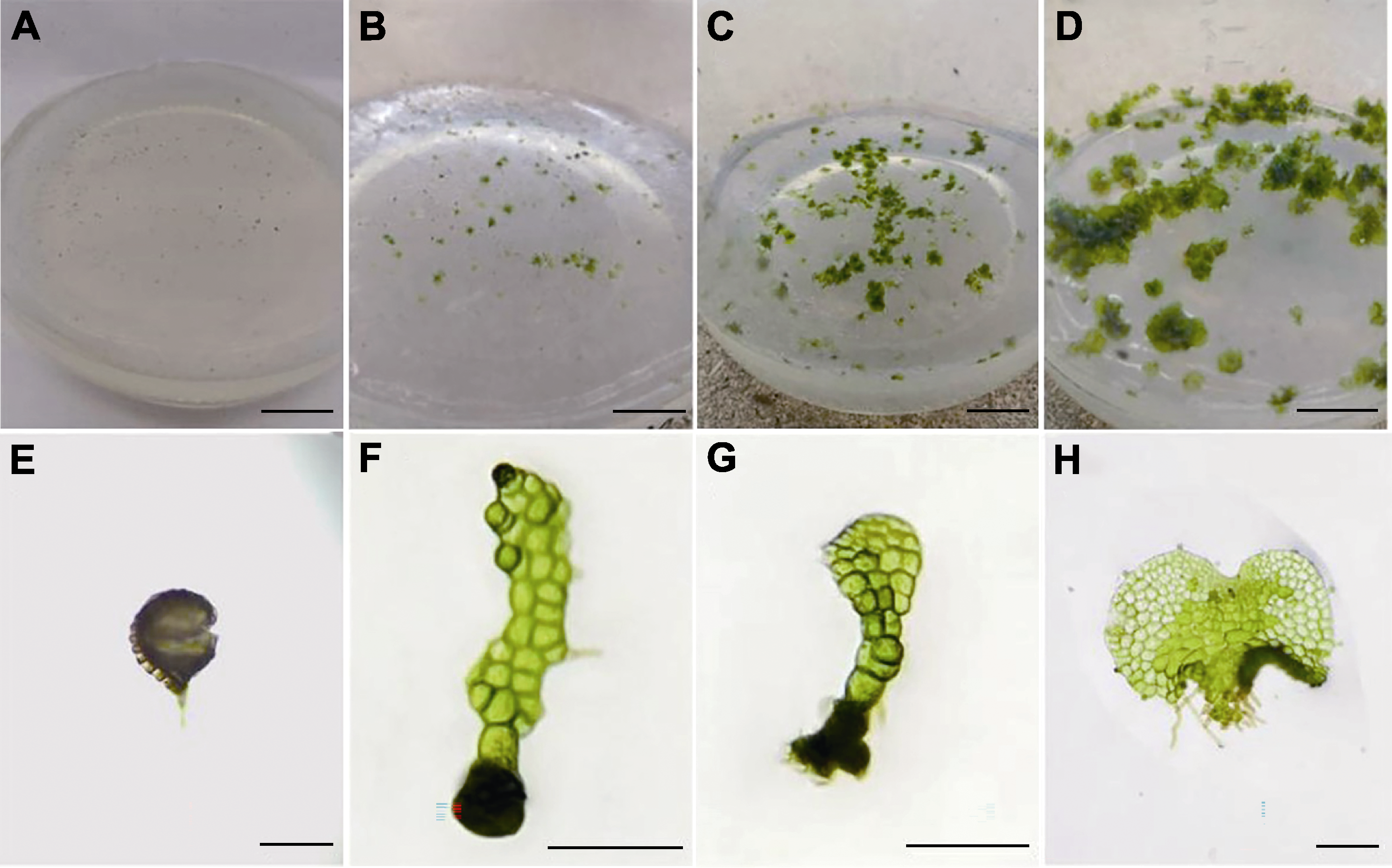
图1 孢子萌发过程 (A) 20天后无菌体系建立(bar=2 cm); (B) 30天后孢子萌发(bar=2 cm); (C) 45天后小团状片状体形成(bar=2 cm); (D) 70天后原叶体形成(bar=2 cm); (E) 孢子萌发(bar=50 μm); (F) 丝状体时期(bar=100 μm); (G) 早期片状体时期(bar=100 μm); (H) 心形原叶体时期(bar=50 μm)
Figure 1 Spore germination process (A) Establishment of aseptic system (20 days) (bar=2 cm); (B) Germination of fertile spores (30 days) (bar=2 cm); (C) Prothallus (45 days) (bar=2 cm); (D) Prothallus (70 days) (bar=2 cm); (E) Spore germination (bar=50 μm); (F) Filamentous period (bar=100 μm); (G) Early lamellar period (bar=100 μm); (H) Cardioprothallus stage (bar=50 μm)
| Number | Factors | Multiplication coefficient | ||||
|---|---|---|---|---|---|---|
| A (basic medium) | B (6-BA) | C (NAA) | D (error) | |||
| 1 | 1 | 1 | 1 | 1 | 8.73±0.07 | |
| 2 | 1 | 2 | 2 | 2 | 8.33±0.07 | |
| 3 | 1 | 3 | 3 | 3 | 9.60±0.12 | |
| 4 | 2 | 1 | 2 | 3 | 7.53±0.18 | |
| 5 | 2 | 2 | 3 | 1 | 6.47±0.07 | |
| 6 | 2 | 3 | 1 | 2 | 6.80±0.23 | |
| 7 | 3 | 1 | 3 | 2 | 6.60±0.12 | |
| 8 | 3 | 2 | 1 | 3 | 7.00±0.12 | |
| 9 | 3 | 3 | 2 | 1 | 6.00±0.12 | |
| Multiplication coefficient | K1 | 8.89 | 7.62 | 7.51 | 7.07 | |
| K2 | 6.93 | 7.29 | 7.29 | 7.24 | ||
| K3 | 6.53 | 7.56 | 7.56 | 7.04 | ||
| R | 2.36 | 0.33 | 0.27 | 0.20 | ||
表3 原叶体增殖L9(34)正交试验结果
Table 3 The orthogonal design L9(34) result of prothallus proliferation
| Number | Factors | Multiplication coefficient | ||||
|---|---|---|---|---|---|---|
| A (basic medium) | B (6-BA) | C (NAA) | D (error) | |||
| 1 | 1 | 1 | 1 | 1 | 8.73±0.07 | |
| 2 | 1 | 2 | 2 | 2 | 8.33±0.07 | |
| 3 | 1 | 3 | 3 | 3 | 9.60±0.12 | |
| 4 | 2 | 1 | 2 | 3 | 7.53±0.18 | |
| 5 | 2 | 2 | 3 | 1 | 6.47±0.07 | |
| 6 | 2 | 3 | 1 | 2 | 6.80±0.23 | |
| 7 | 3 | 1 | 3 | 2 | 6.60±0.12 | |
| 8 | 3 | 2 | 1 | 3 | 7.00±0.12 | |
| 9 | 3 | 3 | 2 | 1 | 6.00±0.12 | |
| Multiplication coefficient | K1 | 8.89 | 7.62 | 7.51 | 7.07 | |
| K2 | 6.93 | 7.29 | 7.29 | 7.24 | ||
| K3 | 6.53 | 7.56 | 7.56 | 7.04 | ||
| R | 2.36 | 0.33 | 0.27 | 0.20 | ||
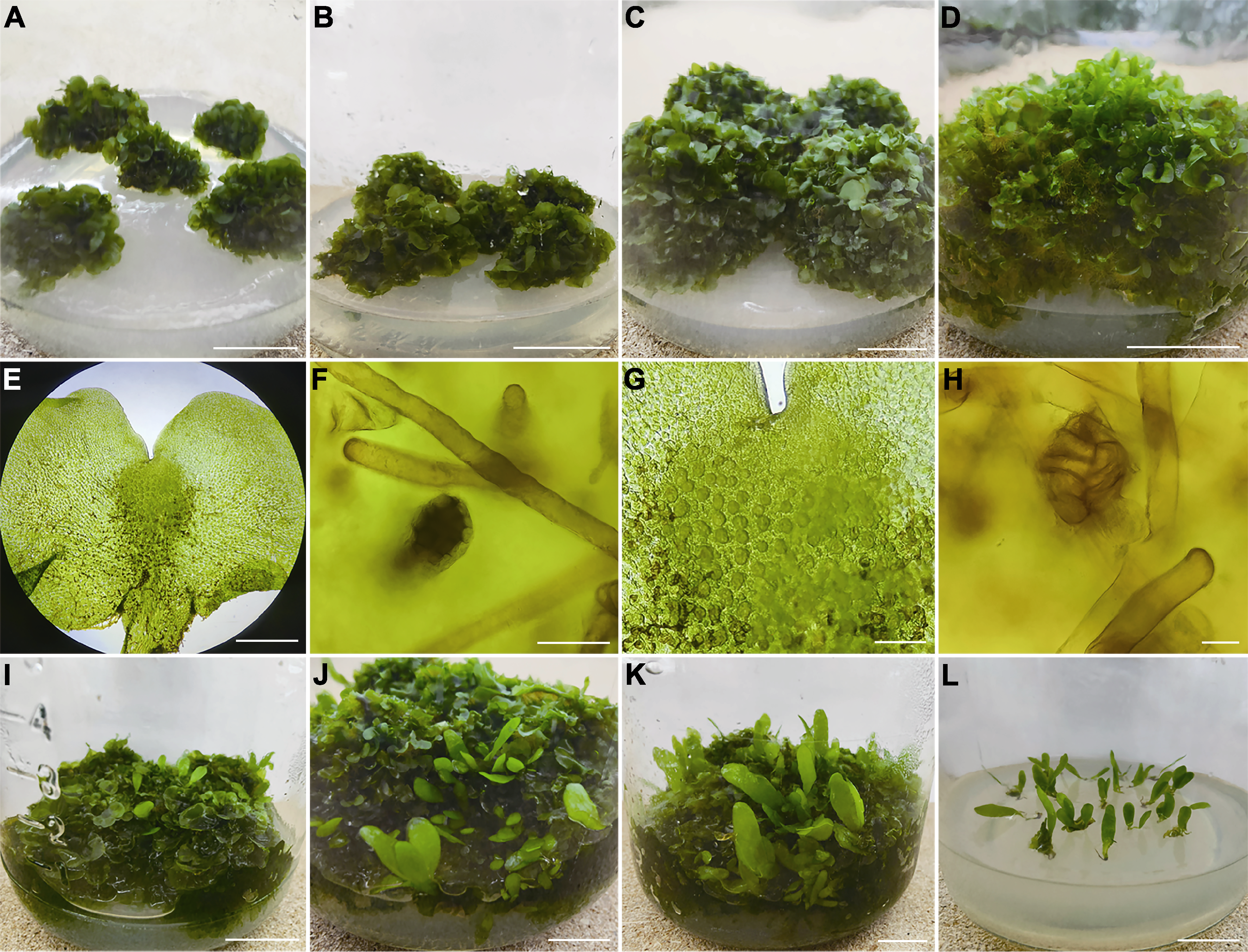
图2 原叶体增殖和幼孢子体诱导 (A) 转接15天后的原叶体团(bar=2 cm); (B) 转接30天后的原叶体团(bar=2 cm); (C) 转接45天后的原叶体团(bar=2 cm); (D) 转接60天后的原叶体团(bar=2 cm); (E) 原叶体(bar=500 μm); (F) 精子器(bar=40 μm); (G) 局部颈卵器(bar=200 μm); (H) 颈卵器(bar=40 μm); (I) 加水培养20天后的原叶体和幼孢子体(bar=2 cm); (J) 加水培养60天后的原叶体和幼孢子体(bar=2 cm); (K) 加水培养90天后的原叶体和幼孢子体(bar=2 cm); (L) 孢子体生根培养(bar=2 cm)
Figure 2 Proliferation of prothallus and induction of young sporophytes (A) Prolobular mass was transferred after 15 days (bar=2 cm); (B) Prolobular mass was transferred after 30 days (bar=2 cm); (C) Prolobular mass was transferred after 45 days (bar=2 cm); (D) Prolobular mass was transferred after 60 days (bar=2 cm); (E) Gametophyte (bar=500 μm); (F) Antheridium (bar=40 μm); (G) Local archegonium (bar=200 μm); (H) Archegonium (bar=40 μm); (I) Prothallus and young sporophyte cultured with water after 20 days (bar=2 cm); (J) Prothallus and young sporophyte cultured with water after 60 days (bar=2 cm); (K) Prothallus and young sporophyte cultured with water after 90 days (bar=2 cm); (L) Sporophyte rooting culture (bar=2 cm)
| Basic medium | Fresh weight before multiplication (g) | Fresh weight after multiplication (g) | Multiplication weight (g) | Multiplication coefficient |
|---|---|---|---|---|
| MS | 3.92±0.54 a | 37.69±0.77 a | 33.77±0.47 a | 9.81±0.62 a |
| 1/2MS | 4.17±0.61 a | 30.72±0.98 b | 26.55±0.83 b | 6.36±0.90 b |
| 1/4MS | 4.03±0.77 a | 28.01±0.82 c | 23.98±0.37 c | 5.95±0.56 c |
表4 不同培养基类型对原叶体重量增加的影响
Table 4 Effect of different culture media on weight increase of prothallus
| Basic medium | Fresh weight before multiplication (g) | Fresh weight after multiplication (g) | Multiplication weight (g) | Multiplication coefficient |
|---|---|---|---|---|
| MS | 3.92±0.54 a | 37.69±0.77 a | 33.77±0.47 a | 9.81±0.62 a |
| 1/2MS | 4.17±0.61 a | 30.72±0.98 b | 26.55±0.83 b | 6.36±0.90 b |
| 1/4MS | 4.03±0.77 a | 28.01±0.82 c | 23.98±0.37 c | 5.95±0.56 c |
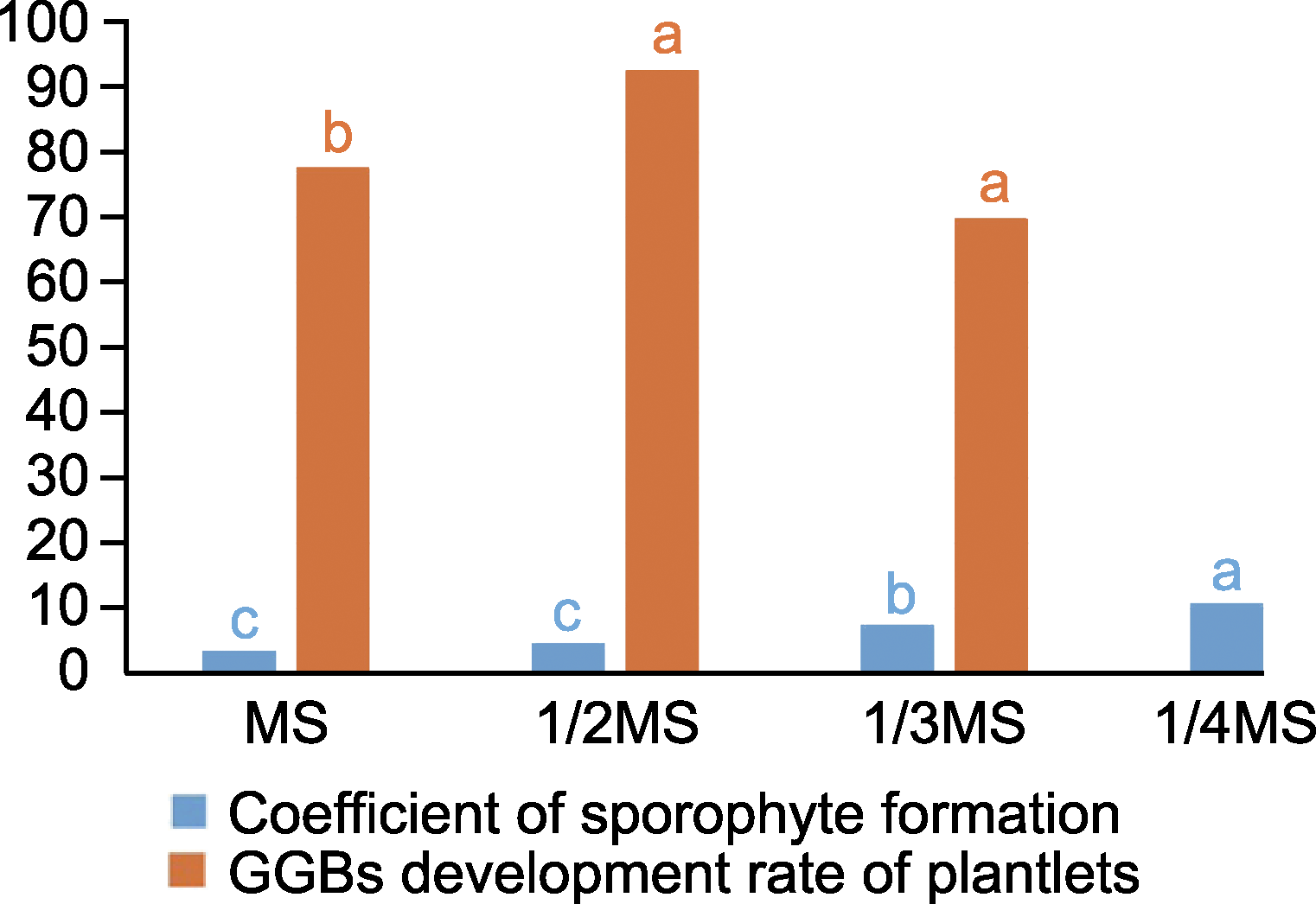
图3 不同无机盐浓度对孢子体诱导及绿色球状小体(GGBs)发育成苗率的影响 不同小写字母表示差异显著(P<0.05)。
Figure 3 Effects of different inorganic salt concentrations on sporophyte induction and plantlet rate of green globular bodies (GGBs) development Different lowercase letters indicate significant differences at the 0.05 level.
| No. | Plant growth regulators | Induction rate (%) | Multiplication coefficient | |
|---|---|---|---|---|
| 6-BA (mg·L-1) | NAA (mg·L-1) | |||
| CK | 0 | 0 | 21.33±0.03 g | 2.63±1.43 d |
| R1 | 0.5 | 0.1 | 76.67±0.03 cd | 18.73±3.40 c |
| R2 | 0.5 | 0.6 | 64.67±0.08 de | 20.60±3.64 bc |
| R3 | 0.5 | 1.2 | 49.33±0.01 f | 19.40±2.50 bc |
| R4 | 1.0 | 0.1 | 80.00±0.04 bc | 19.87±1.65 bc |
| R5 | 1.0 | 0.6 | 70.67±0.05 cde | 13.73±2.32 c |
| R6 | 1.0 | 1.2 | 63.33±0.05 e | 19.13±1.92 bc |
| R7 | 1.5 | 0.1 | 93.33±0.03 a | 32.00±3.30 a |
| R8 | 1.5 | 0.6 | 89.33±0.03 ab | 28.20±2.66 ab |
| R9 | 1.5 | 1.2 | 65.33±0.04 de | 16.60±3.17 c |
表5 不同植物生长调节剂浓度对绿色球状小体(GGBs)诱导和增殖的影响
Table 5 Effects of different plant growth regulators concentrations on green globular bodies (GGBs) induction and proliferation
| No. | Plant growth regulators | Induction rate (%) | Multiplication coefficient | |
|---|---|---|---|---|
| 6-BA (mg·L-1) | NAA (mg·L-1) | |||
| CK | 0 | 0 | 21.33±0.03 g | 2.63±1.43 d |
| R1 | 0.5 | 0.1 | 76.67±0.03 cd | 18.73±3.40 c |
| R2 | 0.5 | 0.6 | 64.67±0.08 de | 20.60±3.64 bc |
| R3 | 0.5 | 1.2 | 49.33±0.01 f | 19.40±2.50 bc |
| R4 | 1.0 | 0.1 | 80.00±0.04 bc | 19.87±1.65 bc |
| R5 | 1.0 | 0.6 | 70.67±0.05 cde | 13.73±2.32 c |
| R6 | 1.0 | 1.2 | 63.33±0.05 e | 19.13±1.92 bc |
| R7 | 1.5 | 0.1 | 93.33±0.03 a | 32.00±3.30 a |
| R8 | 1.5 | 0.6 | 89.33±0.03 ab | 28.20±2.66 ab |
| R9 | 1.5 | 1.2 | 65.33±0.04 de | 16.60±3.17 c |
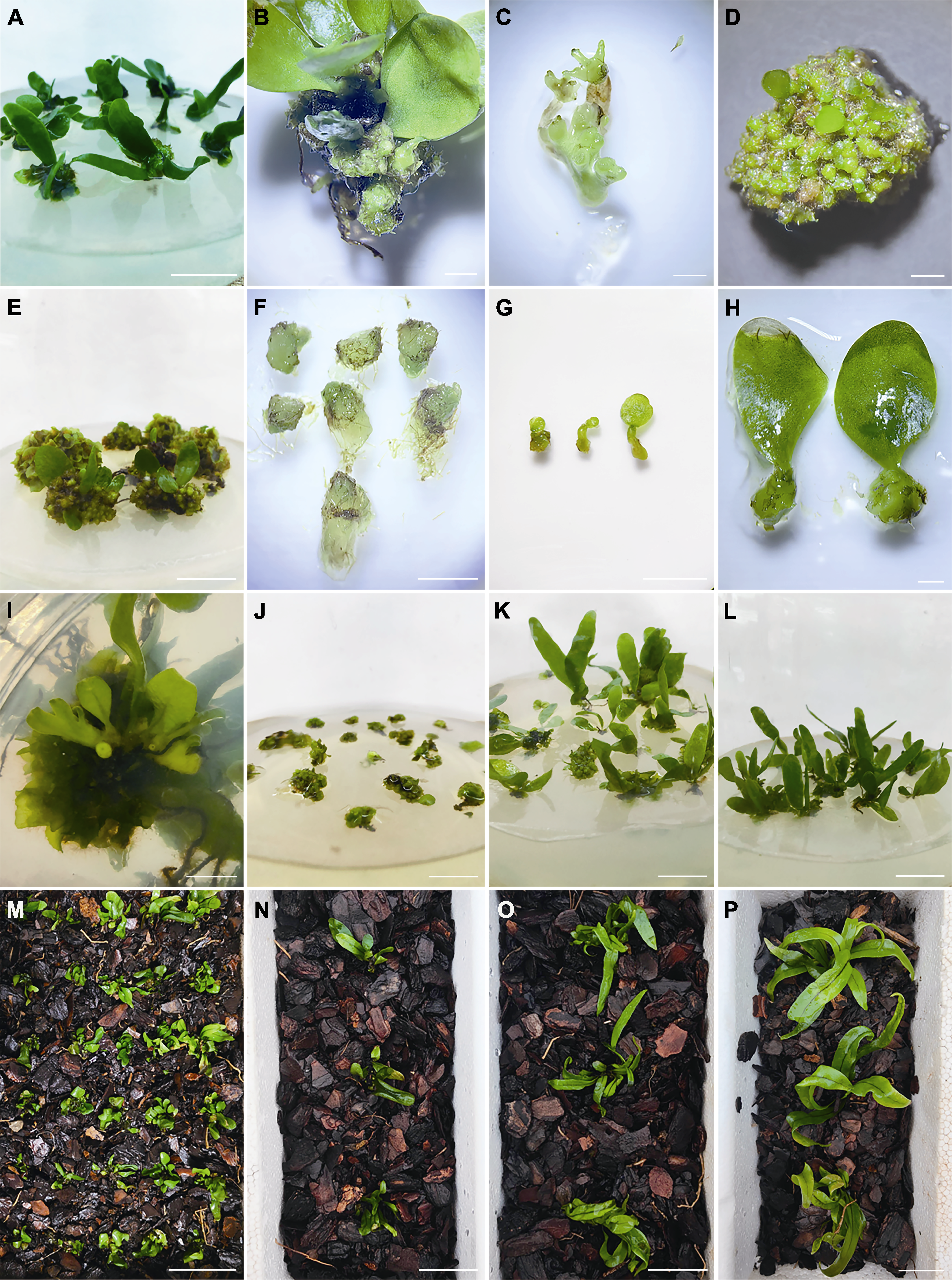
图4 对星蕨孢子体绿色球状小体的诱导及绿色球状小体(GGB)植株的再生与驯化 (A)以孢子体为材料诱导GGBs (bar=1 cm); (B) 孢子体长出绿色球状小体(bar=1 mm); (C) 根状茎分离出绿色球状小体(bar=1 mm); (D), (E) 绿色球体培育成的GGBs聚合体((D) bar=1 mm; (E) (bar=1 cm); (F) GGBs聚合体中分离出单个GGB (bar=500 μm); (G), (H) GGBs分化长出幼孢子体((G) bar=5 mm; (H) bar=1 mm); (I) 孢子体根状茎长出GGB (bar=1 cm); (J) GGB增殖(bar=1 cm); (K) GGB分化成苗(bar=1 cm); (L) 培养60天后孢子体生根(bar=1 cm); (M)-(P) 孢子体驯化((M) bar=5 cm; (N)-(P) bars=3 cm)。因孢子体驯化生长空间有限(M), 后续将其转入面积较大的隔间驯化(N)-(P)。
Figure 4 Green globular induction of sporophytes and regeneration and domestication of green globular body (GGB) plants of Microsorum punctatum (A) GGBs induced by sporophyte (bar=1 cm); (B) Spore grows green globular bodies (bar=1 mm); (C) Rhizomes isolated green globules (bar=1 mm); (D), (E) GGBs polymer cultivated from e-green spheroids ((D) bar=1 mm; (E) bar=1 cm); (F) A single GGB was isolated from GGBs polymer (bar=500 μm); (G), (H) GGBs differentiated into young sporophytes ((G) bar=5 mm; (H) bar=1 mm); (I) Sporophyte rhizomes grow GGB (bar=1 cm); (J) GGB multiplication (bar=1 cm); (K) GGB differentiate into plantlets (bar=1 cm); (L) The sporophyte took root after 60 days of culture (bar=1 cm); (M)-(P) Sporophytic domestication ((M) bar=5 cm; (N)-(P) bars=3 cm). Due to limited space for the domestication and growth of spores (M), they were later transferred to larger compartments for domestication (N)-(P).

图5 星蕨体外再生过程 GGBs: 绿色球状小体
Figure 5 Regeneration process of Microsorum punctatum in vitro GGBs: Green globular bodies
| [1] | Aldea F, Banciu C, Brezeanu A, Helepciuc FE, Soare LC (2016). In vitro micropropagation of fern species (Pteridophyta) of biotechnological interest, for ex situ conservation. Oltenia Studii Si Comunicări Ştiinţele Naturii 32, 27-35. |
| [2] | Banks JA (1999). Gametophyte development in ferns. Annu Rev Plant Biol 50, 163-186. |
| [3] |
Bertrand AM, Albuerne MA, Fernández H, González A, Sánchez-Tamés R (1999). In vitro organogenesis of Polypodium cambricum. Plant Cell Tissue Organ Cult 57, 65-69.
DOI |
| [4] | Chen P, Yang LL, Peng Y, Zhang SZ, Xu GH, Yang JF, Zhang SZ (2021). In vitro regeneration of Osmunda mildei. Guihaia 41, 301-307. (in Chinese) |
| 陈朋, 杨蕾蕾, 彭杨, 张苏州, 徐桂红, 杨建芬, 张寿洲 (2021). 粤紫萁离体再生技术研究. 广西植物 41, 301-307. | |
| [5] | Cho JS, Lee CH (2017). Several factors affecting mass production of Microlepia strigosa (Thunb.) C. Presl sporophytes. Hortic Sci Technol 35, 46-58. |
| [6] | Dela Cruz RY, Ang AMG, Doblas GZ, Librando IL, Porquis HC, Batoctoy BCLS, Cabresos CC, Jacalan DRY, Amoroso VB (2017). Phytochemical screening, antioxidant and anti-inflammatory activities of the three fern (poly- podiaceae) species in Bukidnon, Philippines. Bull Environ Pharmacol Life Sci 6, 28-33. |
| [7] | Duan JQ, Sun DK, Xiang JY, Tang JR (2021). Study on tissue culture and rapid propagation technology of Asplenium nidus. Seed 40(5), 84-90. (in Chinese) |
| 段杰秋, 孙大宽, 向建英, 唐军荣 (2021). 巢蕨组培快繁技术研究. 种子 40(5), 84-90. | |
| [8] |
Fernández H, Revilla MA (2003). In vitro culture of ornamental ferns. Plant Cell Tissue Organ Cult 73, 1-13.
DOI |
| [9] | Flora of China Editorial Committee (2000). Flora of China (vol. 6). Beijing: Science Press. pp. 226. (in Chinese) |
| 中国科学院中国植物志编辑委员会 (2000). 中国植物志(第6卷, 第2分册). 北京: 科学出版社. pp. 226. | |
| [10] | Gao XW, Zhou SY, Bian ZJ, Wang QH, Dai XL (2018). Effects on morphological development of gametophytes of three fern species under different moisture conditions. Jo urnal of Shanghai Normal University (Nat Sci) 47, 726-733. (in Chinese) |
| 高晓雯, 周施雨, 卞竹箐, 王清华, 戴锡玲 (2018). 不同水分条件对3种蕨类植物配子体形态发育的影响. 上海师范大学学报(自然科学版) 47, 726-733. | |
| [11] |
Greer GK, McCarthy BC (2000). Patterns of growth and reproduction in a natural population of the fern Polystichum acrostichoides. Am Fern J 90, 60-76.
DOI URL |
| [12] | Hegde S, D’Souza L (2000). Recent advances in biotechnology of ferns. In: Trivedi PC, ed. Plant Biotechnology—Recent Advances. New Delhi: Panima Publishing Corporation. pp. 213-237. |
| [13] | IUCN (2024). The IUCN Red List of Threatened Species. https://www.iucnredlist.org. 2024-03-09. |
| [14] | Jang BK, Cho JS, Lee KC, Lee CH (2017). Culture conditions affecting spore germination, prothallus propagation and sporophyte formation of Dryopteris nipponensis Koidz. Hortic Sci Technol 35, 480-489. |
| [15] |
Jang BK, Cho JS, Park K, Lee CH (2019). A methodology for large-scale Athyrium sheareri gametophyte proliferation and sporophyte production using tissue culture. In Vitro Cell Dev Biol Plant 55, 519-526.
DOI |
| [16] |
Korpelainen H (1994). Growth, sex determination and reproduction of Dryopteris filix-mas (L.) Schott gametophytes under varying nutritional conditions. Bot J Linn Soc 114, 357-366.
DOI URL |
| [17] |
Korpelainen H (1995). Growth and reproductive characteristics in artificially formed clonal gametophytes of Dryopteris filix-mas (Dryopteridaceae). Plant Syst Evol 196, 195-206.
DOI URL |
| [18] | Krieg CP, Chambers SM (2022). The ecology and physiology of fern gametophytes: a methodological synthesis. Appl Plant Sci 10, e11464. |
| [19] | Lin CW, Shih CH, Chang HC, Kao CY (2024). Regeneration of endangered fern Adiantum reniforme var. sinense. Indian J Agric Res 58, 56-62. |
| [20] |
Murashige T, Skoog F (1962). A revised medium for rapid growth and bio assays with tobacco tissue cultures. Physiol Plant 15, 473-497.
DOI URL |
| [21] |
Park K, Jang BK, Lee CH (2019). Culture condition for gametophyte and sporophyte masspropagation of bamboo fern (Coniogramme japonica) using tissue culture. J Plant Biotechnol 46, 119-126.
DOI URL |
| [22] |
Park K, Jang BK, Lee HM, Cho JS, Lee CH (2020). An efficient method for in vitro shoot-tip culture and sporophyte production using Selaginella martensii Spring sporophyte. Plants 9, 235.
DOI URL |
| [23] |
Petchsri S, Boonkerd T, Baum BR, Karladee D, Suriyong S, Lungkaphin A (2012). Phenetic study of the Microsorum punctatum complex (Polypodiaceae). Sci Asia 38, 1-12.
DOI URL |
| [24] |
Ravi BX, Robert J, Gabriel M (2014). In vitro spore germination and gametophytic growth development of a critically endangered fern Pteris tripartita Sw. Afr J Biotechnol 13, 2350-2358.
DOI URL |
| [25] |
Ravi BX, Varuvel GVA, Kilimas R, Robert J (2015). Apogamous sporophyte development through spore reproduction of a South Asia’s critically endangered fern: Pteris tripartita Sw. Asian Pac J Reprod 4, 135-139.
DOI URL |
| [26] | Rybczyński JJ, Tomiczak K, Grzyb M, Mikuła A (2018). Morphogenic events in ferns:single and multicellular explants in vitro. In: In: Fernández H, ed. Current Advances in Fern Research. Cham: Springer. pp. 99-120. |
| [27] |
Sanders HL, Darrah PR, Langdale JA (2011). Sector analysis and predictive modelling reveal iterative shoot-like development in fern fronds. Development 138, 2925-2934.
DOI PMID |
| [28] |
Somer M, Arbesú R, Menéndez V, Revilla MA, Fernández H (2010). Sporophyte induction studies in ferns in vitro. Euphytica 171, 203-210.
DOI URL |
| [29] |
Vasco A, Moran RC, Ambrose BA (2013). The evolution, morphology, and development of fern leaves. Front Plant Sci 4, 345.
DOI PMID |
| [30] | Yang FC (2009). Special topics on tropical pteridophyte (XIII) cultivation and management of Microsorum punctatum. China Flowers and Horticulture (24), 20-21. (in Chinese) |
| 杨逢春 (2009). 热带蕨类植物专题(十三) 星蕨的栽培管理. 中国花卉园艺 (24), 20-21. | |
| [31] |
Yu RP, Li F, Wang GX, Ruan JW, Wu LF, Wu M, Yang CM, Shan QL (2021). In vitro regeneration of the colorful fern Pteris aspericaulis var. tricolor via green globular bodies system. In Vitro Cell Dev Biol Plant 57, 225-234.
DOI |
| [32] |
Yu RP, Zhang GF, Li H, Cao H, Mo XJ, Gui M, Zhou XH, Jiang YL, Li SC, Wang JH (2017). In vitro propagation of the endangered tree fern Cibotium barometz through formation of green globular bodies. Plant Cell Tissue Organ Cult 128, 369-379.
DOI URL |
| [33] | Zhang DR, Bu ZG, Chen LL, Chang Y (2020). Establishment of a tissue culture and rapid propagation system of Dryopteris fragrans. Chin Bull Bot 55, 760-767. (in Chinese) |
| 张冬瑞, 卜志刚, 陈玲玲, 常缨 (2020). 香鳞毛蕨的组织培养和快速繁殖体系构建. 植物学报 55, 760-767. | |
| [34] |
Zhang W, Wang Q, Chen GH, Chen HF (2020). Partial tissue culture and rapid propagation of Phymatosorus scolopendria spores. Plant Physiology Journal 56, 856-862. (in Chinese)
DOI URL |
| 张薇, 王强, 陈国华, 陈红锋 (2020). 瘤蕨孢子的不完全组织培养与快速繁殖. 植物生理学报 56, 856-862. |
| [1] | 吴小凤, 胡若洋, 李学东. 仙鹤藓的孢子萌发及愈伤组织诱导[J]. 植物学报, 2013, 48(6): 651-657. |
| [2] | 杜红红, 李杨, 李东, 戴绍军, 姜闯道, 石雷. 光照、温度和pH值对小黑桫椤孢子萌发及早期配子体发育的影响[J]. 生物多样性, 2009, 17(2): 182-187. |
| [3] | 邓亚妮, 成晓, 焦瑜, 陈贵菊. 中国特有濒危植物扇蕨的生物生态学特性及其濒危机制初探[J]. 生物多样性, 2009, 17(1): 62-68. |
| [4] | 张开梅 石雷. 傅氏凤尾蕨配子体发育的研究[J]. 植物学报, 2005, 22(增刊): 50-56. |
| [5] | 刘建福, 杨道茂, 欧阳明安, 王丽娜, 张勇, 曾明. 澳洲坚果根系溶提物对AM真菌孢子萌发和菌丝生长的影响[J]. 植物生态学报, 2005, 29(6): 1038-1042. |
| [6] | 衣艳君 强胜. 五种藓类植物的孢子萌发与原丝体发育[J]. 植物学报, 2005, 22(06): 708-714. |
| [7] | 张开梅 石雷 李东. 剑叶凤尾蕨配子体发育的研究[J]. 植物学报, 2005, 22(05): 566-571. |
| [8] | 徐艳 石雷 刘燕 刘保东 李东. 江南星蕨配子体形态发育的研究[J]. 植物学报, 2004, 21(06): 660-666. |
| [9] | 范庆书 赵建成 于树宏 李秀芹. 苔藓植物孢子萌发与原丝体发育研究进展[J]. 植物学报, 2003, 20(03): 280-286. |
| [10] | 刘家熙. 木贼类孢子萌发方式的研究[J]. 植物学报, 1996, 13(专辑): 53-54. |
| 阅读次数 | ||||||
|
全文 |
|
|||||
|
摘要 |
|
|||||
 首页
首页