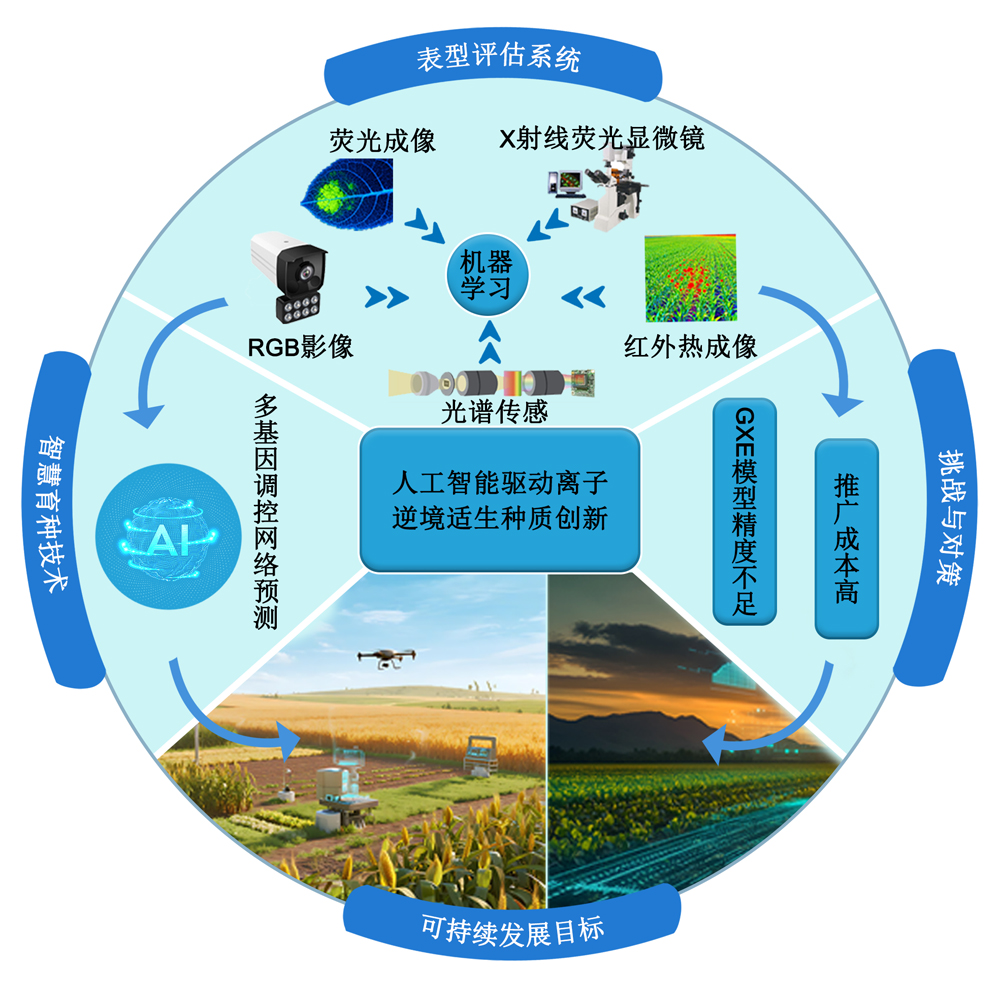
随着全球气候变化与人类活动加剧, 盐碱化与重金属污染等离子逆境导致的耕地退化日益严峻, 威胁粮食安全。人工智能技术的快速发展为离子逆境适生种质创新提供了新范式。本文系统综述了人工智能在离子逆境适生种质创新中的关键进展与应用, 在表型组方面, 多维度表型组采集系统整合RGB成像(Red Green Blue Imaging)、光谱传感、荧光成像、热红外成像与X射线荧光光谱(X-rayFluorescenceSpectrometer, XRF)等技术, 结合机器学习、深度学习与多源数据融合, 实现对离子逆境胁迫表型的早期、精准与无损识别。在智慧育种方面, 人工智能在加速基因挖掘、解析遗传多样性解析、多基因调控网络预测与全基因组选择等方向显著提升育种效率。然而, 当前仍面临数据标准化与共享机制不完善、基因型-环境互作(Genotype-by-Environment Interaction, G×E)模型预测精度有待提升、以及技术推广成本较高等挑战, 制约了技术的规模化应用。展望未来, 随着数据整合能力不断增强, 算法持续优化以及技术普及程度的不断提高, 人工智能有望在退化耕地治理与农业可持续发展中发挥更大作用, 为保障全球粮食安全提供强有力的技术支撑。
闫慧莉
,
秦雅婷
,
周运转
,
许文秀
,
宋晓彦
,
何振艳
. 人工智能在离子逆境适生种质创新中的发展与应用[J]. 植物学报, 2026
, 61(4)
: 588
-597
.
DOI: 10.11983/CBB25177
Global climate change and intensive human activities have led to increasing degradation of arable land due to ionic stress, such as salinization and heavy metal contamination, posing a significant threat to food security. The rapid development of artificial intelligence (AI) technology offers a new approach for germplasm innovation for stress adaptation. This review systematically summarizes key advances and applications of AI in germplasm innovation for ionic stress tolerance. In terms of phenomics, multi-dimensional phenotyping systems integrate technologies including RGB imaging, spectral sensing, fluorescence imaging, thermal infrared imaging, and XRF. These are coupled with machine learning, deep learning, and multi-source data fusion to enable early, accurate, and non-invasive identification of ionic stress responses. In smart breeding, machine learning accelerates gene discovery, while pangenomics elucidates genetic diversity. AI-driven prediction of multi-gene regulatory networks and genomic selection significantly enhance breeding efficiency. However, challenges such as insufficient data standardization and sharing, limited prediction accuracy of genotype-environment interaction (G×E) models, and high technology promotion costs still constrain large-scale application. Future efforts focused on data integration, algorithm optimization, and technology popularization are expected to allow AI to play a greater role in the remediation of degraded farmland and in achieving sustainable agricultural development.
[1]Atieno J,Li Y,Langridge P,Dowling K,Brien C,Berger B,Varshney RK,Sutton T(2017).Exploring genetic variation for salinity tolerance in chickpea using image-based phenotyping.Scientific Reports, 7:1300-.
[2]Awlia M,Alshareef N,Saber N,Korte A,Julkowska MM(2021).Genetic mapping of the early responses to salt stress in Arabidopsis thaliana.The Plant Journal, 107:544-563.
[3]Chaerle L,Straeten DVD(2000).Imaging techniques and the early detection of plant stress.Trends in Plant Science, 5:495-501.
[4]Chen S,Zhang H,Gao S,He K,Yu T,Gao S,Wang J,Li H(2025).Unveiling salt tolerance mechanisms in plants: Integrating the KANMB machine learning model with metabolomic and transcriptomic analysis.Advanced Science, 12:2417560-.
[5]Deng X,Pang H,Fu Y,Zhang A,Zhang J,Chong K(2025).Targeted integrating hyperspectral and metabolomic data with spectral indices and metabolite content models for efficient salt-tolerant phenotype discrimination in Medicago truncatula.Plant Phenomics, 7:100020-.
[6]Deshmukh R,Sonah H,Patil G,Chen W,Prince S,Mutava R,Vuong T,Valliyodan B,Nguyen HT(2014).Integrating omic approaches for abiotic stress tolerance in soybean.Frontiers in Plant Science, 5:244-.
[7]Fu X,Han B,Liu S,Zhou J,Zhang H,Wang H,Zhang H,Ouyang Z(2022).WSVAS: A YOLOv4 -based phenotyping platform for automatically detecting the salt tolerance of wheat based on seed germination vigour.Frontiers in Plant Science, 13:1074360-.
[8]Garriga M,Retamales JB,Romero-Bravo S,Caligari PD,Lobos GA(2014).Chlorophyll,anthocyanin,and gas exchange changes assessed by spectroradiometry in Fragaria chiloensis under salt stress.Journal of Integrative Plant Biology, 56(5):505-515.
[9]Ge H,Ji X,Lu X,Lv M,Jiang Y,Jia Z,Zhang Y(2023).Identification of heavy metal pollutants in wheat by THz spectroscopy and deep support vector machine.Spectrochimica Acta Part A: Molecular and Biomolecular Spectroscopy, 303:123206-.
[10]Gebremedhin A,Li Y,Shunmugam ASK,Sudheesh S,Valipour-Kahrood H,Hayden MJ,Rosewarne GM,Kaur S(2024).Genomic selection for target traits in the Australian lentil breeding program.Frontiers in Plant Science, 14:1284781-.
[11]Hassan,W. M,El-Hendawy,S. E,Refay,Y.,Schmidhalter,U(2017).On the use of spectral reflectance indices to assess agro-morphological traits of wheat plants grown under simulated saline field conditions.Journal of Agronomy and Crop Science, 203:406-428.
[12]Hou D,Jia X,Nriagu J(2025).Global soil pollution by toxic metals threatens agriculture and human health.Science, 388:316-321.
[13]Kurunc A,Tezcan NY,Khan A(2024).Determination of salt stress by plant leaf temperature and thermal imaging in black cumin grown under different salt sources.Communications in Soil Science and Plant Analysis, 56:517-527.
[14]Li J,Yang Z,Zhao Y,Yu K(2024).SERS combined with the SAE-CNN model for estimating apple rootstocks under heavy metal copper stress..Measurement, 224:113911-.
[15]Li J,Zeng H,Huang C,Wu L,Ma J,Zhou B,Ye D,Weng H(2023).Noninvasive detection of salt stress in cotton seedlings by combining multicolor fluorescence–multispectral reflectance imaging with EfficientNet-OB2.Plant Phenomics, 5:125-.
[16]Li X,Liu X,Liu M,Wang C,Xia X(2015).A hyperspectral index sensitive to subtle changes in the canopy chlorophyll content under arsenic stress.International Journal of Applied Earth Observation & Geoinformation, 36:41-53.
[17]Liu JN,Yan L,Chai Z,Liang Q,Dong Y,Wang C,Li X,Li C,Mu Y,Gong A(2025).Pan-genome analyses of 11 Fraxinus species provide insights into salt adaptation in ash trees.Plant communications, 6:101137-.
[18]Liu Z,Jiang Q,Ji Y,Liu R,Liu H,Ya X,Liu Z,Wang Z,Jin X,Yang T(2025).Assessment of salt tolerance in peas using machine learning and multi-sensor data.Plant Stress, 17:100902-.
[19]Lu Y,Nie L,Guo X,Pan T,Chen R,Liu X,Li X,Li T,Liu F(2024).Rapid assessment of heavy metal accumulation capability of Sedum alfredii using hyperspectral imaging and deep learning.Ecotoxicology and Environmental Safety, 282:116704-.
[20]Ma C,Xin M,Feldmann KA,Wang X(2014).Machine learning–based differential network analysis: a study of stress-responsive transcriptomes in Arabidopsis.The Plant Cell, 26:520-537.
[21]Ma Y,Tashpolat N(2023).Current status and development trend of soil salinity monitoring research in China.Sustainability, 15:5874-.
[22]Moghimi A,Yang C,Marchetto PM(2018).Ensemble feature selection for plant phenotyping: a journey from hyperspectral to multispectral imaging.IEEE Access, 6:56870-56884.
[23]Peng Y,Sun J,Cai Z,Shi L,Wu X,Dai C,Xie Y(2025).Copper stress levels classification in oilseed rape using deep residual networks and hyperspectral false-color images.Horticulturae, 11:840-.
[24]Pii Y,Orzes G,Mazzetto F,Sambo P,Cesco S(2024).Advances in viticulture via smart phenotyping: current progress and future directions in tackling soil copper accumulation.Frontiers in Plant Science, 15:1459670-.
[25]Sighicelli M,Guarneri M(2014).Assessing the poplar photochemical response to high zinc concentrations by image processing and statistical approach.Photosynthesis Research, 122(3):315-322.
[26]Sirault XRR,James RA,Furbank RT(2009).A new screening method for osmotic component of salinity tolerance in cereals using infrared thermography.Functional Plant Biology, 36:970-977.
[27]Uygun S,Seddon AE,Azodi CB,Shiu S H(2017).Predictive models of spatial transcriptional response to high salinity.Plant physiology, 174:450-464.
[28]Wei H,Wang X,Zhang Z,Yang L,Zhang Q,Li Y,He H,Chen D,Zhang B,Zheng C(2024).Uncovering key salt-tolerant regulators through a combined eQTL and GWAS analysis using the super pan-genome in rice.National Science Review, 11:43-.
[29]Xu C,Sun L,Zhang LD,Guo ZJ,Wang JC,Zhuang LH,Ma DN,Song LY,Li J,Ding QS(2025).Machine learning based prediction by PlantCdMiner and experimental validation of cadmium-responsive genes in plants.Journal of Hazardous Materials, 494:138582-.
[30]Yang M,Chen S,Huang Z,Gao S,Yu T,Du T,Zhang H,Li X,Liu CM,Chen S(2023).Deep learning-enabled discovery and characterization of HKT genes in Spartina alterniflora.The Plant Journal, 116:690-705.
[31]Yang Z,Li A,Chen J,Dai Z,Su J,Deng C,Ye G,Cheng C,Tang Q,Zhang X(2024).Machine learning phenotyping and GWAS reveal genetic basis of Cd tolerance and absorption in jute.Environmental pollution, 362:124918-.