
基于LA-ICP-MS的文旦柚果实养分原位可视化与半定量分析新方法
福建农林大学资源与环境学院, 根系生物学研究中心, 福州 350000
收稿日期: 2025-06-19
修回日期: 2025-08-12
网络出版日期: 2025-10-22
基金资助
校创基金(No.105-KFB24130A)
Root Biology Center, College of Resources and Environment, Fujian Agriculture and Forestry University, Fuzhou 350002, China
Received date: 2025-06-19
Revised date: 2025-08-12
Online published: 2025-10-22
关键词: 原位可视化; 激光剥蚀-电感耦合等离子体质谱法; 半定量方法; 养分分布
王寒雪 , 陈昊 , 洪佳伟 , 陈玥勤 , 廖红 . 基于LA-ICP-MS的文旦柚果实养分原位可视化与半定量分析新方法[J]. 植物学报, 2026 , 61(5) : 1 -0 . DOI: 10.11983/CBB25113
INTRODUCTION: The distribution and concentration of nutrient elements within fruits directly influence their yield and quality. Conventional analytical methods primarily rely on digestion to quantify nutrient content in different fruit tissues. However, as fruits comprise multiple tissue structures, basic quantification techniques fail to precisely resolve nutrient distribution across these microstructural compartments. Consequently, establishing an in-situ method enabling visualization of spatial nutrient concentration profiles in fruit tissues is imperative.
RATIONALE: Laser Ablation Inductively Coupled Plasma Mass Spectrometry (LA-ICP-MS), as an advanced micro-analytical technique, enables effective visualization of in situ elemental distribution within plant tissues. LA-ICP-MS uses a femtosecond laser (wave-length 343nm) to scan the fruit sample and the standard sample according to the line of the laser beam during the measurement of the femtosecond laser (wave-length 343nm). The burned sample material is sent to the ICP with the carrier gas Ar, and the ionic strength of P31, K39, Ca44, Mg24, Fe57, Mn55, Cu63, Zn66, S34, Al27, Cr52, Mo95, Pb208, Sr88 and Rb85 in different parts of the fruit is detected. Visualize the nutrient distribution between different tissues.
RESULTS: Through LA-ICP-MS analysis, we performed in situ, spatially-resolved and semi-quantitative analysis of nutritional element distributions across distinct tissue structures in pomelo fruit during maturation. Significant tissue-specific heterogeneity was observed in elemental distributions among fruit compartments. Three structures demonstrated consistent nutrient enrichment: cuticle of flavedo, vascular bundle-like structures in albedo, epidermal cells of juice sacs. The concentrations of potassium, nitrogen, calcium, magnesium and phosphorus were higher in the fruit of Wendan pomelo, which were mainly concentrated in the cuticle of flavedo, vascular bundle tissue of albedo and epidermal tissue of juice sac. Among them, the relative average concentration of calcium in the yellow cortex was as high as 516.21 ± 387.40 mg ·L-1, and the relative average concentration of zinc in the cuticle of the yellow cortex was 410.22 ± 279.77 mg ·L-1. The relative concentration of the two in the epidermal cells of the juice sac was the highest, suggesting that calcium and zinc play an important nutritional role in the fruit of Wendan pomelo.
CONCLUSION: This study established a novel LA-ICP-MS methodology for in-situ, visual and semi-quantitative analysis for nutrient distribution in different tissue structures of fruits, was used to establish the spatial relationship of nutrient distribution, which filled the gap in the visualization of fruit nutrient distribution. The relative concentration of different elements in each tissue was analyzed, which provided scientific theory for the subsequent guidance of Wendan pomelo farming measures.
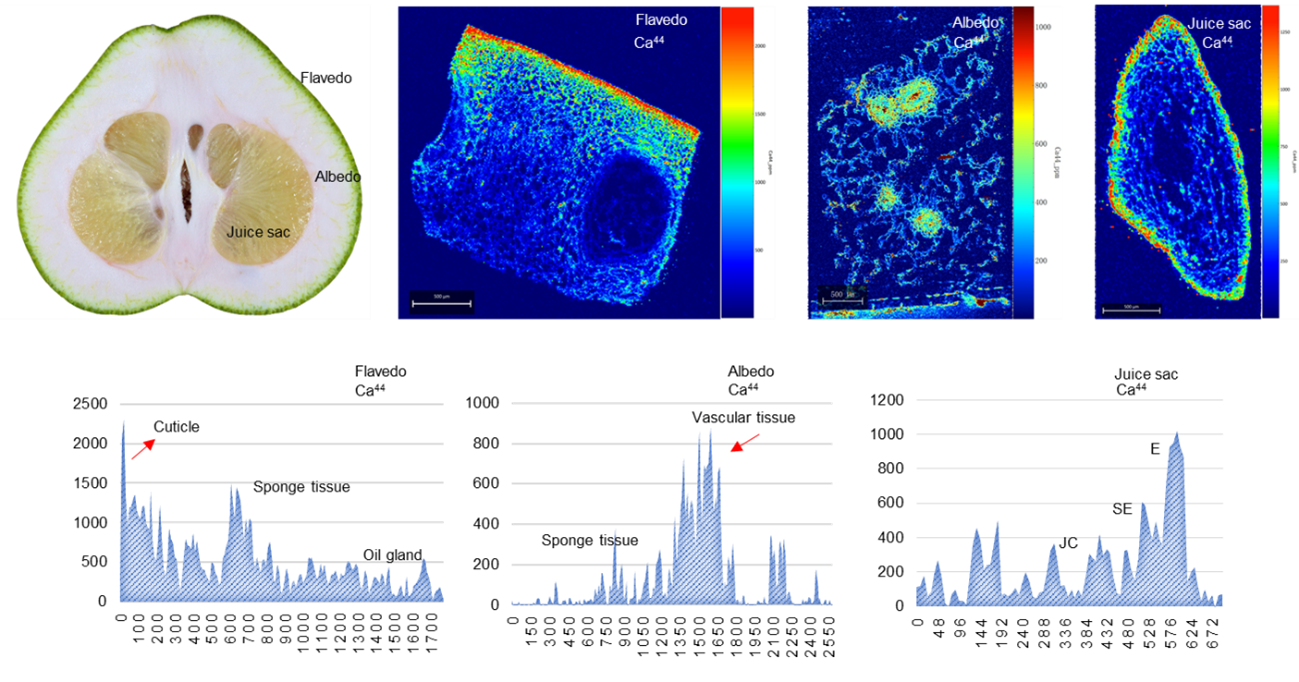
LA-ICP-MS in situ visualization and semi-quantitative calcium concentration in various parts of fruit. The in situ distribution of calcium element in the flavedo, albedo and juice sac and the concentration of tissue structure were analyzed.
/
| 〈 |
|
〉 |

 首页
首页