
WRI1基因在拟南芥幼苗耐热中的功能
收稿日期: 2025-05-13
录用日期: 2025-09-02
网络出版日期: 2025-09-03
基金资助
国家自然科学基金(32200276)
广东省基础与应用基础研究(2025A1515011235)
广东省基础与应用基础研究(2023A1515011841)
Function of WRI1 in Heat Stress of Arabidopsis Seedlings
Received date: 2025-05-13
Accepted date: 2025-09-02
Online published: 2025-09-03
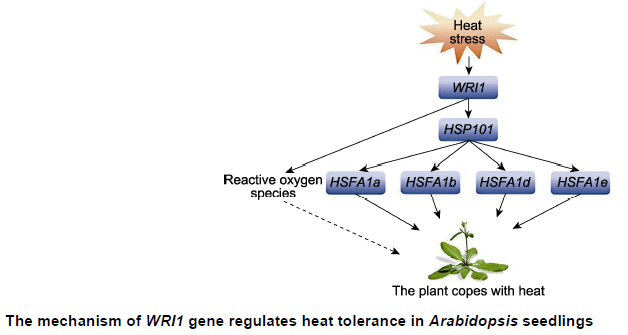
拟南芥 WRI1 ( WRINKLED1)是AP2/EREBP类转录因子基因, 调节糖酵解和脂肪酸生物合成途径之间的碳分配, 在植物生长发育和应激反应中起重要作用。通过构建野生型(WT)、 WRI1突变体( wri1-4)和过表达株系( WRI1-OE), 利用qRT-PCR和表型分析, 发现在热胁迫早期 WRI1显著上调表达, 高温下其过表达株系幼苗存活率较野生型增高且活性氧积累减少, 同时激活热激转录因子HSFA2及其下游 HSP101基因可减轻高温对种子萌发和根生长的抑制作用。研究结果表明, WRI1可增强幼苗耐热性, 主要通过调动核心调控因子 HSF-HSP以及降低活性氧含量减轻氧化损伤。该文揭示了 WRI1基因在高温胁迫下的跨通路调控功能, 为阐明植物响应高温胁迫的分子机制提供了新思路, 为培育耐高温品种提供了重要理论指导。
古旭雅 , 林张曼 , 胡思源 , 李雪宁 , 覃晓琳 , 吴政熹 , 李诺 , 冯铭茵 , 黄瑞华 . WRI1基因在拟南芥幼苗耐热中的功能[J]. 植物学报, 2026 , 61(3) : 428 -436 . DOI: 10.11983/CBB25085
INTRODUCTION: Heat stress severely impairs plant growth and crop productivity. WRINKLED1 (WRI1), an AP2/EREBP-class transcription factor in Arabidopsis thaliana, orchestrates carbon partitioning between glycolysis and fatty acid biosynthesis, playing pivotal roles in development and stress adaptation. Elucidating its molecular function under high-temperature stress is critical for improving thermotolerance in crops. RATIONALE: While WRI1’s metabolic regulatory function has been elucidated, its role in heat response remains unexplored. To decipher the molecular mechanism of WRI1-mediated thermotolerance, we integrated genetic approaches (wild type, wri1-4, and WRI1-OE (overexpression)) with qRT-PCR and phenotyping under controlled heat stress. RESULTS: In this study, histochemical GUS staining of pWRI1::GUS transgenic lines demonstrated constitutive WRI1 expression throughout Arabidopsis seedlings, with significantly enhanced transcription in cotyledons under heat stress (HS) (P <0.05). Prolonged HS induced gradual transcriptional attenuation, though the transcription levels remained elevated than under the optimal temperature (22°C). qRT-PCR confirmed thermo-responsive WRI1 upregulation (peak:1 h HS, 3-fold induction), followed by threshold-dependent decline, indicating acute early-phase responsiveness. Endogenous immunoassays revealed reduced WRI1 protein accumulation under HS, suggesting HS-impaired protein stability or post-translational regulatory mechanisms. Thermotolerance phenotyping of WT, wri1-4, and WRI1-OE lines showed superior HS survival rate in WRI1-OE, with acquired thermotolerance exceeding basal thermotolerance across genotypes, confirming WRI1-mediated positive thermoregulation. The survival rate of WRI1-OE seedlings reached approximately 75%–85%, whereas that of wild type and complementary lines was less than 10%. We found that WRI1-OE reduced reactive oxygen species (ROS) accumulation, where direct transcriptional regulation of HSF/ HSP genes (e.g., HSFA2, HSP101) was excluded by qRT-PCR. Nevertheless, differential gene expression across genotypes indicated WRI1’s auxiliary role in thermotolerance via ROS scavenging and indirect proteostasis maintenance. CONCLUSION: This study proved WRI1 as a master regulator of thermotolerance, functioning through synergistic activation of chaperone networks ( HSFA2-HSPs) and ROS scavenging. The discovery of its cross-pathway coordination mechanism provides novel insights into plant thermal adaptation, and positions WRI1 as a potentially useful target for breeding climate-resilient crops.
Key words: Arabidopsis; WRI1; heat stress; gene expression
|
|
|
|
|
|
|
|
|
|
|
|
|
金龙飞, 周丽霞, 曹红星, 杨耀东 (2022). WRI1调控植物油脂合成的研究进展. 中国油料作物学报 44, 687-698.
|
|
|
|
|
|
|
|
|
|
|
|
齐辉辉, 蔡潇潇, 杨虹伟, 王健美, 刘志斌, 杨毅 (2016). 拟南芥AtHHR3响应热胁迫应答的初步分析. 四川大学学报(自然科学版) 53, 1141-1146.
|
|
|
|
|
|
|
|
|
|
|
|
杨先友, 黄春颖, 吴建峰, 黄有军, 张启香 (2016a). 植物WRI1基因生物信息学分析. 分子植物育种 14, 1140-1151.
|
|
杨先友, 黄有军, 张通, 黄春颖 (2016b). 拟南芥转录激活因子AtWRI1研究进展. 生物技术通报 32(6), 13-18.
|
|
周天军, 陈梓明, 陈晓龙, 左萌, 江洁, 胡帅 (2021). IPCC AR6报告解读: 未来的全球气候——基于情景的预估和近期信息. 气候变化研究进展 17, 652-663.
|
/
| 〈 |
|
〉 |

 首页