研究论文

不同枸杞水培条件下不定根发生的转录组比较分析

  • 杨改儿 1, 2 ,
  • 张璇 1, 2 ,
  • 王嘉栋 1, 2 ,
  • 张波 3 ,
  • 段淋渊 3 ,
  • 李翔 , 1, 2, *
展开
  • 1 宁夏大学 林业与草业学院 , 银川 750021
  • 2 林木资源高效生产全国重点实验室 , 银川 750021
  • 3 宁夏农林科学院 枸杞科学研究所 , 银川 750026
* Author for correspondence. E-mail:

收稿日期: 2025-04-25

  录用日期: 2025-09-02

  网络出版日期: 2025-09-03

基金资助

宁夏重点研发计划 (引才专项)(2024BEH04068)

宁夏自然科学基金(2023AAC05025)

Comparative Analysis of Transcriptome of Adventitious Roots Under Different Hydroponic Conditions of Lycium barbarum

  • Gaier Yang 1, 2 ,
  • Xuan Zhang 1, 2 ,
  • Jiadong Wang 1, 2 ,
  • Bo Zhang 3 ,
  • Linyuan Duan 3 ,
  • Xiang Li , 1, 2, *
Expand
  • 1 College of Forestry and Prataculture, Ningxia University , Yinchuan 750021, China
  • 2 National Key Laboratory for Efficient Production of Forest Resources , Yinchuan 750021, China
  • 3 Lycium barbarum Research Institute of Ningxia Academy of Agriculture and Forestry Sciences , Yinchuan 750026, China

Received date: 2025-04-25

  Accepted date: 2025-09-02

  Online published: 2025-09-03

摘要

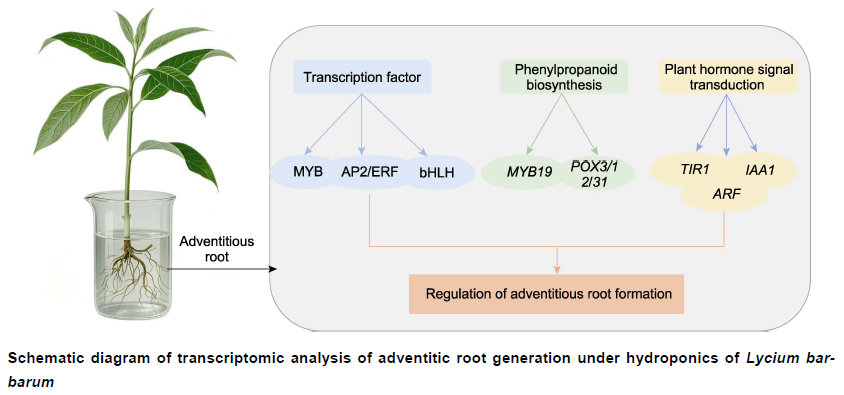
枸杞 ( Lycium barbarum) 是重要的经济林树种, 其扦插繁殖效率与不定根形成密切相关, 但枸杞不定根形成相关分子机制尚不明确, 制约了枸杞的规模化繁育及高效利用。以3种生根能力不同的枸杞品系 (L、M和H) 为材料, 通过水培实验分析其不定根发生过程中的转录水平差异。结果显示, 转录组分析鉴定出6 448个差异表达基因 (DEGs), 其中L-vs-H组DEGs数量最多, 达4 413个, 包括2 583个上调和1 830个下调基因。转录因子分析鉴定出281个转录因子, 以MYB、AP2/ERF和bHLH家族为主, 且表达模式存在差异。GO富集分析发现1 714个DEGs被富集到32个GO条目中, KEGG富集分析表明DEGs主要富集于苯丙烷生物合成和植物激素信号转导通路。其中, MYB19 (Lba07g01820) 是苯丙烷通路中的核心基因, TIR1 (Lba08g00069) 是植物激素信号转导通路中的核心基因, 推测它们在枸杞不定根发生过程中发挥重要作用。此外, 通过qRT-PCR验证了转录组数据的可靠性。该研究解析了枸杞不定根形成的转录调控网络, 初步揭示了枸杞不定根形成的分子机理, 为枸杞及其它木本植物的遗传改良提供了新的视角。
本文引用格式

杨改儿 , 张璇 , 王嘉栋 , 张波 , 段淋渊 , 李翔 . 不同枸杞水培条件下不定根发生的转录组比较分析[J]. 植物学报, 2026 , 61(3) : 462 -474 . DOI: 10.11983/CBB25077

Abstract

INTRODUCTION: Lycium barbarum is an important economic forest tree species, and its cutting propagation efficiency is closely related to the formation of adventitious roots. However, the molecular mechanism of adventitious root formation is not clear, which restricts the large-scale breeding and efficient utilization of Lycium barbarum. RATIONALE: In order to explore the transcriptome differences in adventitious root formation of L. barbarum, three wolfberry genotypes with different root-forming abilities were used as experimental materials. A hydroponic experiment was conducted to analyze the transcriptional differences during adventitious root formation. RESULTS: Transcriptome sequencing identified 6 448 differentially expressed genes (DEGs), with the L-vs-H group having the highest number of DEGs at 4 413, including 2 583 upregulated and 1 830 downregulated genes. A total of 281 transcription factors were identified, mainly from the MYB, AP2/ERF, and bHLH families, with distinct expression patterns. GO enrichment analysis revealed that 1 714 DEGs were enriched in 32 GO terms. KEGG enrichment analysis indicated that DEGs were mainly enriched in the phenylpropanoid biosynthesis and plant hormone signal transduction pathways. Among these, MYB19 (Lba07g01820) is a core gene in the phenylpropanoid pathway, and TIR1 (Lba08g00069) is a core gene in the plant hormone signal transduction pathway. Both genes play crucial roles in adventitious root formation in wolfberry. qRT-PCR validated the reliability of the transcriptome data. CONCLUSION: In this study, the transcriptional regulatory network of adventitious root formation in L. barbarum was analyzed, which provided new insights into the root development mechanism of woody plants, revealed the molecular mechanism of adventitious root formation in L. barbarum, and laid an important theoretical foundation for genetic improvement and efficient breeding of L. barbarum and other woody plants.

CaiKW, ZhangDD, LiX, ZhangQH, JiangLP, LiYX, SongRX, SunSQ, GuoRX, HanR, HuXQ, ZhouXD, PeiXN, ZhaoXY (2023). Exogenous phytohormone application and transcriptome analysis provides insights for adventitious root formation in Taxus cuspidata S. et Z. Plant Growth Regul 100, 33-53.

ChenCJ, ChenH, ZhangY, ThomasHR, FrankMH, HeYH, XiaR (2020). TBtools: an integrative toolkit developed for interactive analyses of big biological data. Mol Plant 13, 1194-1202.

DuttaD, SharmaV, GuriaS, ChakrabortyS, SarveswaranS, HarshavardhanD, RoyP, NandiS, ThakurA, KumarS, SonarSS, KhadkaN, LakshmiM, ShahMNS (2023). Optimizing plant growth and crop productivity through hydroponics technique for sustainable agriculture: a review. Int J Environ Climate Change 13, 933-940.

FuH, WeiX, ChenQ, YongSY, LiuQJ, DangJB, WuD, LiangGL, GuoQG (2023). Comparative transcriptome analysis of molecular mechanisms underlying adventitious root developments in Huangshan Bitter tea (Camellia gymnogyna Chang) under red light quality. Front Plant Sci 14, 1154169.

Hu JX, Chen YX, Yu MF, Zheng BS, Yan DL (2024). Research progress on regulation mechanism of plant adventitious root formation. Mol Plant Breed 22, 6151-6159. (in Chinese)

扈嘉鑫, 陈宇熙, 余敏芬, 郑炳松, 闫道良 (2024). 植物不定根生成的生理及分子调控机制研究进展. 分子植物育种 22, 6151-6159.

JiapaerR, SunYJ, ZhongLZ, ShenY, YeXQ (2013). A review of phytochemical composition and bio—active of Lycium barbarum Fruit (Goji). J Chin Inst Food Sci Technol 13(8), 161-172. (in Chinese)

如克亚·加帕尔, 孙玉敬, 钟烈州, 沈妍, 叶兴乾 (2013). 枸杞植物化学成分及其生物活性的研究进展. 中国食品学报 13(8), 161-172.

KimD, LangmeadB, SalzbergSL (2015). HISAT: a fast spliced aligner with low memory requirements. Nat Methods 12, 357-360.

LakehalA, ChaabouniS, CavelE, LeHir R, RanjanA, RaneshanZ, NovákO, PăcurarDI, PerroneI, JobertF, GutierrezL, BakòL, BelliniC (2019). A molecular framework for the control of adventitious rooting by TIR1/AFB2—Aux/IAA—dependent auxin signaling in Arabidopsis . Mol Plant 12, 1499-1514.

LeeHW, ChoC, PandeySK, ParkY, KimMJ, KimJ (2019). LBD16 and LBD18 acting downstream of ARF7 and ARF19 are involved in adventitious root formation in Arabidopsis. BMC Plant Biol 19, 46.

LiKP (2014). Study on Rooting of Hybrid Larch In Vitro and Analysis on Clone and Expression Pattern of AP2—like Genes Retaled to Rooting Trait . Master’s thesis. Beijing: Chinese Academy of Forestry. pp. 1-134. (in Chinese)

李魁鹏 (2014). 杂种落叶松组培不定根诱导及生根相关AP2—like基因的克隆与表达研究. 硕士论文. 北京: 中国林业科学研究院. pp. 1-134.

LiuR, WenSS, SunTT, WangR, ZuoWT, YangT, WangC, HuJJ, LuMZ, WangLQ (2022). PagWOX11/12a positively regulates the PagSAUR36 gene that enhances adventitious root development in poplar. J Exp Bot 73, 7298-7311.

LoveMI, HuberW, AndersS (2014). Moderated estimation of fold change and dispersion for RNA—seq data with DESeq2. Genome Biol 15, 550.

Rivas, FrieroI, AlarcónMV, SalgueroJ (2022). Auxin—cytokinin balance shapes maize root architecture by controlling primary root elongation and lateral root development. Front Plant Sci 13, 836592.

ShannonP, MarkielA, OzierO, BaligaNS, WangJT, RamageD, AminN, SchwikowskiB, IdekerT (2003). Cytoscape: a software environment for integrated models of biomolecular interaction networks. Genome Res 13, 2498-2504.

ShiX (2020). Transcription Factor HY5 Regulates the Formation of Adventitious Roots and Callus and Shoot Regeneration in Arabidopsis thaliana. Master’s thesis. Xi’an: Shaanxi Normal University. pp. 1-91. (in Chinese)

师雄 (2020). 转录因子HY5调控拟南芥不定根和愈伤组织形成以及芽再生的研究. 硕士论文. 西安: 陕西师范大学. pp. 1-91.

ShuWB, ZhouHJ, JiangC, ZhaoST, WangLQ, LiQZ, YangZQ, GrooverA, LuMZ (2019). The auxin receptor TIR1 homolog (PagFBL 1) regulates adventitious rooting through interactions with Aux/IAA28 in Populus. Plant Biotechnol J 17, 338-349.

SongXB, HuangRM, LiuH, ZhangJP, ChangYY, PeiD (2024). Transcriptome profiling of indole—3—butyric acid—induced adventitious root formation in softwood cuttings of walnut. Hortic Plant J 10, 1336-1348.

Sun XL, Yang CT, Hu YN, Zou XH (2021). Rooting mechanism of plant cuttings: a review. J Agric 11(10), 33-40. (in Chinese)

孙雪莲, 杨楚童, 胡亚楠, 邹显花 (2021). 植物扦插生根机理的研究进展. 农学学报 11(10), 33-40.

WangHM, BaG, UwamunguJY, MaWJ, YangLN (2024). Transcription factor MdPLT1 involved adventitious root initiation in apple rootstocks. Horticulturae 10, 64.

Wang JD, Zhao JH, Ma XM, Yang GE, Duan LY, Yao WK, Yin X, Li X (2024). Comparative analysis of rooting ability of different Lycium resources under cutting propagation and hydroponic culture. Non—wood For Res 42, 140-149. (in Chinese)

王嘉栋, 赵佳慧, 马西梅, 杨改儿, 段淋渊, 姚文孔, 尹晓, 李翔 (2024). 不同枸杞扦插及水培生根能力比较分析. 经济林研究 42, 140-149.

Wang YX, Li JY, Hu TT (2024). Summary of the main active ingredients and pharmacological effects of fructus lycii. Guangzhou Chem Ind 52(24), 1-4. (in Chinese)

王雨心, 李金洋, 胡婷婷 (2024). 枸杞子化学成分和药理作用研究进展. 广州化工 52(24), 1-4.

WeiSJ (2024). Transcriptome Dynamics of Adventitious Root Development from Stem Cuttings in Citrus. Master’s thesis. Wuhan: Huazhong Agricultural University. pp. 1-71. (in Chinese)

魏斯佳 (2024). 柑橘不定根发生过程的基因转录动态与关键基因挖掘. 硕士论文. 武汉: 华中农业大学. pp. 1-71.

Wu WQ, Hu ZJ, Shen SY, Zhang GF, Lin JX, Zhang X (2026). Research progress on the hormonal regulation related to adventitious root regeneration and cuttings rooting in plants. Bull Bot Res 46, 13-24. (in Chinese)

吴卫倩, 胡子建, 沈诗雅, 张贵芳, 林金星, 张曦 (2026). 植物不定根再生与扦插生根相关激素调控研究进展. 植物研究 46, 13-24.

XuZH, ZhangXS, SuYH, HuYX, XuL, WangJW (2019). Plant cell totipotency and regeneration. Sci Sin Vitae 49, 1282-1300. (in Chinese)

许智宏, 张宪省, 苏英华, 胡玉欣, 徐麟, 王佳伟 (2019). 植物细胞全能性和再生. 中国科学: 生命科学 49, 1282-1300.

Yuan JL, Li Y, Luo YW, Xuan YH, He NJ (2025). Evaluation of cutting growth and rooting potentials of different mulberry varieties. J Southwest Univ (Nat Sci Edn) 47(2), 61-69. (in Chinese)

袁姜莲, 李炎, 罗义维, 轩亚辉, 何宁佳 (2025). 不同桑树品种扦插生长情况及其生根能力评价. 西南大学学报 (自然科学版) 47(2), 61-69.

Zhang PD, YE, Zhang RX, Wang H, JH (2025). The effect of exogenous hormones on rooting and physiological—biochemical characteristics of softwood cuttings from Elaeagnus angustifolia. J Northeast For Univ 53(4), 79-87. (in Chinese)

张鹏迪, 吕艳娥, 张仁雪, 王慧, 吕晋慧 (2025). 外源激素对沙枣嫩枝扦插生根及生理生化的影响. 东北林业大学学报 53(4), 79-87.

ZhangQQ, ShiMR, TangF, SuN, JinFY, PanYN, ChuLW, LuMZ, ShuWB, LiJC (2023). Transcriptome analysis reveals the hormone signaling coexpression pathways involved in adventitious root formation in Populus. Forests 14, 1436.

ZhangYL, LinX, WuY, LiMJ, ZhangSJ, LuM, RaoYC, WangYX (2020). Research progress on genetics and breeding of rice roots. Chin Bull Bot 55, 382-393. (in Chinese with English abstract)

章怡兰, 林雪, 吴仪, 李梦佳, 张晟婕, 路梅, 饶玉春, 王跃星 (2020). 水稻根系遗传育种研究进展. 植物学报 55, 382-393.

ZhaoK, FengR, MandaT, LiuS, ZhengR, YangLM (2025). Genomic survey and characterization of 14—3—3 genes in Lycium barbarum L. and its expression patterns responding to infection of Fusarium solani. Trop Plant Biol 18, 34.

ZhaoM, LiuK, WangY, HuQ, DiDL, PeiD, LuB (2024). Transcriptome analysis on formation of adventitious root during olive horizontal press seedling. J West China For Sci 53(3), 68-77. (in Chinese)

赵敏, 刘坤, 王毅, 胡青, 邸多隆, 裴栋, 陆斌 (2024). 油橄榄压条不定根发生的转录组分析. 西部林业科学 53(3), 68-77.

ZhaoMQ, LeiYJ, WuL, QiHR, SongZH, XuM (2024). The miR159a—PeMYB33 module regulates poplar adventitious rooting through the abscisic acid signal pathway. Plant J 118, 879-891.

文章导航

/
