
新疆春小麦品种加代模式和遗传转化效率探究
收稿日期: 2025-05-06
修回日期: 2025-06-07
网络出版日期: 2025-07-21
基金资助
小麦种业创新工程(No.K3031222159)
Exploration of Rapid Generation Advancement Models and Genetic Transformation Efficiency in Xinjiang Spring Wheat Varieties
Received date: 2025-05-06
Revised date: 2025-06-07
Online published: 2025-07-21
邱四春 , 康禧 , 张舒琪 , 孙羽晨 , 刘世岩 , 史雪 , 许盛宝 . 新疆春小麦品种加代模式和遗传转化效率探究[J]. 植物学报, 2026 , 61(2) : 291 -299 . DOI: 10.11983/CBB25083
INTRODUCTION: Global climate change and soil degradation have posed new challenges to the breeding efficiency of wheat (Triticum aestivum). Traditional breeding cycles are lengthy and inefficient, making it difficult to meet the ever-growing demand for food. As a major high-quality wheat producing region in China, Xinjiang urgently needs to establish a rapid generation-advancement system and an efficient genetic transformation platform tailored to its local cultivars, in order to shorten breeding cycles and expand the range of transgenic recipient materials.
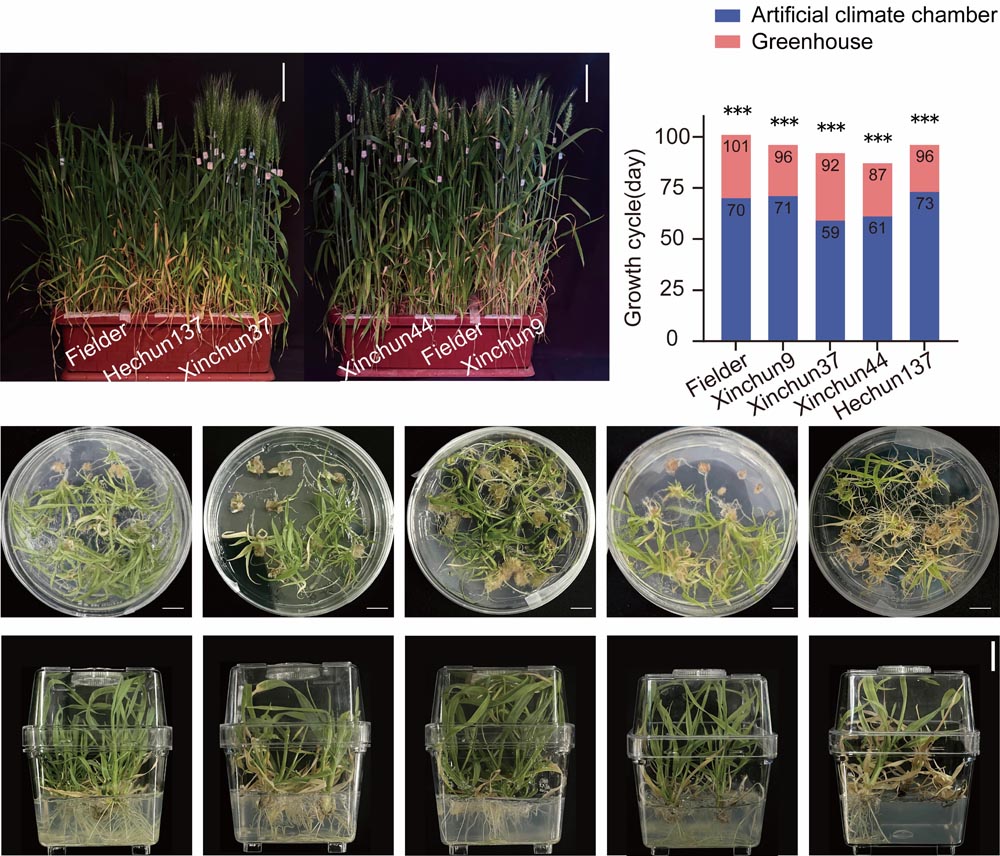
RATIONALE: Compared to conventional greenhouse conditions, all five materials showed a significant reduction in generation time under artificial climate chamber conditions. XinChun 37 exhibited the greatest reduction, shortening its lifecycle from 92 days to 59 days; In Agrobacterium-mediated embryo transformation assays, XinChun 37 achieved a transformation efficiency of 23.30%, outperforming the other three Xinjiang cultivars but remaining lower than the Fielder control. XinChun 9, XinChun 44, and HeChun 137 also demonstrated measurable transformation efficiencies.
RESULTS: Under artificial climate chamber conditions compared to conventional greenhouse conditions, all five materials showed a significant reduction in generation time. XinChun 37 exhibited the greatest reduction, shortening its lifecycle from 92 days to 59 days; In Agrobacterium-mediated embryo transformation assays, XinChun 37 achieved a transformation efficiency of 23.30%, outperforming the other three Xinjiang cultivars but remaining lower than the Fielder control. XinChun 9, XinChun 44, and HeChun 137 also demonstrated measurable transformation efficiencies.
CONCLUSION: This study successfully established a novel rapid generation-advancement system for the main wheat cultivars of Xinjiang and, for the first time, compared their embryonic genetic transformation efficiencies. These findings will greatly shorten breeding cycles and provide key technological support for expanding the selection of transgenic recipient materials, thereby contributing to germplasm innovation and food-security strategies in Xinjiang and beyond.

The effects of speed breeding on agronomic traits of different spring wheat varieties. Under artificial climate chamber rapid-generation conditions, wheat grew well with normal fertility, all lines showed significantly shortened growth cycles and reduced spike length, while the number of effective tillers increased markedly.
/
| 〈 |
|
〉 |

 首页
首页