技术方法

MicroTom番茄非组培快速遗传转化方法的建立

  • 王伟坤 1 ,
  • 傅雯倩 1 ,
  • 洪秋梅 1 ,
  • 郑杨 1 ,
  • 于嘉慧 1 ,
  • 王艳 1 ,
  • 刘良淼 1 ,
  • 杨莉 1, 2 ,
  • 王长春 , 1, 2, * ,
  • 郭卫东 , 1, 2, *
展开
  • 1 浙江师范大学 生命科学学院 , 金华 321004
  • 2 金华市特色经济植物生物技术重点实验室 , 金华 321004
* 王长春, 浙江师范大学生命科学学院副教授, 硕士生导师。主要从事番茄与水稻抗逆分子机制与作物栽培技术研究。

收稿日期: 2025-04-08

  录用日期: 2025-07-01

  网络出版日期: 2025-07-02

基金资助

国家自然科学基金(32470174)

浙江省农业新品种选育重大科技专项(2021C02066-9)

A Rapid In Planta Genetic Transformation System for MicroTom Tomato

  • Weikun Wang 1 ,
  • Wenqian Fu 1 ,
  • Qiumei Hong 1 ,
  • Yang Zheng 1 ,
  • Jiahui Yu 1 ,
  • Yan Wang 1 ,
  • Liangmiao Liu 1 ,
  • Li Yang 1, 2 ,
  • Changchun Wang , 1, 2, * ,
  • Weidong Guo , 1, 2, *
Expand
  • 1 College of Life Sciences, Zhejiang Normal University , Jinhua 321004, China
  • 2 Key Laboratory of Biotechnology on Specialty Economic Plants of Jinhua , Jinhua 321004, China

Received date: 2025-04-08

  Accepted date: 2025-07-01

  Online published: 2025-07-02

摘要

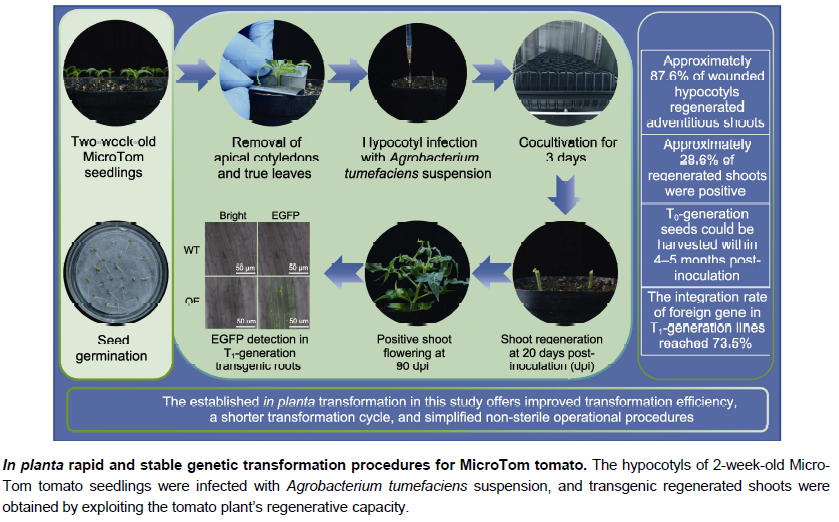
MicroTom番茄( Solanum lycopersicum ‘MicroTom’)是一种矮化模式植物, 因其具有较短的生命周期和清晰的遗传背景而广泛用于植物基因功能研究。传统基于组培的MicroTom番茄遗传转化体系存在效率低、转化周期长及操作复杂等缺陷, 限制了该体系的应用。该研究以2周龄MicroTom实生苗为材料, 在切除顶端子叶与真叶后, 用根癌农杆菌( Agrobacterium tumefaciens)菌液浸润下胚轴切口并诱导再生芽, 成功构建了一套高效的MicroTom番茄非组培遗传转化体系。结果显示, 切口处再生芽阳性率为28.6%, 4–5个月即可收获T 0代番茄种子, T 1代植株中外源基因表达比例达73.5%。与传统组培遗传转化体系相比, MicroTom番茄非组培转化体系转化效率显著提高, 转化周期缩短且操作流程简单, 为番茄果实性状基因功能解析提供了高效的技术平台, 对加快番茄分子育种进程具有重要意义。
本文引用格式

王伟坤 , 傅雯倩 , 洪秋梅 , 郑杨 , 于嘉慧 , 王艳 , 刘良淼 , 杨莉 , 王长春 , 郭卫东 . MicroTom番茄非组培快速遗传转化方法的建立[J]. 植物学报, 2026 , 61(3) : 475 -484 . DOI: 10.11983/CBB25061

Abstract

INTRODUCTION: Genetic transformation, combined with genome editing strategies, has provided essential insights into plant biology and revolutionized crop improvement. MicroTom ( Solanum lycopersicum ‘MicroTom’) is widely used for functional characterization due to its short life cycle and clear genetic background. However, traditional tissue culture-dependent genetic transformation systems for MicroTom are constrained by low efficiency, long durations, and highly trained individuals. Therefore, developing a rapid and efficient tissue culture-independent genetic transformation system is necessary. RATIONALE: Agrobacterium-mediated transformation is the most widely used method for gene transfer in plants. During this process, wounded plant cells secrete phenolic compounds that induce Agrobacterium cells to transfer and integrate foreign DNA into plant chromosomes. In this study, we established a novel transformation protocol using two-week-old MicroTom seedlings as recipients. After removing the apical cotyledons and true leaves, the wounded hypocotyls were directly inoculated with an A. tumefaciens suspension. Based on the somatic cell reprogramming mechanism triggered by wounding signaling, the wound hypocotyls formed calli and regenerated adventitious shoots, accompanied by the integration of foreign DNA. RESULTS: Two-week-old seedlings with hypocotyl diameters exceeding 1.5 mm were optimal for Agrobacterium infection. After a 2-day preculture in darkness, the hypocotyls were infected with A. tumefaciens suspension (OD 600=0.6) for 10 min and then cocultured in darkness at 90% relative humidity for 3 d. Callus differentiation was observed at the hypocotyl ends at 10 days post-inoculation (dpi), and adventitious shoots regenerated at 20 dpi. Mature T 0-generation seeds could be harvested within 4–5 months post-inoculation. Approximately 87.6% of the wounded hypocotyls regenerated adventitious shoots at 20 dpi, and PCR analysis confirmed that 28.6% of the regenerated shoots contained the foreign gene. Through antibiotic screening combined with an EGFP reporter system, the stable expression rate of the foreign gene in T 1-generation lines reached 73.5%. CONCLUSION: Compared to conventional tissue culture-dependent systems, the established in planta transformation in this study offers improved transformation efficiency, a shorter transformation cycle, and simplified nonsterile operational procedures. This system provides a robust platform for functional genomics studies and significantly lowers technical barriers in tomato molecular breeding.

AhmedS, WanAzizan WAS, AkhondAY, JuraimiAS, IsmailSI, AhmedR, MdHatta MA (2023). Optimization of in vitro regeneration protocol of tomato cv. MT1 for genetic transformation. Horticulturae 9, 800.

AnjanappaRB, GruissemW (2021). Current progress and challenges in crop genetic transformation. J Plant Physiol 261, 153411.

AriasGD, UribeF (2025). Agrobacterium tumefaciens—mediated stable cotyledon transformation of Solanum lycopersicum var. Micro—Tom. In: Klein CS, ed. Agrobacterium: Methods and Protocols. New York: Humana. pp. 107-119.

Bailey—SerresJ, ParkerJE, AinsworthEA, OldroydGED, SchroederJI (2019). Genetic strategies for improving crop yields. Nature 575, 109-118.

BartonKA, BinnsAN, MatzkeAJM, ChiltonMD (1983). Regeneration of intact tobacco plants containing full length copies of genetically engineered T—DNA, and transmission of T—DNA to R1 progeny. Cell 32, 1033-1043.

BelangerJG, CopleyTR, Hoyos—VillegasV, CharronJB, O’DonoughueL (2024). A comprehensive review of in planta stable transformation strategies. Plant Methods 20, 79.

Cao XM , Bao Y , Zhang YX , Li RJ , Su JX , Zhang W (2025). Tissue culture, rapid propagation and efficient transient expression systems of Rosa multiflora. Chin Bull Bot 60, 235-245. (in Chinese with English abstract)

曹雪敏, 包颖, 张悦新, 李瑞杰, 苏健馨, 张蔚 (2025). 野蔷薇组培快繁和高效瞬时表达体系的建立. 植物学报 60, 235-245.

Chu P, Agapito—Tenfen SZ (2022). Unintended genomic outcomes in current and next generation GM techniques: a systematic review. Plants (Basel) 11, 2997.

Cruz—Mendívil A, Rivera—López J, Germán—Báez LJ, López—Meyer M, Hernández—Verdugo S, Lopez—Valenzuela JA, Reyes—Moreno C, Valdez—Ortiz A (2011). A simple and efficient protocol for plant regeneration and genetic transformation of tomato cv. Micro—Tom from leaf explants. HortScience 46, 1655-1660.

DanYH, FeiZJ, RothanC (2007). MicroTom—a new model system for plant genomics. Genes Genom 1, 167-179.

DanYH, YanH, MunyikwaT, DongJ, ZhangYL, ArmstrongCL (2006). MicroTom—a high—throughput model transformation system for functional genomics. Plant Cell Rep 25, 432-441.

Fan B , Ren M , Wang YF , Dang FF , Chen GL , Cheng GT , Yang JY , Sun HR (2025). Functions of SlWRKY45 in response to low—temperature and drought stress in tomato. Chin Bull Bot 60, 186-203. (in Chinese with English abstract)

樊蓓, 任敏, 王延峰, 党峰峰, 陈国梁, 程国亭, 杨金雨, 孙会茹 (2025). 番茄SlWRKY45转录因子在响应低温和干旱胁迫中的功能. 植物学报 60, 186-203.

Guo M, Zhang YL, Meng ZJ, Jiang J (2012). Optimization of factors affecting Agrobacterium—mediated transformation of Micro—Tom tomatoes. Genet Mol Res 11, 661-671.

Hu DL , Sun YW (2024). Advances in virus—mediated genome editing technology in plants. Chin Bull Bot 59, 452-462. (in Chinese with English abstract)

胡丹玲, 孙永伟 (2024). 病毒介导的植物基因组编辑技术研究进展. 植物学报 59, 452-462.

KhuongTTH, CrétéP, RobagliaC, CaffarriS (2013). Optimisation of tomato Micro—Tom regeneration and selection on glufosinate/Basta and dependency of gene silencing on transgene copy number. Plant Cell Rep 32, 1441-1454.

Li J , Li Y , Liu DH (2011). Alternative methods of plant genetic transformation and recent advances. Biotechnol Bull (7), 31—36, 45. (in Chinese)

李君, 李岩, 刘德虎 (2011). 植物遗传转化的替代方法及研究进展. 生物技术通报 (7), 31-36, 45.

LiY, ChenY, ZhouL, YouSJ, DengH, ChenY, AlseekhS, YuanY, FuR, ZhangZX, SuD, FernieAR, BouzayenM, MaT, LiuMC, ZhangY (2020). MicroTom metabolic network: rewiring tomato metabolic regulatory network throughout the growth cycle. Mol Plant 13, 1203-1218.

Liu XH , Zhang LL , Zhu CQ , Chen KS , Xu CJ (2008). Mechanisms for miniature dwarf characteristics of Micro—Tom tomato and its application in plant functional genomics studies. Hereditas 30, 1257-1264. (in Chinese)

刘小花, 张岚岚, 朱长青, 陈昆松, 徐昌杰 (2008). Micro—Tom番茄矮化微型机制及其在植物功能基因组学研究中的应用. 遗传 30, 1257-1264.

Livak KJ, Schmittgen TD (2001). Analysis of relative gene expression data using real—time quantitative PCR and the 2 —∆∆CT method . Methods 25, 402-408.

LuJH, LiSS, DengS, WangMG, WuYH, LiM, DongJS, LuSH, SuCL, LiGF, LangZB, ZhuJK (2024). A method of genetic transformation and gene editing of succulents without tissue culture. Plant Biotechnol J 22, 1981-1988.

Lu Y, Zhu HL (2022). The regulation of nutrient and flavor metabolism in tomato fruit. Veg Res 2, 5.

McCormickS, NiedermeyerJ, FryJ, BarnasonA, HorschR, FraleyR (1986). Leaf disc transformation of cultivated tomato (L. esculentum) using Agrobacterium tumefaciens. Plant Cell Rep 5, 81-84.

Mei GG, Chen A, Wang YR, Li SQ, Wu MY, Hu YL, Liu X, Hou XL (2024). A simple and efficient in planta transformation method based on the active regeneration capacity of plants. Plant Commun 5, 100822.

PhillipsRL, KaepplerSM, OlhoftP (1994). Genetic instability of plant tissue cultures: breakdown of normal controls. Proc Natl Acad Sci USA 91, 5222-5226.

Sun HJ, Uchii S, Watanabe S, Ezura H (2006). A highly efficient transformation protocol for Micro—Tom, a model cultivar for tomato functional genomics. Plant Cell Physiol 47, 426-431.

Tóth M, Tóth ZG, Fekete S, Szabo Z, Tóth Z (2022). Improved and highly efficient Agrobacterium rhizogenes—mediated genetic transformation protocol: efficient tools for functional analysis of root—specific resistance genes for Solanum lycopersicum cv. Micro—Tom. Sustainability 14, 6525.

Wu XY, Zhang Y, Jiang X, Ma TS, Guo YT, Wu XX, Guo YS, Cheng XF (2024). Considerations in engineering viral vectors for genome editing in plants. Virology 589, 109922.

Xiong FQ , Liu JX , Liu J , He LQ , Jiang J , Tang XM , Huang ZP , Wu HN , Zhong RC , Han ZQ , Tang RH (2019). Comparative analysis and application of five improved CTAB extraction methods for peanut DNA. Mol Plant Breed 17, 2207-2216. (in Chinese)

熊发前, 刘俊仙, 刘菁, 贺梁琼, 蒋菁, 唐秀梅, 黄志鹏, 吴海宁, 钟瑞春, 韩柱强, 唐荣华 (2019). 花生DNA的五种改良CTAB提取方法的比较分析及其应用. 分子植物育种 17, 2207-2216.

XueJY, FanHY, ZengZ, ZhouYH, HuSY, LiSX, ChengYJ, MengXR, ChenF, ShaoZQ, vande Peer Y (2023). Comprehensive regulatory networks for tomato organ development based on the genome and RNAome of MicroTom tomato. Hortic Res 10, uhad147.

YangL, WangCC, WangLH, XuCJ, ChenKS (2013). An efficient multiplex PCR assay for early detection of Agrobacterium tumefaciens in transgenic plant materials. Turk J Agric For 37, 157-162.

Yang WT, Zhai HW, Wu FM, Deng L, Chao Y, Meng XW, Chen Q, Liu CH, Bie XM, Sun CL, Yu Y, Zhang XF, Zhang XY, Chang ZQ, Xue M, Zhao YJ, Meng XB, Li BS, Zhang XS, Zhang DJ, Zhao XY, Gao CX, Li JY, Li CY (2024). Peptide REF1 is a local wound signal promoting. Cell 187, 3024-3038.

YasmeenA, MirzaB, InayatullahS, SafdarN, JamilM, AliS, FayyazChoudhry M (2009). In planta transformation of tomato. Plant Mol Biol Rep 27, 20-28.

Yu KD , Ye MJ , Chen WR , Zhu KL , Zhang CJ , Guo WD (2016). Methods for RNA isolation from blueberry tissues. J Zhejiang Norm Univ (Nat Sci) 39, 60-64. (in Chinese)

余柯达, 叶美娟, 陈文荣, 朱凯丽, 张常晶, 郭卫东 (2016). 蓝莓组织RNA提取方法的研究. 浙江师范大学学报(自然科学版) 39, 60-64.

Zhang QZ , Han TF (2004). Non—tissue culture transformation of plants. Mol Plant Breed 2, 85-91. (in Chinese)

张庆祝, 韩天富 (2004). 植物非组培遗传转化方法研究的进展. 分子植物育种 2, 85-91.

Zheng LF (2020). Establishment of Genetic Transformation System of CmCs2, CmAco3 Gene Based on Micro—Tom Tomato (Lycopersicon esculentum) Regeneration System. Master’s thesis. Fuzhou: Fujian Agriculture and Forestry University. pp. 32-33. (in Chinese)

郑立峰 (2020). 基于番茄高效再生体系的柚Cs2、Aco3基因转化体系的建立. 硕士论文. 福州: 福建农林大学. pp. 32-33.

文章导航

/
