
菠菜AT-hook基因家族鉴定与表达谱分析
收稿日期: 2024-07-30
录用日期: 2024-12-26
网络出版日期: 2024-12-27
基金资助
上海市科技兴农项目(2022-02-08-00-12-F01116)
Identification of the Spinach AT-hook Gene Family and Analysis of Expression Profiles
Received date: 2024-07-30
Accepted date: 2024-12-26
Online published: 2024-12-27
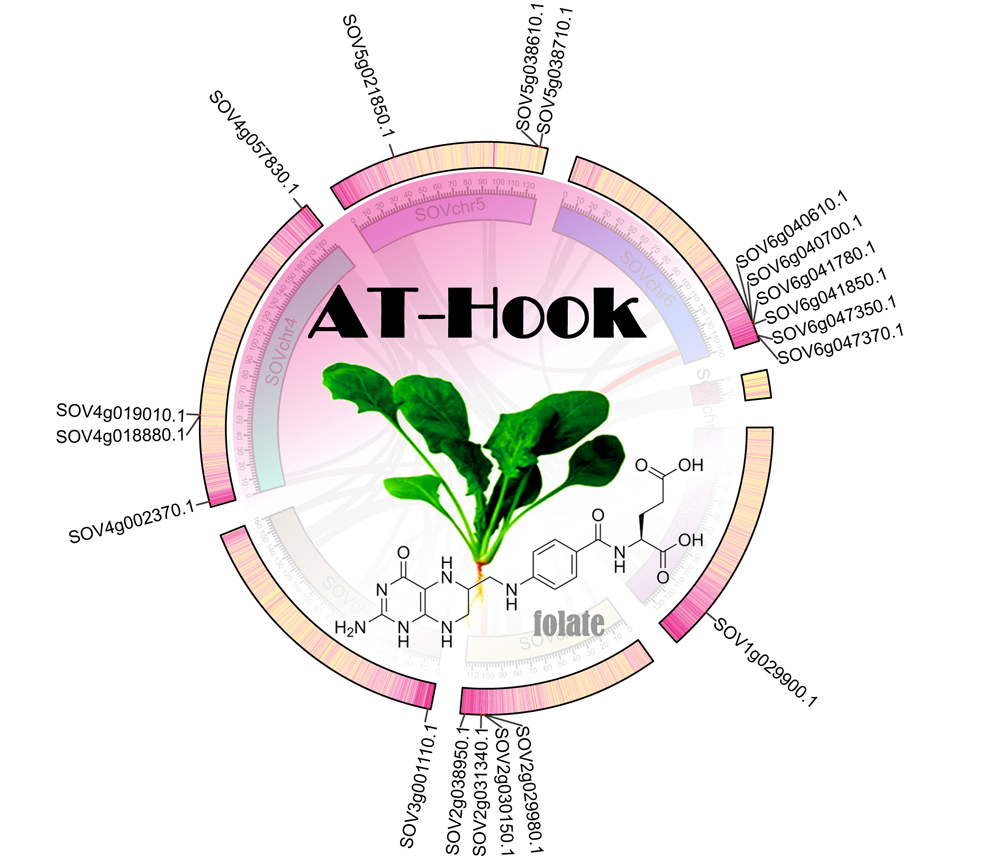
关键词: 菠菜; AT-hook基因家族; 生物信息学; 水杨酸
杨莉 , 曲茜彤 , 陈子航 , 邹婷婷 , 王全华 , 王小丽 . 菠菜AT-hook基因家族鉴定与表达谱分析[J]. 植物学报, 2025 , 60(3) : 377 -392 . DOI: 10.11983/CBB24117
INTRODUCTION: The AT-hook motif nuclear localized (AHL) gene family is a highly conserved transcription factors involved in plant growth, development, and stress responses, but their roles in spinach are still unknown.
RATIONALE:To reveal the basic characteristics of the AHL family in spinach, members of the spinach SoAHLfamily were identified at the whole-genome level, and their physicochemical properties, gene structure, conserved motifs, promoter elements, and salicylic acid-responsive expression profiles were analyzed in this study.
RESULTS: The results revealed 19 SoAHL family members in the spinach genome, which were unevenly distributed across six chromosomes. These SoAHL members can be classified into three branches, with 10 members in subfamily I and 9 members in subfamily II. The sequence composition of PPC and AT-hook conserved motifs varies among subfamilies; most of the SoAHL genes are located in the nucleus, cytoplasm, and mitochondrion. Members of subfamily I of SoAHL have no introns, whereas members of subfamily II contain 4-5 introns. The varying numbers of cis-acting elements relate to phytohormones and abiotic stress responses were distributed upstream of the promoters of the SoAHL members. The SoAHL genes can be expressed in roots, leaves, and petioles, with most genes expressed at relatively high levels in roots. The expression of two SoAHL genes (SOV6g041850.1 and SOV2g038950.1) was significantly induced by salicylic acid treatment. The expression profiles and salicylic acid-induced expression levels of SOV2g031340.1 and SOV4g018880.1 were highly correlated with the folic acid content, which may play a role in the spinach response to the salicylic acid signaling pathway. The transient overexpression of SOV4g018880.1 increased the folate content of spinach leaves by 1.75 times.
CONCLUSION: The results from the sequence characteristics, expression profiles and exogenous salicylic acid treatment revealed that the SoAHLs had potential functional diversity and that specific members may have positive effects on spinach folate accumulation. Our results will lay the foundation for further resolving the function of spinach AT-hook genes.
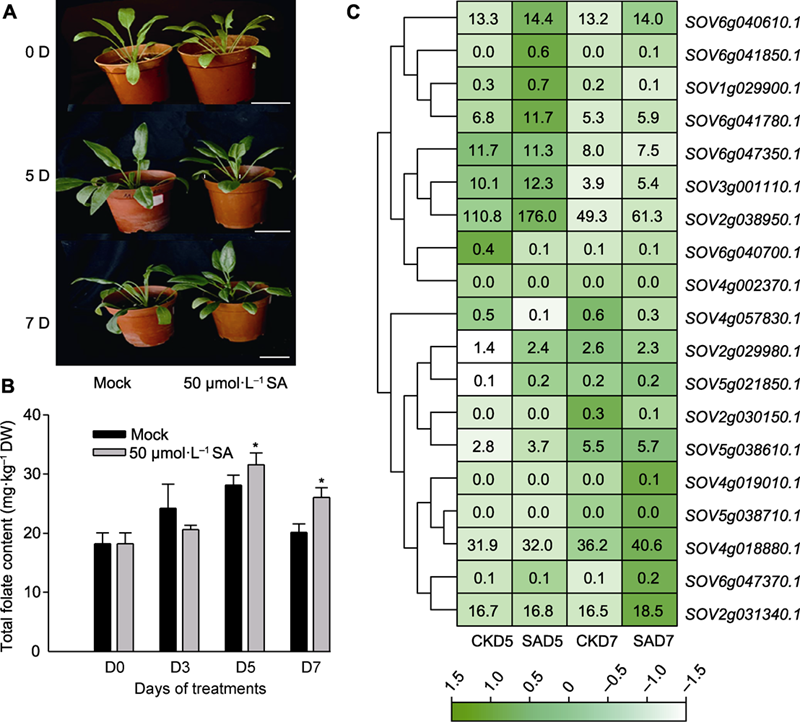
Phenotype (A), total folate content (B) and expression analysis of SoAHL (C) under 50 μmol∙L-1 salicylic acid (SA) treatment for 5 days (D5) and 7 days (D7). CK: Control
Key words: spinach; AT-hook gene family; bioinformatics; salicylic acid
| [1] | Bishop EH, Kumar R, Luo F, Saski C, Sekhon RS (2020). Genome-wide identification, expression profiling, and network analysis of AT-hook gene family in maize. Genomics 112, 1233-1244. |
| [2] | Cai GQ, Kim SC, Li JW, Zhou YM, Wang XM (2020). Transcriptional regulation of lipid catabolism during seedling establishment. Mol Plant 13, 984-1000. |
| [3] | Chen CJ, Wu Y, Li JW, Wang X, Zeng ZH, Xu J, Liu YL, Feng JT, Chen H, He YH, Xia R (2023). TBtools-II: a "one for all, all for one" bioinformatics platform for biological big-data mining. Mol Plant 16, 1733-1742. |
| [4] | Delaney SK, Orford SJ, Martin-Harris M, Timmis JN (2007). The fiber specificity of the cotton FSltp4 gene promoter is regulated by an AT-rich promoter region and the AT-hook transcription factor GhAT1. Plant Cell Physiol 48, 1426-1437. |
| [5] | Ding LX, Li T, Li ZL, Xu XW, Li Y, Wang HM, Wang YF, Ma SM, Li ZX (2016). Genome-wide identification and expression analysis in oxidative stress of AT-hook gene family in tomato. J Plant Genet Resour 17, 303-315. (in Chinese) |
| 丁丽雪, 李涛, 李植良, 徐小万, 李颖, 王恒明, 王永飞, 马三梅, 黎振兴 (2016). 番茄AT-hook基因家族的鉴定及胁迫条件下的表达分析. 植物遗传资源学报 17, 303-315. | |
| [6] | Eckner R, Birnstiel ML (1989). Cloning of cDNAs coding for human HMG I and HMG Y proteins: both are capable of binding to the octamer sequence motif. Nucl Acids Res 17, 5947-5959. |
| [7] | Favero DS, Kawamura A, Shibata M, Takebayashi A, Jung JH, Suzuki T, Jaeger KE, Ishida T, Iwase A, Wigge PA, Neff MM, Sugimoto K (2020). AT-hook transcription factors restrict petiole growth by antagonizing PIFs. Curr Biol 30, 1454-1466. |
| [8] | Feng CY, Li T, Li ZX, Li ZL, Xu XW, Ding LX, Wang YF (2015). Expression analysis of root-specific genes in tomato. Plant Physiol J 51, 921-934. (in Chinese) |
| 冯婵莹, 李涛, 黎振兴, 李植良, 徐小万, 丁丽雪, 王永飞 (2015). 番茄根特异基因的表达分析. 植物生理学报 51, 921-934. | |
| [9] | Hu DX, Liu H, Liang XQ, Wu ZM, Fang JH (2021). Bioinformatics analysis of AT-hook genes family in peanut (Arachis hypogaea L.). Chin J Trop Crops 42, 649-659. (in Chinese) |
| 胡冬秀, 刘浩, 梁炫强, 吴自明, 方加海 (2021). 花生AT-hook家族基因的生物信息学分析. 热带作物学报 42, 649-659. | |
| [10] | Huang PX, Dong Z, Guo PR, Zhang X, Qiu YP, Li BS, Wang YC, Guo HW (2020). Salicylic acid suppresses apical hook formation via NPR1-mediated repression of EIN3 and EIL1in Arabidopsis. Plant Cell 32, 612-629. |
| [11] | Jacques CN, Favero DS, Kawamura A, Suzuki T, Sugimoto K, Neff MM (2022). SUPPRESSOR OF PHYTOCHROME B-4 #3 reduces the expression of PIF-activated genes and increases expression of growth repressors to regulate hypocotyl elongation in short days. BMC Plant Biol 22, 399. |
| [12] | Jeffares DC, Penkett CJ, B?hler J (2008). Rapidly regulated genes are intron poor. Trends Genet 24, 375-378. |
| [13] | Jeong HN, Sun HJ, Zuo ZF, Lee DH, Song PS, Kang HG, Lee HY (2020). Overexpression of ATHG1/AHL23 and ATPG3/AHL20,Arabidopsis AT-hook motif nuclear-localized genes, confers salt tolerance in transgenic Zoysia japonica. Plant Biotechnol Rep 14, 351-361. |
| [14] | Kim SY, Kim YC, Seong ES, Lee YH, Park JM, Choi D (2007). The chili pepper CaATL1: an AT-hook motif-containing transcription factor implicated in defence responses against pathogens. Mol Plant Pathol 8, 761-771. |
| [15] | Li XL, He HH, Wang H, Wu XQ, Wang H, Mao J (2021). Identification and expression analysis of the AHL gene family in grape (Vitis vinifera). Plant Gene 26, 100285. |
| [16] | Liu HH, Chong PF (2023). Bioinformatics analysis of the AHL gene family in Populus euphratica and its expression characteristics under stress. Acta Agrestia Sin 31, 741-750. (in Chinese) |
| 刘行行, 种培芳 (2023). 胡杨AHL基因家族生物信息学分析及逆境胁迫下的表达特征. 草地学报 31, 741-750. | |
| [17] | Livak KJ, Schmittgen TD (2001). Analysis of relative gene expression data using real-time quantitative PCR and the 2-ΔΔCTmethod. Methods 25, 402-408. |
| [18] | Lu HB, Zou Y, Feng N (2010). Overexpression of AHL20 negatively regulates defenses in Arabidopsis. J Integr Plant Biol 52, 801-808. |
| [19] | Pan X (2023). Screening and Identification of Upstream Regulatory Factors of SoGCH1 and SoPTAR Genes in Spinach. Master's thesis. Shanghai: Shanghai Normal University. pp. 52-60. (in Chinese) |
| 潘曦 (2023). 菠菜SoGCH1与SoPTAR基因上游调控因子筛选及鉴定. 硕士论文. 上海: 上海师范大学. pp. 52-60. | |
| [20] | Pan X, Sun F, Zhang JY, Yang F, Wang QH, Wang XL (2023). Research progress on folate accumulation in horticultural plants. China Veg (4), 29-38. (in Chinese) |
| 潘曦, 孙飞, 张玖漪, 杨帆, 王全华, 王小丽 (2023). 园艺植物叶酸积累规律研究进展. 中国蔬菜 (4), 29-38. | |
| [21] | Puthusseri B, Divya P, Lokesh V, Neelwarne B (2013). Salicylic acid-induced elicitation of folates in coriander (Coriandrum sativum L.) improves bioaccessibility and reduces pro-oxidant status. Food Chem 136, 569-575. |
| [22] | Scott J, Rébeillé F, Fletcher J (2000). Folic acid and folates: the feasibility for nutritional enhancement in plant foods. J Sci Food Agric 80, 795-824. |
| [23] | ?irl M, ?najdrová T, Gutiérrez-Alanís D, Dubrovsky JG, Vielle-Calzada JP, Kulich I, Soukup A (2020). AT-hook motif nuclear localised protein 18 as a novel modulator of root system architecture. Int J Mol Sci 21, 1886. |
| [24] | Sun JL (2023). Function Analysis of PuAHL17 Gene for Drought Tolerance in Populus ussuriensis. Master's thesis. Harbin:Northeast Forestry University. pp. 32-50. (in Chinese) |
| 孙佳丽 (2023). 大青杨PuAHL17基因抗旱功能研究. 硕士论文. 哈尔滨: 东北林业大学. pp. 32-50. | |
| [25] | Tayengwa R, Sharma Koirala P, Pierce CF, Werner BE, Neff MM (2020). Overexpression of AtAHL20 causes delayed flowering in Arabidopsis via repression of FT expression. BMC Plant Biol 20, 559. |
| [26] | Wang LY, Li TT, Liu N, Liu XC (2023). Identification of tomato AHL gene families and functional analysis their roles in fruit development and abiotic stress response. Plant Physiol Biochem 202, 107931. |
| [27] | Wang M, Chen BW, Zhou W, Xie LN, Wang LS, Zhang YL, Zhang QZ (2021a). Genome-wide identification and expression analysis of the AT-hook Motif Nuclear Localized gene family in soybean. BMC Genomics 22, 361. |
| [28] | Wang XL, Cai XF, Xu CX, Wang QH (2021b). Identification and characterization of the NPF, NRT2 and NRT3 in spinach. Plant Physiol Biochem 158, 297-307. |
| [29] | Xiao CW, Chen FL, Yu XH, Lin CT, Fu YF (2009). Over-expression of an AT-hook gene, AHL22, delays flowering and inhibits the elongation of the hypocotyl in Arabidopsis thaliana. Plant Mol Biol 71, 39-50. |
| [30] | Yun J, Kim YS, Jung JH, Seo PJ, Park CM (2012). The AT-hook motif-containing protein AHL22 regulates flowering initiation by modifying FLOWERING LOCUS chromatin in Arabidopsis. J Biol Chem 287, 15307-15316. |
| [31] | Zeng QK, Song L, Xia MZ, Zheng Z, Chen ZA, Che XM, Liu D (2023). Overexpression of AHL proteins enhances root hair production by altering the transcription of RHD6- downstream genes. Plant Direct 7, e517. |
| [32] | Zhang DY, Qi WC, Wan Q, Liu J, Xu ZL, Huang YH, Shao HB (2017). Cloning and localization analysis on five AT- hook genes GmAHLs from Glycine max. J Plant Resour Environ 26(4), 1-7. (in Chinese) |
| 张大勇, 戚维聪, 万群, 刘佳, 徐照龙, 黄益洪, 邵宏波 (2017). 5个大豆AT-hook基因GmAHLs的克隆与定位分析. 植物资源与环境学报 26(4), 1-7. | |
| [33] | Zhang GW, Zeng Y, Guo W, Luo Q (2014). Bioinformatics analysis of the AT-hook gene family in rice. Chin Bull Bot 49, 49-62. (in Chinese) |
| 张贵慰, 曾珏, 郭维, 罗琼 (2014). 水稻AT-hook基因家族生物信息学分析. 植物学报 49, 49-62. | |
| [34] | Zhang JY, Cai XF, Xu CX, Wang QH, Wang XL (2020). Gene identification and expression profiling analysis of spinach folate anabolic pathway. J Shanghai Norm Univ (Nat Sci) 49, 637-649. (in Chinese) |
| 张玖漪, 蔡晓锋, 徐晨曦, 王全华, 王小丽 (2020). 菠菜叶酸合成代谢途径基因鉴定及表达谱分析. 上海师范大学学报(自然科学版) 49, 637-649. | |
| [35] | Zhang SL, Wang T, Lima RM, Pettkó-Szandtner A, Ker- eszt A, Downie JA, Kondorosi E (2023). Widely conserved AHL transcription factors are essential for NCR gene expression and nodule development in Medicago. Nat Plants 9, 280-288. |
| [36] | Zhang WM, Cheng XZ, Fang D, Cao J (2022). AT-hook motif nuclear localized (AHL) proteins of ancient origin radiate new functions. Int J Biol Macromol 214, 290-300. |
| [37] | Zhang YW, Wang XT, Zhang XL, Tang XN, Liu J, Guo JC (2024). Cloning and expression analysis of MeAHL17 gene in cassava. Chi J Trop Crops 45, 1303-1313. (in Chinese) |
| 张亚文, 王晓彤, 张兴龙, 唐湘宁, 刘姣, 郭建春 (2024). 木薯MeAHL17基因的克隆及表达分析. 热带作物学报 45, 1303-1313. | |
| [38] | Zhao JF, Favero DS, Peng H, Neff MM (2013). Arabidopsis thaliana AHL family modulates hypocotyl growth redundantly by interacting with each other via the PPC/DUF296 domain. Proc Natl Acad Sci USA 110, E4688-E4697. |
| [39] | Zhao LJ, Lü YJ, Chen W, Yao JB, Li Y, Li QL, Pan JW, Fang ST, Sun J, Zhang YS (2020). Genome-wide identification and analyses of the AHL gene family in cotton (Gossypium). BMC Genomics 21, 69. |
| [40] | Zhou YS, Zhang XM, Chen J, Guo XP, Wang HY, Zhen WB, Zhang JL, Hu ZB, Zhang XB, Botella JR, Ito T, Guo SY (2022). Overexpression of AHL9 accelerates leaf senescence in Arabidopsis thaliana. BMC Plant Biol 22, 248. |
| [41] | Zhu M, Yan BW, Hu YJ, Cui ZB, Wang XX (2020). Genome-wide identification and phylogenetic analysis of rice FTIP gene family. Genomics 112, 3803-3814. |
/
| 〈 |
|
〉 |

 首页
首页