
植物学报 ›› 2022, Vol. 57 ›› Issue (4): 490-499.DOI: 10.11983/CBB22080 cstr: 32102.14.CBB22080
黄俊文, 冯琦伊, 郑凯勇, 黄俊杰, 王林博, 赖瑞强, 赖建彬, 阳成伟( )
)
收稿日期:2022-04-12
修回日期:2022-06-23
出版日期:2022-07-01
发布日期:2022-07-14
通讯作者:
阳成伟
作者简介:* E-mail: yangchw@scnu.edu.cn基金资助:Huang Junwen, Feng Qiyi, Zheng Kaiyong, Huang Junjie, Wang Linbo, Lai Jianbin Lai Ruiqiang, Yang Chengwei
Received:2022-04-12
Revised:2022-06-23
Online:2022-07-01
Published:2022-07-14
About author:First author contact:† These authors contributed equally to this paper
摘要: 蛋白质SUMO化修饰是一种调控蛋白命运的关键修饰方式, 广泛参与植物生长发育及逆境胁迫响应。SUMO化修饰过程主要由激活酶(E1)-结合酶(E2)-连接酶(E3)组成的级联酶促反应催化, 其关键酶组分将SUMO分子缀合至底物蛋白的赖氨酸残基, 形成共价异肽键以完成SUMO化修饰过程。该文报道了1种植物蛋白质SUMO化修饰体外高效检测系统, 通过在大肠杆菌(Escherichia coli)中构建拟南芥(Arabidopsis thaliana) SUMO化修饰的关键通路实现对底物蛋白的SUMO化修饰, 结果可通过免疫印迹进行检测。该系统可以简化植物蛋白质SUMO化修饰的检测流程, 为植物细胞SUMO化修饰的功能研究提供了有力工具。
黄俊文, 冯琦伊, 郑凯勇, 黄俊杰, 王林博, 赖瑞强, 赖建彬, 阳成伟. 植物蛋白质SUMO化修饰体外高效检测系统. 植物学报, 2022, 57(4): 490-499.
Huang Junwen, Feng Qiyi, Zheng Kaiyong, Huang Junjie, Wang Linbo, Lai Jianbin Lai Ruiqiang, Yang Chengwei. An Effective in Vitro SUMOylation Detection System for Plant Proteins. Chinese Bulletin of Botany, 2022, 57(4): 490-499.
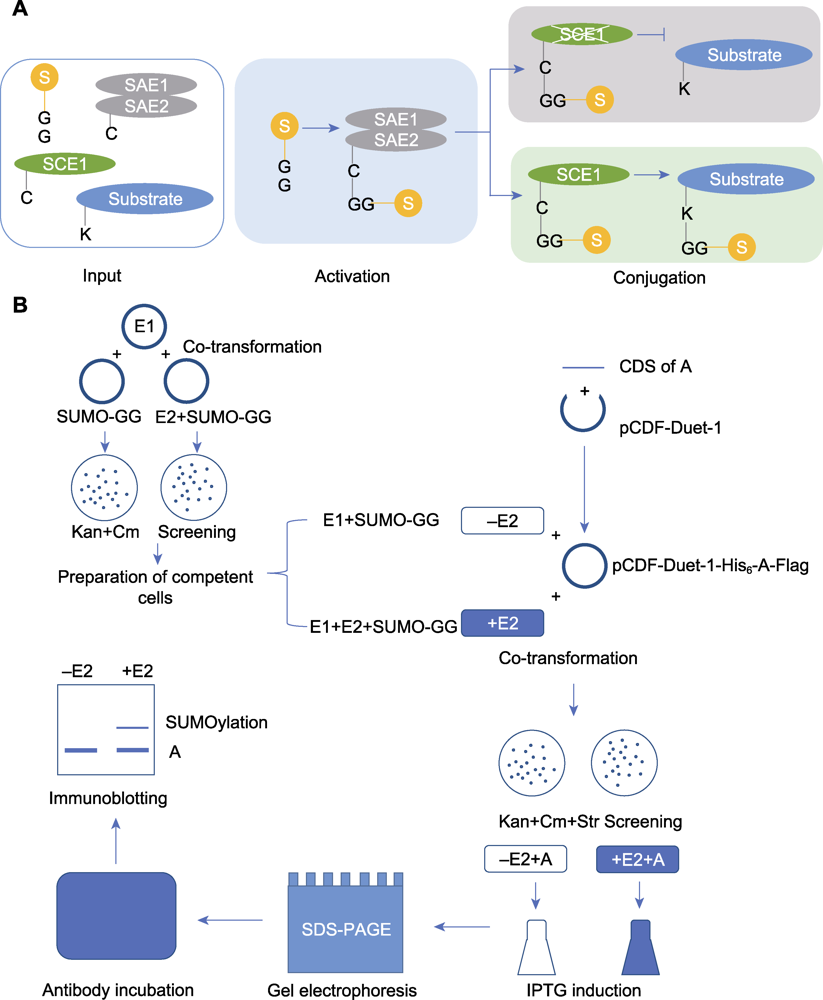
图1 体外SUMO化修饰检测流程 (A) 体外SUMO化修饰检测过程(输入: 将SUMO修饰关键组分基因和候选底物蛋白基因导入大肠杆菌表达; 激活: E1结合以激活SUMO分子参与修饰; 结合: E2将E1激活后的SUMO分子连接至底物完成修饰); (B) 体外SUMO化修饰检测实验流程(共转化: 将SUMO化修饰关键组分载体导入大肠杆菌, 通过卡那霉素和氯霉素平板筛选阳性克隆; 制备感受态细胞: 将获得的阳性克隆制备成感受态细胞; 共转化: 将构建好的底物蛋白表达载体导入感受态细胞, 通过卡那霉素、氯霉素和链霉素平板筛选阳性克隆; 诱导: 通过IPTG诱导蛋白表达; 凝胶电泳: 将获得的菌体样品裂解变性后通过SDS-PAGE凝胶电泳将不同分子量的蛋白分离, 将蛋白从凝胶转移至PVDF膜上; 抗体孵育: 将封闭后的PVDF膜与抗体进行孵育; 显影: 观察并记录实验结果)
Figure 1 The process of in vitro SUMOylation analysis (A) The process diagram of in vitro SUMOylation detection (Input: the key component genes of SUMO modification and the candidate substrate protein gene were introduced into Escherichia coli for expression; Activating: E1 activates SUMO molecules to participate in the modification; Conjugating: E2 attaches the activated SUMO molecules to the substrate); (B) The experimental procedure of in vitro SUMOylation detection (Co-transformation: The plasmids for expressing key SUMOylation components were introduced into E. coli, and the positive colonies were screened on LB agar plates containing kanamycin and chloramphenicol; Preparation of competent cells: The obtained positive colonies were prepared into competent cells; Co-transformation: The constructed plasmid for substrate protein expression was introduced into the competent cells mentioned above, and positive colonies were screened on LB agar plates by kanamycin, chloramphenicol and streptomycin; Induction: Protein expression was induced by IPTG; Gel electrophoresis: After lysed and denatured, samples were separated by SDS-PAGE. Then the proteins were transferred from gel to PVDF membrane; Antibody incubation: The blocked PVDF membrane was incubated with antibody; Immunoblotting: Observation and recording of the experimental results)
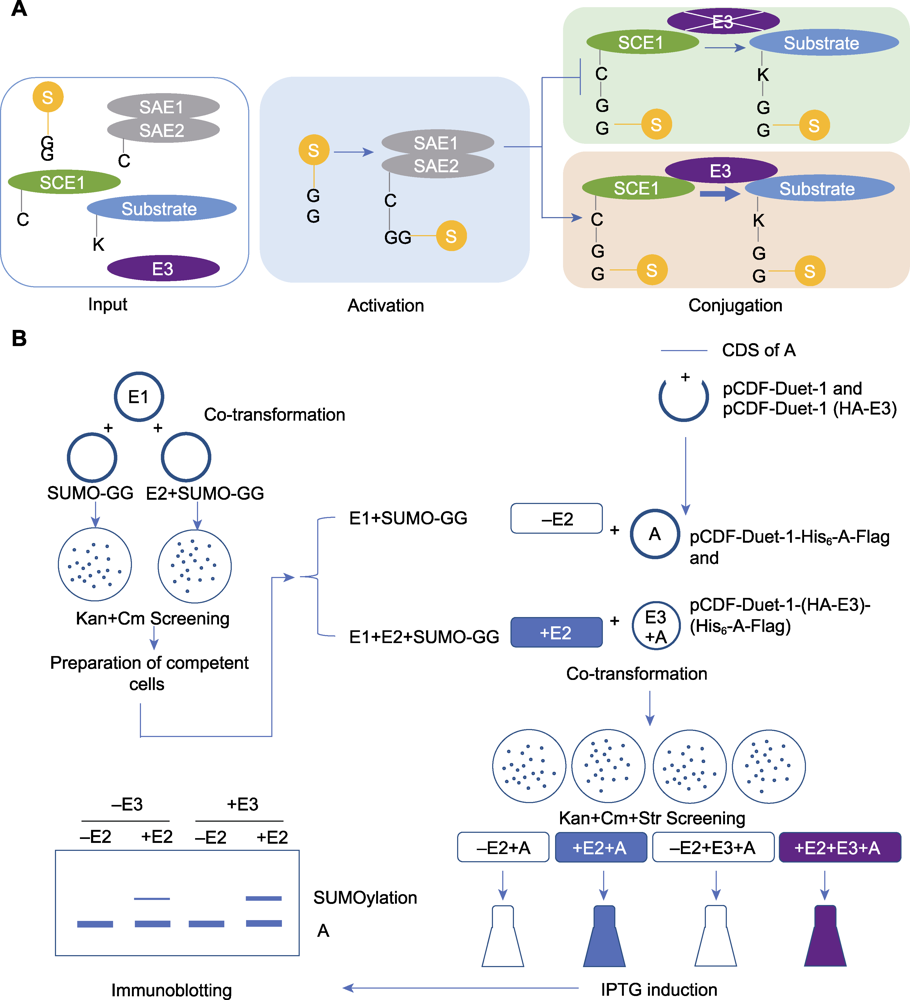
图2 E3连接酶介导的体外SUMO化修饰检测 (A) E3连接酶介导的体外SUMO化修饰检测过程(输入: 将SUMO化修饰关键组分基因和候选底物蛋白基因导入大肠杆菌表达; 激活: E1结合以激活SUMO分子参与修饰; 结合: E2将E1激活后的SUMO分子连接至底物完成修饰, 在E3存在的条件下, E3促进了SUMO分子从E2到底物蛋白的连接); (B) E3连接酶介导的体外SUMO化修饰检测实验流程(共转化: SUMO关键组分载体导入大肠杆菌, 通过卡那霉素和氯霉素平板筛选阳性克隆; 制备感受态细胞: 将获得的阳性克隆制备成感受态细胞; 共转化: 将构建好的底物蛋白表达载体(带有独立的E3表达框)导入感受态细胞, 通过卡那霉素、氯霉素和链霉素平板筛选阳性克隆; 诱导: 通过IPTG诱导蛋白表达; 免疫印迹: 通过SDS-PAGE凝胶电泳将不同分子量的蛋白分离, 将蛋白从凝胶转移至PVDF膜上, 将封闭后的PVDF膜与抗体进行孵育, 通过显影观察并记录实验结果)
Figure 2 The process of in vitro SUMOylation analysis mediated by an E3 ligase (A) The process diagram of the E3 ligase-mediated in vitro SUMOylation detection (Input: The key component genes of SUMO modification and the candidate substrate protein gene were introduced into Escherichia coli for expression; Activating: E1 activates SUMO molecules to participate in the modification; Conjugating: E2 attaches the activated SUMO molecules to the substrate. In the presence of E3, E3 facilitates the attachment of SUMO molecules from E2 to the substrate protein); (B) The experimental procedure of the E3 ligase-mediated in vitro SUMOylation detection (Co-transformation: The plasmids for expression of key SUMOylation components were introduced into E. coli, and the positive colonies were screened on LB agar plates containing kanamycin and chloramphenicol; Preparation of competent cells: The obtained positive colonies were transformed into competent cells; Co-transformation: The constructed plasmid for substrate protein expression (with independent E3 expression cassette) was introduced into the competent cells mentioned above, and the positive colonies were screened by LB agar plates containing kanamycin, chloramphenicol and streptomycin; Induction: Protein expression was induced by IPTG; Immunoblotting: After lysed and denatured, samples were separated by SDS-PAGE gel electrophoresis, then the proteins were transferred from gel to PVDF membrane, the blocked PVDF membrane was incubated with antibody, the result was observed and recorded by immunoblotting).
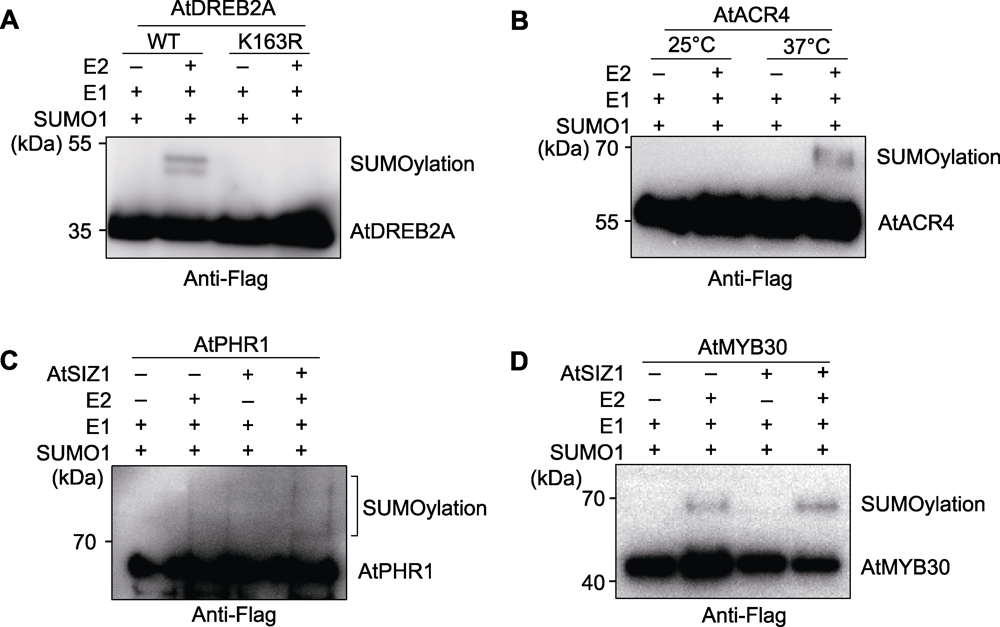
图3 检测实例 (A) AtDREB2A蛋白SUMO化修饰检测; (B) 温度影响AtACR4蛋白的SUMO化修饰水平; (C) E3连接酶AtSIZ1促进AtPHR1蛋白的SUMO化修饰; (D) E3连接酶AtSIZ1促进AtMYB30蛋白的SUMO化修饰
Figure 3 Experimental cases (A) SUMOylation test of AtDREB2A; (B) Temperature affects SUMOylation of AtACR4; (C) The E3 ligase AtSIZ1 facilitates SUMOylation of AtPHR1; (D) The E3 ligase AtSIZ1 facilitates SUMOylation of AtMYB30
| [1] |
韩丹璐, 赖建彬, 阳成伟 (2018). SUMO E3连接酶在植物生长发育中的功能研究进展. 植物学报 53, 175-184.
DOI |
| [2] |
曲高平, 金京波 (2020). 植物蛋白SUMO化修饰检测方法. 植物学报 55, 83-89.
DOI |
| [3] |
Augustine RC, Vierstra RD (2018). SUMOylation: re-wiring the plant nucleus during stress and development. Curr Opin Plant Biol 45, 143-154.
DOI PMID |
| [4] | Dai Vu L, Gevaert K, De Smet I (2018). Protein language: post-translational modifications talking to each other. Tren- ds Plant Sci 23, 1068-1080. |
| [5] |
Fang Q, Zhang J, Zhang Y, Fan N, van den Burg HA, Huang CF (2020). Regulation of aluminum resistance in Arabidopsis involves the SUMOylation of the zinc finger transcription factor STOP1. Plant Cell 32, 3921-3938.
DOI URL |
| [6] |
Han DL, Lai JB, Yang CW (2021). SUMOylation: a critical transcription modulator in plant cells. Plant Sci 310, 110987.
DOI URL |
| [7] |
Huang LX, Yang SG, Zhang SC, Liu M, Lai JB, Qi YL, Shi SF, Wang JX, Wang YQ, Xie Q, Yang CW (2009). The Arabidopsis SUMO E3 ligase AtMMS21, a homologue of NSE2/MMS21, regulates cell proliferation in the root. Plant J 60, 666-678.
DOI URL |
| [8] |
Jiang JM, Xie Y, Du JJ, Yang CW, Lai JB (2021). A SUMO ligase OsMMS21 regulates rice development and auxin response. J Plant Physiol 263, 153447.
DOI URL |
| [9] |
Jin JB, Jin YH, Lee J, Miura K, Yoo CY, Kim WY, Van Oosten M, Hyun Y, Somers DE, Lee I, Yun DJ, Bressan RA, Hasegawa PM (2008). The SUMO E3 ligase, AtSIZ1, regulates flowering by controlling a salicylic acid-mediated floral promotion pathway and through affects on FLC chromatin structure. Plant J 53, 530-540.
DOI URL |
| [10] |
Kong XF, Hong YC, Hsu YF, Huang H, Liu X, Song Z, Zhu JK (2020). SIZ1-mediated SUMOylation of ROS1 enhances its stability and positively regulates active DNA demethylation in Arabidopsis. Mol Plant 13, 1816-1824.
DOI URL |
| [11] |
Li YR, Williams B, Dickman M (2017). Arabidopsis B-cell lymphoma2 (Bcl-2)-associated athanogene 7 (BAG7)- mediated heat tolerance requires translocation, SUMOylation and binding to WRKY29. New Phytol 214, 695-705.
DOI URL |
| [12] |
Liu YY, Lai JB, Yu MY, Wang FG, Zhang JJ, Jiang JM, Hu H, Wu Q, Lu GH, Xu PL, Yang CW (2016). The Arabidopsis SUMO E3 ligase AtMMS21 dissociates the E2Fa/ DPa complex in cell cycle regulation. Plant Cell 28, 2225-2237.
DOI URL |
| [13] |
Miura K, Jin JB, Lee J, Yoo CY, Stirm V, Miura T, Ashworth EN, Bressan RA, Yun DJ, Hasegawa PM (2007). SIZ1-mediated SUMOylation of ICE1 controls CBF3/DREB1A expression and freezing tolerance in Arabidopsis. Plant Cell 19, 1403-1414.
DOI URL |
| [14] |
Miura K, Lee J, Miura T, Hasegawa PM (2010). SIZ1 controls cell growth and plant development in Arabidopsis through salicylic acid. Plant Cell Physiol 51, 103-113.
DOI URL |
| [15] |
Miura K, Rus A, Sharkhuu A, Yokoi S, Karthikeyan AS, Raghothama KG, Baek D, Koo YD, Jin JB, Bressan RA, Yun DJ, Hasegawa PM (2005). The Arabidopsis SUMO E3 ligase SIZ1 controls phosphate deficiency responses. Proc Natl Acad Sci USA 102, 7760-7765.
DOI URL |
| [16] |
Morrell R, Sadanandom A (2019). Dealing with stress: a review of plant SUMO proteases. Front Plant Sci 10, 1122.
DOI URL |
| [17] |
Niu D, Lin XL, Kong XX, Qu GP, Cai B, Lee J, Jin JB (2019). SIZ1-mediated SUMOylation of TPR1 suppresses plant immunity in Arabidopsis. Mol Plant 12, 215-228.
DOI PMID |
| [18] |
Okada S, Nagabuchi M, Takamura Y, Nakagawa T, Shinmyozu K, Nakayama JI, Tanaka K (2009). Reconstitution of Arabidopsis thaliana SUMO pathways in E. coli: functional evaluation of SUMO machinery proteins and mapping of SUMOylation sites by mass spectrometry. Plant Cell Physiol 50, 1049-1061.
DOI URL |
| [19] |
Perry JJP, Tainer JA, Boddy MN (2008). A SIM-ultaneous role for SUMO and ubiquitin. Trends Biochem Sci 33, 201-208.
DOI URL |
| [20] |
Roy D, Sadanandom A (2021). SUMO mediated regulation of transcription factors as a mechanism for transducing environmental cues into cellular signaling in plants. Cell Mol Life Sci 78, 2641-2664.
DOI URL |
| [21] |
Sakuma Y, Maruyama K, Qin F, Osakabe Y, Shinozaki K, Yamaguchi-Shinozaki K (2006). Dual function of an Arabidopsis transcription factor DREB2A in water-stress- responsive and heat-stress-responsive gene expression. Proc Natl Acad Sci USA 103, 18822-18827.
DOI URL |
| [22] |
Saleh A, Withers J, Mohan R, Marqués J, Gu YN, Yan SP, Zavaliev R, Nomoto M, Tada Y, Dong XN (2015). Posttranslational modifications of the master transcriptional regulator NPR1 enable dynamic but tight control of plant immune responses. Cell Host Microbe 18, 169-182.
DOI URL |
| [23] |
Saracco SA, Miller MJ, Kurepa J, Vierstra RD (2007). Genetic analysis of SUMOylation in Arabidopsis: conjugation of SUMO1 and SUMO2 to nuclear proteins is essential. Plant Physiol 145, 119-134.
PMID |
| [24] | Verma V, Srivastava AK, Gough C, Campanaro A, Srivastava M, Morrell R, Joyce J, Bailey M, Zhang CJ, Krysan PJ, Sadanandom A (2021). SUMO enables substrate selectivity by mitogen-activated protein kinases to regulate immunity in plants. Proc Natl Acad Sci USA 118, e2021351118. |
| [25] | Wang FG, Liu YY, Shi YQ, Han DL, Wu YY, Ye WX, Yang HL, Li GW, Cui F, Wan SB, Lai JB, Yang CW (2020). SUMOylation stabilizes the transcription factor DREB2A to improve plant thermotolerance. Plant Physiol 183, 41-50. |
| [26] |
Wang Z, Prelich G (2009). Quality control of a transcriptional regulator by SUMO-targeted degradation. Mol Cell Biol 29, 1694-1706.
DOI URL |
| [27] |
Xu JM, Zhu JY, Liu JJ, Wang JX, Ding ZJ, Tian HY (2021). SIZ1 negatively regulates aluminum resistance by mediating the STOP1-ALMT1 pathway in Arabidopsis. J Integr Plant Biol 63, 1147-1160.
DOI URL |
| [28] |
Zhang JJ, Lai JB, Wang FG, Yang SG, He ZP, Jiang JM, Li QL, Wu Q, Liu YY, Yu MY, Du JJ, Xie Q, Wu KQ, Yang CW (2017). A SUMO ligase AtMMS21 regulates the stability of the chromatin remodeler BRAHMA in root development. Plant Physiol 173, 1574-1582.
DOI URL |
| [29] |
Zheng Y, Schumaker KS, Guo Y (2012). SUMOylation of transcription factor MYB30 by the small ubiquitin-like modifier E3 ligase SIZ1 mediates abscisic acid response in Arabidopsis thaliana. Proc Natl Acad Sci USA 109, 12822-12827.
DOI URL |
| [30] |
Zhou LJ, Zhang CL, Zhang RF, Wang GL, Li YY, Hao YJ (2019). The SUMO E3 ligase MdSIZ1 targets MdbHLH104 to regulate plasma membrane H+-ATPase activity and iron homeostasis. Plant Physiol 179, 88-106.
DOI PMID |
| [1] | 肖治术, 范宗骥, 于桂清, 范明亮. 油麻藤属(Mucuna)植物的传粉和种子传播研究进展: 现状与展望[J]. , 2027, 51(动植物互作): 0-. |
| [2] | 刘志祥, 黎凤兰, 黄晓磊. 昆虫虫瘿生态系统的复杂性及成瘿机制研究进展[J]. , 2027, 51(动植物互作): 0-. |
| [3] | 曹伊菲, 苏涛, 曹敏, 汪海燕, 杨洁. 新生代被子植物叶脉密度演化的驱动因素研究:气候适应与植食压力[J]. , 2027, 51(动植物互作): 0-. |
| [4] | 陈欣蕊, 宋维峰, 王燚, 王浩, 孙诗瑶, 王彩江, 蔡世鹏, 任红, 何玉陶, 潘珉, 曹光秀, 严毅, 谢志勇, 王行. 滇池湖滨带典型挺水植物氮磷重吸收特征及其适应策略[J]. , 2026, 50(预发表): 0-. |
| [5] | 胡光明, 欧旭, 龙文兴. 热带云雾林宿主树皮粗糙度对附生维管植物多样性与孢子定殖的影响[J]. 植物生态学报, 2026, 50(预发表): 1-. |
| [6] | 段建林, 孟晟, 陈仁利, 熊林峰, 卢春洋, 席念勋. 全球变化因子多样性对菌根植物性状的影响[J]. , 2026, 50(预发表): 0-. |
| [7] | 杨梅花, 张子嘉, 乔栋, 冯俊娜, 庞子杰, 钱龙, 刘志晖, 蔡娜娜, 胡中民, 杨国姣. 海南热带森林乔木群落调查和多样性数据集[J]. 植物生态学报, 2026, 50(预发表): 0-. |
| [8] | 赵掷艺, 黄伟权, 胡婧妍, 王义越, 虞梦婕, 吴玉环. 泥炭沼泽湿地植物残体分解及微生物作用机理研究进展[J]. , 2026, 50(预发表): 0-. |
| [9] | 何青, 袁旭东, 任博申, 冯治洋, 鲁梦珍, 林巧玲, 姜庆虎, 杨林森, 余辉亮, 姚辉, 杨敬元, 刘峰, 江明喜. 一年蓬(Erigeron annuus)入侵对亚高山泥炭湿地植物群落结构与多样性的影响[J]. 植物生态学报, 2026, 50(预发表): 0-. |
| [10] | 柯嘉雯, 程张浩, 高雪夷, 徐云剑, 王毅. 镉污染下的植物响应:从吸收、转运到应答与缓解机制[J]. 植物生态学报, 2026, 50(预发表): 1-. |
| [11] | 郭蓉, 吴旭东, 张雨, 康瑞红, 王一凡, 王占军, 蒋齐, 俞鸿千, 马琨. 荒漠草原土壤丛枝菌根真菌群落对降水变化的响应[J]. 生物多样性, 2026, 34(5): 26028-. |
| [12] | 郝晨阳, 高少羽, 程跃华, 扎西尼玛, 徐波, 杨扬. 横断山区高山冰缘植物毡毛雪莲紧实深色头状花序的生态功能[J]. 生物多样性, 2026, 34(5): 25489-. |
| [13] | 尹翔正, 姜海燕, 张俊, 罗春生, 张元明. 极端干旱区荒漠灌木叶际细菌群落多样性特征[J]. 生物多样性, 2026, 34(4): 25485-. |
| [14] | 李劲, 程铭昊, 张溢, 刘峰, 姜庆虎, 叶基荣, 陈展, 张于光. 不同海拔巴山冷杉林土壤微生物多样性及植物-微生物跨界生态网络关系[J]. 生物多样性, 2026, 34(4): 25276-. |
| [15] | 赵慧, 杨晓瑞, 韩洁, 陈四龙. 基于AI的植物生物学课程知识图谱建设与应用[J]. 植物学报, 2026, 61(4): 1-0. |
| 阅读次数 | ||||||
|
全文 |
|
|||||
|
摘要 |
|
|||||
 首页
首页