
植物学报 ›› 2019, Vol. 54 ›› Issue (4): 497-502.DOI: 10.11983/CBB19108 cstr: 32102.14.CBB19108
陈立超,詹妮,李彦莎,冯健,左建儒*( )
)
收稿日期:2019-06-13
接受日期:2019-06-20
出版日期:2019-07-01
发布日期:2020-01-08
通讯作者:
左建儒
基金资助:
Lichao Chen,Ni Zhan,Yansha Li,Jian Feng,Jianru Zuo*()
Received:2019-06-13
Accepted:2019-06-20
Online:2019-07-01
Published:2020-01-08
Contact:
Jianru Zuo
摘要: S-亚硝基化是一种重要的蛋白质翻译后修饰方式, 是指一氧化氮(NO)基团共价连接至靶蛋白特定半胱氨酸残基的自由巯基, 从而形成S-亚硝基硫醇(SNO)的过程。S-亚硝基化修饰广泛存在于各有机体中, 通过改变蛋白质生化活性、稳定性、亚细胞定位以及蛋白质-蛋白质相互作用等机制而调控不同的生物学过程或信号通路。在蛋白质S-亚硝基化检测分析方法中, 最为广泛使用的是生物素转化法(biotin switch assay), 其基本原理是首先封闭未被修饰的自由巯基, 进而将被修饰的SNO基团特异地还原为自由巯基并使用生物素将其特异标记。被生物素标记的半胱氨酸残基(即被修饰位点)可进一步通过蛋白质免疫印迹和/或质谱等方法进行检测分析。该文详细描述了植物蛋白质样品的体内和体外生物素转化法的实验流程, 并对实验过程中的注意事项进行了讨论。
陈立超,詹妮,李彦莎,冯健,左建儒. 植物蛋白质S-亚硝基化修饰的检测与分析. 植物学报, 2019, 54(4): 497-502.
Lichao Chen,Ni Zhan,Yansha Li,Jian Feng,Jianru Zuo. Detection and Analysis of Protein S-nitrosylation in Plants. Chinese Bulletin of Botany, 2019, 54(4): 497-502.
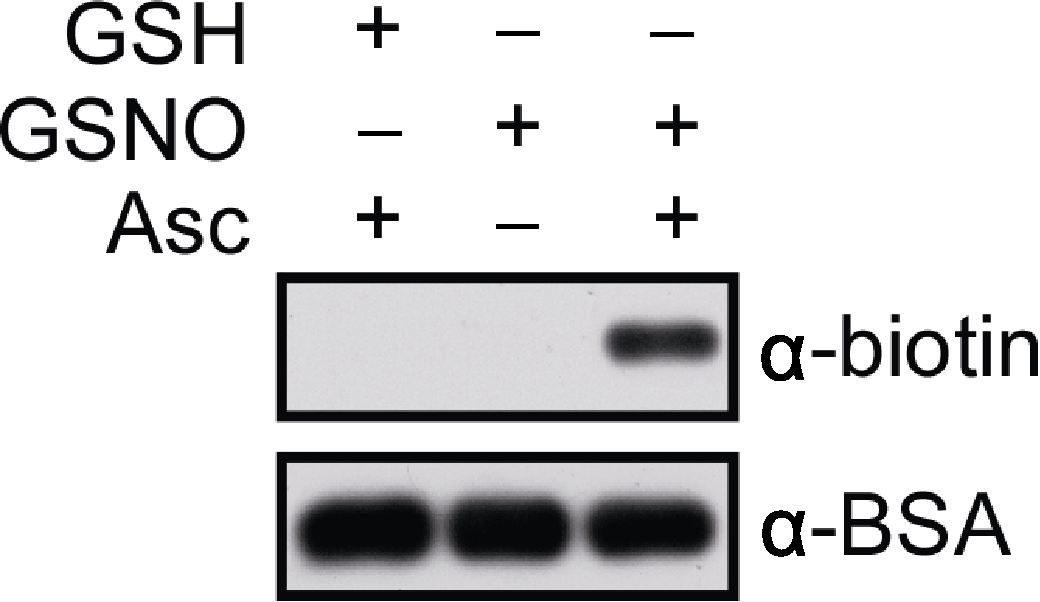
图1 牛血清白蛋白(BSA)体外S-亚硝基化修饰的分析检测 使用biotin-maleimide标记BSA样品, 经SDS-PAGE胶分离后进行免疫印迹分析。分别采用anti-biotin和anti-BSA抗体作为第一抗体(primary antibodies; 1:20 000稀释), anti-mouse IgG为第二抗体(secondary antibodies)。样品信号用SuperSignal Western Femto Maximun Sensitivity Substrate Kit检测。曝光时间分别为20秒(上)和30秒(下)。GSH: 谷胱甘肽; GSNO: S-亚硝基谷胱甘肽; Asc: 抗坏血酸盐
Figure 1 In vitro analysis of S-nitrosylated bovine serum albumin (BSA) BSA is labelled with biotin-maleimide, subjected to SDS- PAGE and western blotting. Anti-biotin and anti-BSA antibodies are used as primary antibodies, respectively (dilution in 1:20 000) and anti-mouse IgG as a secondary antibody. Signals are detected by using the SuperSignal Western Femto Maximun Sensitivity Substrate Kit. The blots are exposed for 20 sec (top) and 30 sec (bottom), respectively. GSH: Glutathione; GSNO: S-nitrosoglutathione; Asc: Sodium ascorbate
| [1] | Albertos P, Romero-Puertas MC, Tatematsu K, Mateos I, Sánchez-Vicente I, Nambara E, Lorenzo O ( 2015). S-nitrosylation triggers ABI5 degradation to promote seed germination and seedling growth. Nat Commun 6, 8669. |
| [2] | Chen R, Sun S, Wang C, Li Y, Liang Y, An F, Li C, Dong H, Yang X, Zhang J, Zuo J ( 2009). The Arabidopsis PARAQUAT RESISTANT2 gene encodes an S-nitrosoglutathione reductase that is a key regulator of cell death. Cell Res 19, 1377. |
| [3] | Cui B, Pan Q, Clarke D, Villarreal MO, Umbreen S, Yuan B, Shan W, Jiang J, Loake GJ ( 2018). S-nitrosylation of the zinc finger protein SRG1 regulates plant immunity. Nat Commun 9, 4226. |
| [4] | Feng J, Chen L, Zuo J ( 2019). Protein S-nitrosylation in plants: current progresses and challenges. J Integr Plant Biol doi. org/10.1111/jipb.12780. |
| [5] | Feng J, Wang C, Chen Q, Chen H, Ren B, Li X, Zuo J ( 2013). S-nitrosylation of phosphotransfer proteins represses cytokinin signaling. Nat Commun 4, 1529. |
| [6] | He Y, Tang RH, Hao Y, Stevens RD, Cook CW, Ahn SM, Jing L, Yang Z, Chen L, Guo F, Fiorani F, Jackson RB, Crawford NM, Pei ZM ( 2004). Nitric oxide represses the Arabidopsis floral transition. Science 305, 1968-1971. |
| [7] | Hess DT, Matsumoto A, Kim SO, Marshall HE, Stamler JS ( 2005). Protein S-nitrosylation: purview and parameters. Nat Rev Mol Cell Biol 6, 150-166. |
| [8] | Hess DT, Stamler JS ( 2012). Regulation by S-nitrosylation of protein post-translational modification. J Biol Chem 287, 4411-4418. |
| [9] | Hu J, Huang X, Chen L, Sun X, Lu C, Zhang L, Wang Y, Zuo J ( 2015). Site-specific nitrosoproteomic identification of endogenously S-nitrosylated proteins in Arabidopsis. Plant Physiol 167, 1731-1746. |
| [10] | Hu J, Yang H, Mu J, Lu T, Peng J, Deng X, Kong Z, Bao S, Cao X, Zuo J ( 2017). Nitric oxide regulates protein methylation during stress responses in plants. Mol Cell 67, 702-710. |
| [11] | Iglesias MJ, Terrile MC, Correa-Aragunde N, Colman SL, Izquierdo-Álvarez A, Fiol DF, París R, Sánchez-López N, Marina A, Calderón Villalobos LIA, Estelle M, Lamattina L, Martínez-Ruiz A, Casalongué CA ( 2018). Regulation of SCFTIR1/AFBs E3 ligase assembly by S-nitrosylation of Arabidopsis SKP1-like1 impacts on auxin signaling. Redox Biol 18, 200-210. |
| [12] | Jaffrey SR, Snyder SH ( 2001). The biotin switch method for the detection of S-nitrosylated proteins. Sci STKE 2001,pl1. |
| [13] | Ling T, Bellin D, Vandelle E, Imanifard Z, Delledonne M ( 2017). Host-mediated S-nitrosylation disarms the bacterial effector HopAI1 to reestablish immunity. Plant Cell 29, 2871-2881. |
| [14] | Lytvyn DI, Raynaud C, Yemets AI, Bergounioux C, Blume YB ( 2016). Involvement of inositol biosynthesis and nitric oxide in the mediation of UV-B induced oxidative stress. Front Plant Sci 7, 430. |
| [15] | Pan QN, Geng CC, Li DD, Xu SW, Mao DD, Umbreen S, Loake GJ, Cui BM ( 2019). Nitrate reductase-mediated nitric oxide regulates the leaf shape in Arabidopsis by mediating the homeostasis of reactive oxygen species. Int J Mol Sci 20, 2235. |
| [16] | París R, Vazquez MM, Graziano M, Terrile MC, Miller ND, Spalding EP, Otegui MS, Casalongué CA ( 2018). Distribution of endogenous NO regulates early gravitropic response and PIN2 localization in Arabidopsis roots. Front Plant Sci 9, 495. |
| [17] | Seth D, Hess DT, Hausladen A, Wang L, Wang YJ, Stamler JS ( 2018). A multiplex enzymatic machinery for cellular protein S-nitrosylation. Mol Cell 69, 451-464. |
| [18] | Seth P, Hsieh PN, Jamal S, Wang L, Gygi SP, Jain MK, Coller J, Stamler JS ( 2019). Regulation of microRNA machinery and development by interspecies S-nitrosylation. Cell 176, 1014-1025. |
| [19] | Shekariesfahlan A, Lindermayr C ( 2018). Identification of NO-sensitive cysteine residues using cysteine mutants of recombinant proteins. In: Mengel A, Lindermayr C, eds. Nitric Oxide: Methods and Protocols. New York: Springer New York. pp. 183-203. |
| [20] | Shi H, Liu W, Wei Y, Ye T ( 2017). Integration of auxin/ indole-3-acetic acid 17 and RGA-LIKE3 confers salt stress resistance through stabilization by nitric oxide in Arabidopsis. J Exp Bot 68, 1239-1249. |
| [21] | Tada Y, Spoel SH, Pajerowska-Mukhtar K, Mou Z, Song J, Wang C, Zuo J, Dong X ( 2008). Plant immunity requires conformational charges of NPR1 via S-nitrosylation and thioredoxins. Science 321, 952-956. |
| [22] | Wang P, Zhu JK, Lang Z ( 2015). Nitric oxide suppresses the inhibitory effect of abscisic acid on seed germination by S-nitrosylation of SnRK2 proteins. Plant Signal Behav 10, e1031939. |
| [23] | Willems P, Horne A, Van Parys T, Goormachtig S, De Smet I, Botzki A, Van Breusegem F, Gevaert K ( 2019). The Plant PTM Viewer, a central resource for exploring plant protein modifications. Plant J 99, 752-762. |
| [24] | Xue Y, Liu Z, Gao X, Jin C, Wen L, Yao X, Ren J ( 2010). GPS-SNO: computational prediction of protein S-nitrosylation sites with a modified GPS algorithm. PLoS One 5, e11290. |
| [25] | Yang H, Mu J, Chen L, Feng J, Hu J, Li L, Zhou JM, Zuo J ( 2015). S-nitrosylation positively regulates ascorbate peroxidase activity during plant stress responses. Plant Physiol 167, 1604. |
| [26] | Zhan N, Wang C, Chen L, Yang H, Feng J, Gong X, Ren B, Wu R, Mu J, Li Y, Liu Z, Zhou Y, Peng J, Wang K, Huang X, Xiao S, Zuo J ( 2018). S-nitrosylation targets GSNO reductase for selective autophagy during hypoxia responses in plants. Mol Cell 71, 142-154. |
| [27] | Zhang L, Shi X, Zhang Y, Wang J, Yang J, Ishida T, Jiang W, Han X, Kang J, Wang X, Pan L, Lv S, Cao B, Zhang Y, Wu J, Han H, Hu Z, Cui L, Sawa S, He J, Wang G ( 2019 a). CLE9 peptide-induced stomatal closure is mediated by abscisic acid, hydrogen peroxide, and nitric oxide in Arabidopsis thaliana. Plant Cell Environ 42, 1033-1044. |
| [28] | Zhang ZW, Fu YF, Zhou YH, Wang CQ, Lan T, Chen GD, Zeng J, Chen YE, Yuan M, Yuan S, Hu JY ( 2019 b). Nitrogen and nitric oxide regulate Arabidopsis flowering differently. Plant Sci 284, 177-184. |
| [1] | 刘志祥, 黎凤兰, 黄晓磊. 昆虫虫瘿生态系统的复杂性及成瘿机制研究进展[J]. , 2027, 51(动植物互作): 0-. |
| [2] | 曹伊菲, 苏涛, 曹敏, 汪海燕, 杨洁. 新生代被子植物叶脉密度演化的驱动因素研究:气候适应与植食压力[J]. , 2027, 51(动植物互作): 0-. |
| [3] | 肖治术, 范宗骥, 于桂清, 范明亮. 油麻藤属(Mucuna)植物的传粉和种子传播研究进展: 现状与展望[J]. , 2027, 51(动植物互作): 0-. |
| [4] | 胡光明, 欧旭, 龙文兴. 热带云雾林宿主树皮粗糙度对附生维管植物多样性与孢子定殖的影响[J]. 植物生态学报, 2026, 50(预发表): 1-. |
| [5] | 段建林, 孟晟, 陈仁利, 熊林峰, 卢春洋, 席念勋. 全球变化因子多样性对菌根植物性状的影响[J]. , 2026, 50(预发表): 0-. |
| [6] | 杨梅花, 张子嘉, 乔栋, 冯俊娜, 庞子杰, 钱龙, 刘志晖, 蔡娜娜, 胡中民, 杨国姣. 海南热带森林乔木群落调查和多样性数据集[J]. 植物生态学报, 2026, 50(预发表): 0-. |
| [7] | 陈欣蕊, 宋维峰, 王燚, 王浩, 孙诗瑶, 王彩江, 蔡世鹏, 任红, 何玉陶, 潘珉, 曹光秀, 严毅, 谢志勇, 王行. 滇池湖滨带典型挺水植物氮磷重吸收特征及其适应策略[J]. , 2026, 50(预发表): 0-. |
| [8] | 何青, 袁旭东, 任博申, 冯治洋, 鲁梦珍, 林巧玲, 姜庆虎, 杨林森, 余辉亮, 姚辉, 杨敬元, 刘峰, 江明喜. 一年蓬(Erigeron annuus)入侵对亚高山泥炭湿地植物群落结构与多样性的影响[J]. 植物生态学报, 2026, 50(预发表): 0-. |
| [9] | 柯嘉雯, 程张浩, 高雪夷, 徐云剑, 王毅. 镉污染下的植物响应:从吸收、转运到应答与缓解机制[J]. 植物生态学报, 2026, 50(预发表): 1-. |
| [10] | 赵掷艺, 黄伟权, 胡婧妍, 王义越, 虞梦婕, 吴玉环. 泥炭沼泽湿地植物残体分解及微生物作用机理研究进展[J]. , 2026, 50(预发表): 0-. |
| [11] | 郭蓉, 吴旭东, 张雨, 康瑞红, 王一凡, 王占军, 蒋齐, 俞鸿千, 马琨. 荒漠草原土壤丛枝菌根真菌群落对降水变化的响应[J]. 生物多样性, 2026, 34(5): 26028-. |
| [12] | 郝晨阳, 高少羽, 程跃华, 扎西尼玛, 徐波, 杨扬. 横断山区高山冰缘植物毡毛雪莲紧实深色头状花序的生态功能[J]. 生物多样性, 2026, 34(5): 25489-. |
| [13] | 闫慧莉, 秦雅婷, 周运转, 张怀, 李斌峰, 公保南加, 张生燕, 许文秀, 宋晓彦, 何振艳. 人工智能在离子逆境适生种质创新中的发展与应用[J]. 植物学报, 2026, 61(4): 1-0. |
| [14] | 张晋越, 卞宝乐, 唐泰然, 农文豪, 朱书峰, 卢新民. 植物-根际微生物互作及对昆虫胁迫的响应[J]. 生物多样性, 2026, 34(4): 25334-. |
| [15] | 尹翔正, 姜海燕, 张俊, 罗春生, 张元明. 极端干旱区荒漠灌木叶际细菌群落多样性特征[J]. 生物多样性, 2026, 34(4): 25485-. |
| 阅读次数 | ||||||
|
全文 |
|
|||||
|
摘要 |
|
|||||
 首页
首页