
AI赋能与农林特色融合: 以能力为导向的教学改革探索与实践
收稿日期: 2025-12-29
录用日期: 2026-02-24
网络出版日期: 2026-05-28
基金资助
广东省本科高校教学质量与教学改革项目(粤教高函[2024]9号)
广东省本科高校教学质量与教学改革项目(粤教高函[2024]30号)
华南农业大学2023年度课程改革建设项目(JG2023078)
华南农业大学2023年度课程改革建设项目(JG2023034)
AI Empowerment and Integration of Agricultural and Forestry Characteristics: Exploration and Practice of Competency-oriented Teaching Reform
Received date: 2025-12-29
Accepted date: 2026-02-24
Online published: 2026-05-28
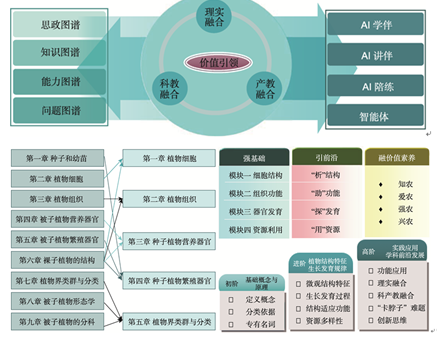
在新农科建设与教育数字化转型双重背景下, 针对农林院校植物学课程学用脱节、知识内化不足及学生兴趣缺失等核心痛点, 华南农业大学以AI为关键赋能工具, 构建了“资源-工具-场景-成果”四位一体的支撑体系, 实施理实、科教和产教融合的“三融合”闭环教学改革。通过重构“细胞-组织-器官-类群-资源利用”分层教学内容、打造多模态AI智慧资源矩阵、采用“三维度-三阶段”过程性考核, 实现学生核心能力与素养多维提升、教师专业能力增强及资源辐射效应凸显。该改革实践为农林院校植物学课程数字化转型提供了可复制范式, 为培养厚植“四农(知农、爱农、强农、兴农)”情怀及服务现代农业与乡村振兴的创新型复合人才提供了助力。
白玫 , 张荣京 , 梁祥修 , 刘自强 . AI赋能与农林特色融合: 以能力为导向的教学改革探索与实践[J]. 植物学报, 2026 , 61(4) : 549 -714 . DOI: 10.11983/CBB25235
Against the dual backdrop of New Agricultural Science development and educational digital transformation, South China Agricultural University addresses core challenges in botany courses at agricultural and forestry universities, such as the disconnection between learning and application, insufficient knowledge internalization, and lack of student interest. With AI as a key enabling tool, the university has constructed a four-in-one support system of ‘resources-tools-scenarios-achievements’ and implemented a closed-loop teaching reform integrating theory-practice, science-education, and industry-education. By reconstructing hierarchical teaching content centered on ‘cell-tissue-organ-group-resource utilization’, building a multi-modal AI intelligent resource matrix, and implementing a ‘three-dimension, three-stage’ process-based assessment, the reform has achieved multi-dimensional improvement of students’ core competencies and qualities, enhanced teachers’ professional capabilities, and highlighted resource radiation effects. This reform provides a replicable paradigm for the digital transformation of botany courses in agricultural and forestry universities, helping to cultivate innovative and compound talents who embody the ‘Four Agriculture’ ethos (understanding agriculture, loving agriculture, strengthening agriculture, and revitalizing agriculture) and serve modern agriculture and rural revitalization.
|
白建华, 陈晓江, 张建华 (2022). 思维导图在“植物学”教学中的应用研究. 江苏科技信息 39(8), 51-53.
|
|
高教司 (2019). 安吉共识——中国新农科建设宣言. 中国农业教育 20(3), 105-106.
|
|
何小侠 (2025). “四新”背景下AI赋能高校青年教师教学能力提升与教学内容创新实践研究. 2025年高等教育发展论坛教改分论坛. 郑州: 河南省民办教育协会. pp. 31-33.
|
|
刘华彬, 周成 (2023). 应用型人才培养模式下植物学教学研究与实践探索. 创新创业理论研究与实践 6(16), 52-54.
|
|
吕新, 张泽, 侯彤瑜, 林皎 (2019). “新农科”背景下农学类专业创新人才培养模式研究. 教育现代化 6(68), 16—18, 51.
|
|
穆丹, 龙洪婕, 陈静怡, 胡心怡, 方世涛, 周琪, 步佳豪, 白雅茹, 张原蓉, 尚钰琪, 石旌男, 郝倩文, 毕晨悦, 张欣燕, 秦华光, 饶玉春, 孙廷哲 (2025). 基于“手作+课程包”的植物科普实践模式探索. 植物学报 60, 1017-1027.
|
|
谢小芳, 陈煜, 林向民 (2021). 基于实践能力提升为本位的植物学实验教学改革. 教育教学论坛 (38), 46-49.
|
|
尹新明, 周红飞 (2021). 聚焦新农科建设 培养卓越农林人才. 农村·农业·农民(B版) (6), 53-54.
|
|
张滢 (2024). 着力构建高质量高等教育体系的“一二三四+N”主要任务. 中国教育报 2024—04—29.
|
|
赵丽艳, 谈洁, 陈必峰, 胡平, 李梦薇 (2026). 数智驱动下高校智慧课程的内涵、实践与创新. 吉林省教育学院学报 42, 117-123.
|
|
赵沛 (2025). AI赋能力学领域“101计划”——“AIM”力学大模型. 力学与实践 47, 1086-1097.
|
|
|
|
|
|
|
|
|
|
|
|
|
/
| 〈 |
|
〉 |

 首页