
收稿日期: 2025-10-08
修回日期: 2025-12-25
网络出版日期: 2026-01-15
基金资助
宁夏重点研发计划(引才专项) (No.2021BEB04057)
Identification of SET Domain Gene Family in Capsicum annuum and Their Expression Patterns under Salt and Drought Stress Conditions
郭亚楠 , 张斌 , 田悦 , 郭猛 . 辣椒SET结构域基因家族鉴定及在盐与干旱胁迫下的表达模式[J]. 植物学报, 0 : 1 -0 . DOI: 10.11983/CBB25179
INTRODUCTION: Proteins containing the conserved Su(var)3?9, Enhancer?of?zeste and Trithorax (SET) domain can catalyze histone lysine methylation, thereby modulating chromatin structure and the transcription of related genes, and are involved in various physiological and developmental processes in plants. As an important vegetable crop worldwide, research on the abiotic stress resistance mechanisms in pepper holds significant practical value for molecular breeding. However, the role of the SET gene family in stress responses in pepper remains unclear. RATIONALE: We used the pepper genome as a reference to identify the members of pepper SET gene family, and analyzed their phylogenetic relationships, gene structure, conserved motifs, cis-regulatory elements, gene duplication events, as well as the expression patterns of these genes under salt and drought stress conditions. RESULTS: A total of 39 CaSETs were identified in pepper genome. Based on their conserved domains and phylogenetic relationships, CaSETs were classified into six branches (I, II, III, IV, V, and VI), and each branch's CaSETs were characterized by specific conserved domains. The CaSETs were distributed on the other 10 chromosomes except for chromosomes 5 and 9. Most CaSETs were likely to be in the nucleus or cytoplasm. Tandem duplication and segmental duplication events jointly promoted the expansion of CaSET family. A total of 403 plant hormone and stress response cis-regulatory elements were found in the promoters of CaSETs. Expression analysis indicated differential expression of CaSETs across various pepper tissues, with most members showing higher expression levels in early developmental fruits compared to other tissues. Moreover, the expression of several CaSETs was regulated under salt and drought stress, with leaves exhibiting greater sensitivity to these stresses than roots. CONCLUSION: This study conducted a systematic analysis of the CaSET family in pepper. The results are expected to facilitate the future application of CaSETs-related epigenetic genome engineering in the improvement of pepper crops.
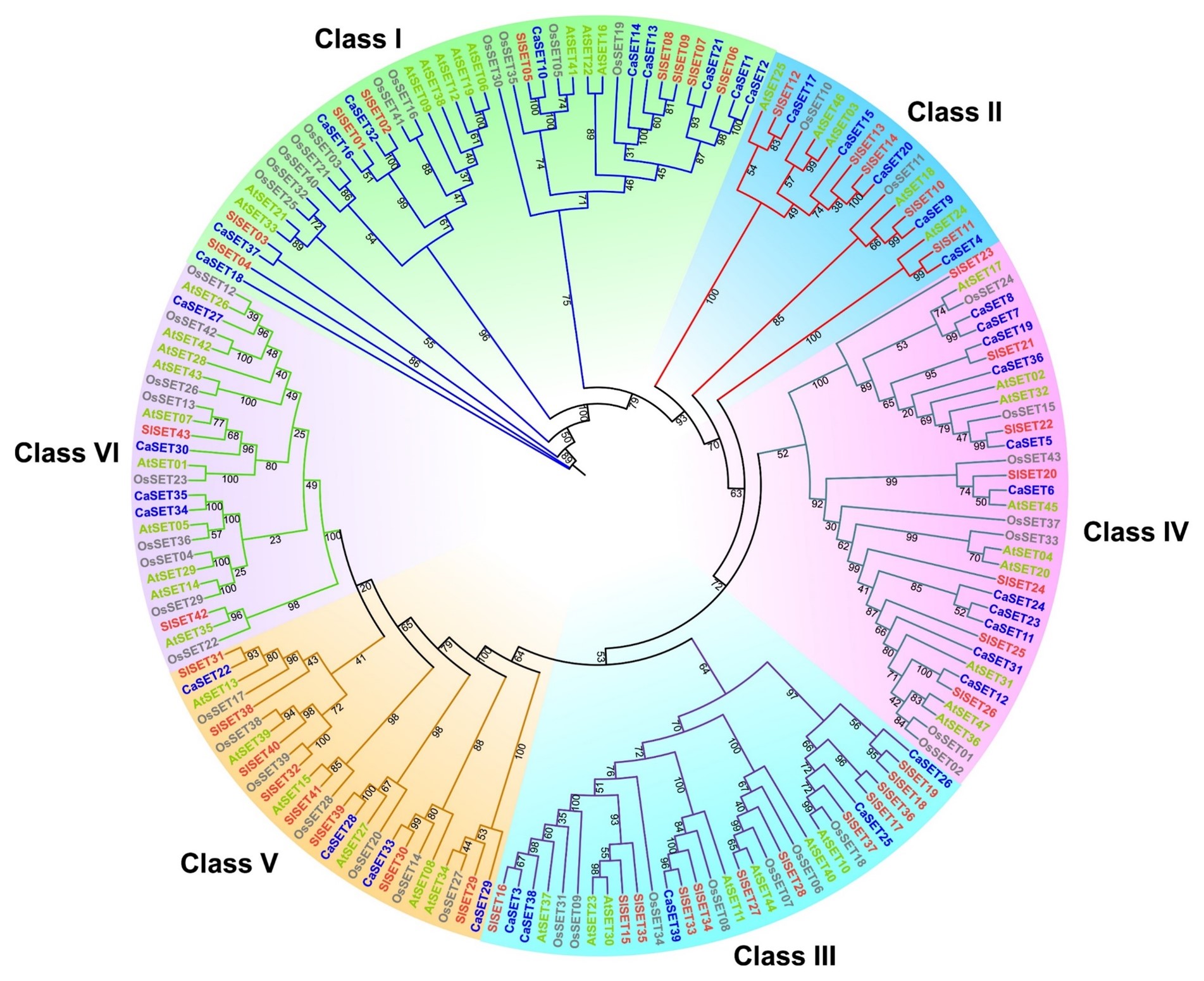
Phylogenetic tree of pepper, Arabidopsis, rice and tomato SET members
The member of Arabidopsis (prefixed by At), rice (Os), tomato (Sl) and pepper (Ca) SET family are used, and the six clades (Class I-VI) are marked by different colors
Key words: Capsicum annuum; SET domain gene; histone methylation; drought stress; salt stress
/
| 〈 |
|
〉 |

 首页
首页