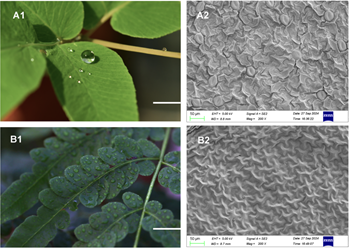
植物叶片的超疏水性结构具有防尘和防菌等重要功能, 且为人类研制仿生材料的重要基础原理。蕨类植物作为最早由水生向陆生过渡的维管植物, 其疏水结构存在显著多样性。该文在文献研究和疏水性初步观察的基础上, 选取25种蕨类植物进行叶表皮微形态研究, 并对其中20种植物进行接触角测量, 结果表明: (1) 叶片疏水性与其表面微结构密切相关, 多数疏水性蕨类植物的叶表皮呈现由多边形凸起与蜡晶体组成的多层级结构; 蕨类植物叶片接触角大于130°时, 已可观察到明显的疏水现象; (2) 生境相关性分析显示, 喜水环境中生长的蕨类植物, 其疏水性表现更加显著; (3) 基于叶绿体基因组的系统发育分析表明, 蕨类植物的疏水特性呈现多次独立起源的演化模式。作为最古老的陆生维管植物类群, 蕨类植物超疏水机制研究为理解植物适应陆地环境的演化策略提供了新视角, 也为开发新型仿生功能材料提供了新的天然模板。
曾霓
,
孙维悦
,
舒江平
,
周定港
,
严岳鸿
,
何祖霞
. 蕨类植物叶表皮微形态与超疏水效应研究[J]. 植物学报, 2026
, 61(5)
: 846
-858
.
DOI: 10.11983/CBB25141
INTRODUCTION: The superhydrophobic structures on plant leaves are crucial for self-cleaning and anti-microbial functions, acting as both a core functional mechanism and a biomimetic blueprint for advanced materials design. Ferns, as the earliest vascular plants that transitioned from aquatic to terrestrial habitats, have evolved a remarkable diversity of these water-repellent structures, offering unique insights into their evolutionary adaptations. However, systematic studies on the hydrophobic mechanisms and adaptive significance of ferns remain relatively scarce.
RATIONALE: To elucidate the structural basis, ecological relevance, and evolutionary trajectory of superhydrophobicity in ferns, we combined literature review and preliminary observations to select 25 fern species for detailed analysis of leaf epidermal micromorphology. Among these, 20 species exhibiting notable hydrophobic properties were further investigated to quantify their surface wettability and correlate microstructure with function. We integrated habitat preference data and phylogenetic reconstructions based on chloroplast genomes to examine the potential influence of environmental factors and evolutionary history on the development of hydrophobic traits.
RESULTS: Our investigations revealed that leaf hydrophobicity in ferns is closely associated with surface microstructure. Most hydrophobic species displayed hierarchical structures comprising polygonal protrusions and epicuticular wax crystals, with a contact angle exceeding 130° serving as a reliable indicator of significant hydrophobicity. Habitat correlation analysis indicated that species endemic to humid or water-rich environments exhibited more pronounced hydrophobic properties. Furthermore, phylogenetic reconstruction demonstrated that superhydrophobicity evolved independently multiple times during fern diversification, suggesting convergent adaptation to specific ecological conditions.
CONCLUSION: Leaf hydrophobicity in ferns correlates directly with surface microstructure complexity, exhibiting unique multi-scale hierarchical organizations. Notably, a contact angle exceeding 130° already induces distinct hydrophobicity in ferns-lower than the conventional 140° threshold for superhydrophobicity. Species from humid habitats show enhanced water repellency, supporting superhydrophobicity as an evolutionary adaptation to environmental constraints. These findings advance the theoretical framework for plant surface hydrophobicity and provide biomimetic design principles for functional materials. Future studies should examine wax chemistry, ecological factors, and soral structures to further elucidate hydrophobic mechanisms.
[1] Baker EA (1982). Chemistry and morphology of plant epicuticular waxes. In: Cutler DF, Alvin KL, Price CE, eds. The Plant Cuticle. London: Academic Press. pp. 139-166.
[2] Barthlott W, Büdel B, Mail M, Neumann KM, Bartels D, Fischer E (2022). Superhydrophobic terrestrial cyanobacteria and land plant transition.Front Plant Sci 13, 880439.
[3] Barthlott W, Mail M, Bhushan B, Koch K (2017). Plant surfaces: structures and functions for biomimetic innovations.Nanomicro Lett 9, 23.
[4] Barthlott W, Mail M, Neinhuis C (2016). Superhydrophobic hierarchically structured surfaces in biology: evolution, structural principles and biomimetic applications.Philos Trans A Math Phys Eng Sci 374, 20160191.
[5] Barthlott W, Neinhuis C (1997). Purity of the sacred lotus, or escape from contamination in biological surfaces.Planta 202, 1-8.
[6] Barthlott W, Neinhuis C, Cutler D, Ditsch F, Meusel I, Theisen I, Wilhelmi H (1998). Classification and terminology of plant epicuticular waxes.Bot J Linn Soc 126, 237-260.
[7] Barthlott W, Schimmel T, Wiersch S, Koch K, Brede M, Barczewski M, Walheim S, Weis A, Kaltenmaier A, Leder A, Bohn HF (2010). TheSalvinia paradox: superhydrophobic surfaces with hydrophilic pins for air retention under water. Adv Mater 22, 2325-2328.
[8] Barthlott W, Wiersch S, Čolić Z, Koch K (2009). Classification of trichome types within species of the water fernSalvinia, and ontogeny of the egg-beater trichomes. Botany 87, 830-836.
[9] Cassie ABD, Baxter S (1944). Wettability of porous surfaces.Trans Faraday Soc 40, 546-551.
[10] Feng L, Zhang YN, Xi JM, Zhu Y, Wang N, Xia F, Jiang L (2008). Petal effect: a superhydrophobic state with high adhesive force.Langmuir 24, 4114-4119.
[11] Fogg GE (1944). Diurnal fluctuation in a physical property of leaf cuticle.Nature 154, 515.
[12] Gao LC, McCarthy TJ (2006). The “lotus effect” explained: two reasons why two length scales of topography are important.Langmuir 22, 2966-2967.
[13] Gao XF, Jiang L (2004). Water-repellent legs of water striders.Nature 432, 36.
[14] Guo ZG, Liu WM (2007). Biomimic from the superhydrophobic plant leaves in nature: binary structure and unitary structure.Plant Sci 172, 1103-1112.
[15] Hansen WR, Autumn K (2005). Evidence for self-cleaning in gecko setae.Proc Natl Acad Sci USA 102, 385-389.
[16] Jeffree CE (1986). The cuticle, epicuticular waxes and trichomes of plants, with reference to their structure, functions and evolution. In: Juniper BE, Southwood TRE, eds. Insects and the Plant Surface. London: Edward Arnold Publishers Ltd. pp. 23-64.
[17] Jin DM, Zhou XL, Schneider H, Wei HJ, Wei HY, Yan YH (2021). Functional traits: adaption of ferns in forest.J Syst Evol 59, 1040-1050.
[18] Law KY (2014). Definitions for hydrophilicity, hydrophobicity, and superhydrophobicity: getting the basics right.J Phys Chem Lett 5, 686-688.
[19] Li MT, Yu LJ, Li W, Li Q, Li T, Miao YJ, Liu JM (2006). Ecological adaptation ofAdiantum flabellulatum leaf in Karst areas. Chin Bull Bot 23, 691-697. (in Chinese with English abstract)
栗茂腾, 余龙江, 李为, 李强, 李涛, 苗英杰, 刘建民 (2006). 扇叶铁线蕨叶片对岩溶环境的生态适应. 植物学通报 23, 691-697.
[20] Neinhuis C, Barthlott W (1997). Characterization and distribution of water-repellent, self-cleaning plant surfaces.Ann Bot 79, 667-677.
[21] Nguyen SH, Webb HK, Mahon PJ, Crawford RJ, Ivanova EP (2014). Natural insect and plant micro-/nanostructured surfaces: an excellent selection of valuable templates with superhydrophobic and self-cleaning properties.Molecules 19, 13614-13630.
[22] Prats KA (2022). Fern Ecophysiology: Linking Photosynthesis, Water Relations, and Stomatal Dynamics in Ferns. PhD dissertation. New Haven: Yale University. pp. 1-168.
[23] Smith WK, McClean TM (1989). Adaptive relationship between leaf water repellency, stomatal distribution, and gas exchange.Am J Bot 76, 465-469.
[24] Wenzel RN (1936). Resistance of solid surfaces to wetting by water.Ind Eng Chem 28, 988-994.
[25] Young T (1805). An essay on the cohesion of fluids.Philos Trans R Soc Lond 95, 65-87.
[26] Zhang KX, Li Z, Maxey M, Chen S, Karniadakis GE (2019). Self-cleaning of hydrophobic rough surfaces by coalescence-induced wetting transition.Langmuir 35, 2431-2442.
[27] Zhang SB, Sun M, Cao KF, Hu H, Zhang JL (2014). Leaf photosynthetic rate of tropical ferns is evolutionarily linked to water transport capacity.PLoS One 9, e84682.


 首页