
多肉植物普适组织培养体系构建及其解剖结构特征分析
收稿日期: 2025-08-27
录用日期: 2025-12-06
网络出版日期: 2025-12-17
基金资助
国家自然科学基金委青年基金(32401931)
湖南省创新计划资助项目(2021RC1013)
湖南省普通高等学校教学改革研究项目(JGZD2429)
Establishment of a Universal Tissue Culture System and Anatomical Structure Characteristics of Succulent Plants
Received date: 2025-08-27
Accepted date: 2025-12-06
Online published: 2025-12-17
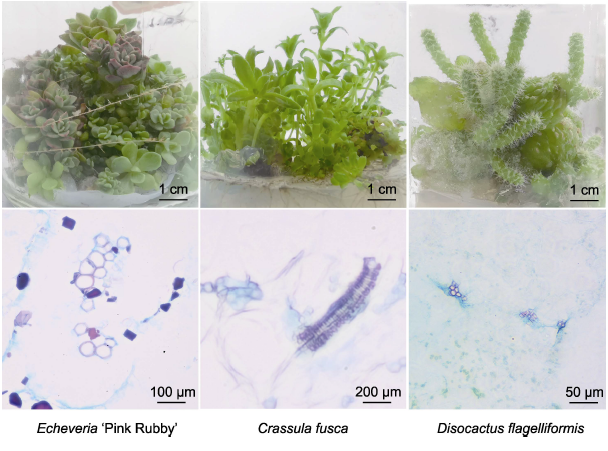
多肉植物形态多样、附加值高且抗逆性强, 但其产业化进程受制于繁殖系数低和种子量小等因素, 组织培养技术为突破这一困境提供了新路径。然而不同品种多肉植物所用的培养基不同增加了快繁体系构建的难度。因此, 该研究选取颜色和形状具有多样化的2个科3个属的多肉植物(红宝石( Echeveria ‘Pink Rubby’)、赤鬼城( Crassula fusca)以及鼠尾掌( Disocactus flagelliformis))为实验材料, 建立叶(或茎)普适的外植体消毒法、不定芽分化、不定芽生根(传统和开放式组培法)和移栽的组织培养体系, 以及多肉植物的冰冻切片技术, 以便分析组培苗与盆栽苗的解剖结构差异。结果表明, 最适通用叶(或茎)分化芽和芽生根培养基分别为MS+3.0 mg·L–1 6-BA+0.8 mg·L–1 NAA(诱导率达95%以上)以及MS+4.0 mg·L–1 IBA+2.0 mg·L–1 NAA+0.4 mg·L–1 KT(开放式培养时添加0.3 mL·L–1 S206, 生根率达90%以上); 最适通用移栽基质为草炭土:沙=2:1(v/v), 成活率达99%以上。3种多肉植物组培苗的上表皮厚度均显著小于实生苗, 仅1种植物(鼠尾掌)维管束面积远小于实生苗, 而在维管束数量方面组培苗占据优势。建立的冰冻切片技术采用普通胶水包埋, 价格低廉且简便易操作, 普适性强。该研究为多肉植物的快速繁殖和移栽驯化提供了实践参考。
文梦奇 , 唐映红 , 赵灿材 , 伍茗 , 郑伊倩 , 罗璐 , 陈建荣 . 多肉植物普适组织培养体系构建及其解剖结构特征分析[J]. 植物学报, 2026 , 61(3) : 506 -518 . DOI: 10.11983/CBB25154
INTRODUCTION: Succulent plants have high added value with high morphological diversity and strong stress resistance. However, the industrial production of these plants encounters obstacles such as the challenge of low propagation efficiency and small seed quantities. Tissue culture technology offers a novel solution to overcome these challenges. However, significant differences in the culture medium used between different species and the difficulty of cross group generalization of tissue culture parameters have increased the difficulty of establishing rapid propagation systems. RATIONALE: Therefore, the three succulent plants with diverse colors and shapes ( Echeveria ‘Pink Rubby’, Crassula fusca, and Disocactus flagelliformis) from two families and three genera were selected as experimental materials in this study. The universal issue culture system and freezing section techniques for succulent plants were be established, including procedures for disinfecting leaf/stem explants, differentiating adventitious buds, rooting adventitious buds (using traditional and open tissue culture methods), and transplanting. A frozen section technique to facilitate the analysis of anatomical structural differences between tissue culture plantlets and wild seedlings. RESULTS: We found that the optimal medium for leaf/stem differentiation adventitious bud was MS supplemented with 3.0 mg·L–1 6-BA and 0.8 mg·L–1 NAA, achieving an induction rate of over 95%. For adventitious bud rooting, the optimal medium of MS with 4.0 mg·L–1 IBA, 2.0 mg·L–1 NAA, and 0.4 mg·L–1 KT, further enhanced with an additional 0.3 mg·L–1 S206 in open tissue culture, resulted in a rooting rate exceeding 90%. The optimal universal transplanting substrate was a mix of grass charcoal soil and sand at a ratio of 2:1 by volume, resulting in a survival rate exceeding 99%. In addition, we found that the epidermal thickness of tissue cultured plantlets of three succulent plants were significantly thinner than that of wild seedlings. Only the vascular bundle area of Disocactus flagelliformis was much smaller than that of wild seedlings, but the number of vascular bundles of tissue cultured plantlets was significantly higher than that of wild seedlings. The frozen section technique was established uses conventional glue embedding, offering low cost, ease of operation, and universality. CONCLUSION: Our findings offer theoretical underpinning for establishing an efficient different species propagation system and frozen section technique. This study provides practical references for the rapid propagation and transplantation domestication of succulent plants.
|
柴清东, 陈明真, 范之斌, 白艳丽, 王凤冯, 刘柏玲 (2018).多肉植物黑王子组织培养体系的研究. 曲阜师范大学学报(自然科学版) 44, 91–94.
|
|
陈伟, 曾凡, 赵光辉 (2021). 多肉植物红宝石组织培养快繁技术. 福建农业科技 52, 33–38.
|
|
陈艺荃, 罗远华, 吴建设, 林兵, 叶秀仙 (2024). 景天科多肉植物品种资源评价体系构建及应用. 福建农业学报 39, 320–329.
|
|
党霓裳, 高润梅, 石晓东, 张雨晴, 李红月(2021). 穿龙薯蓣种子离体再生体系构建及其组培苗解剖结构特征. 西北植物学报 41, 585–594.
|
|
冯贤云, 谢淋 (2022). 多肉绿植培育及市场价值分析. 贵州农机化 (1), 30–32.
|
|
胡颖慧, 马春祥, 梁孝莉 (2014). 松塔景天组织培养与快速繁殖的研究. 中国林副特产 (2), 3–6.
|
|
黄利辉, 王艺胜, 翁飞凤, 罗璐, 张天翼, 汪秀 (2016). 景天科多肉植物愈伤组织诱导体系的建立. 南方农业 10, 59–62.
|
|
金点坤, 吕卓, 王曙光, 龙昊, 张冲, 王声翰 (2023). 6种竹子叶器官的解剖结构比较. 南京林业大学学报(自然科学版) 47, 109–120.
|
|
李玥莹, 赵冯杰, 栾宇佳, 吴天洋, 潘汝佳 (2022). 景天科多肉植物组织培养研究进展. 乡村科技 13(12), 70–73.
|
|
李尊洋, 刘贺, 刘璇, 王红玉, 卢姝梦, 孔令婧 (2020). 光照强度对‘红宝石’多肉叶片呈色及冠幅的影响. 现代园艺 43(7), 26–28.
|
|
刘芳, 唐映红, 袁有美, 郭清泉, 沈帆, 陈建荣 (2016). 多肉植物劳尔的组织培养. 植物学报 51, 251–256.
|
|
卢兴霞, 柴慈江, 张婷, 史燕山, 骆建霞 (2014). 栒子试管苗玻璃化影响因素的研究. 北方园艺 (18), 103–106.
|
|
秦扬 (2016). 景天科三个属植物组培体系的建立与植株再生研究. 硕士论文. 银川: 宁夏大学. pp. 1–37.
|
|
邱小芳 (2017). 几种多肉植物离体再生体系的建立. 硕士论文. 太原: 山西农业大学. pp. 2.
|
|
王少翠, 杜欢欢, 戴希尧, 刘婕, 李占台, 任喜波 (2022). 我国多肉植物组织培养研究进展. 河北北方学院学报(自然科学版) 38, 25–29, 37.
|
|
王心可, 郭庆梅 (2021). 冰冻切片技术在高等植物中的应用. 植物生理学报 57, 1047–1054.
|
|
王燕, 牟豪杰, 吕永平, 李海营, 汪一婷, 陈剑平 (2017). 寿锦的离体植株再生及组培产业化增殖. 植物学报 52, 331-336.
|
|
卫卫, 李梅兰, 朱木兰 (2018). 多肉植物离体再生研究进展. 生物资源 40, 308-313.
|
|
伍茗, 唐映红, 罗璐, 郑伊倩, 谢丹妮, 何奕奕 (2023). 多肉植物红宝石快速繁殖体系的建立. 湖南文理学院学报(自然科学版) 35(4), 51-55.
|
|
吴卢, 上官小卢 (2020). 多肉植物大苍角殿再生体系的建立. 山西农业科学 48, 1557-1560, 1592.
|
|
闫金国, 王大鹏, 赵著梅, 孔丽娜 (2020). 景天科多肉植物大和锦组织培养体系的建立. 江西农业 (6), 38, 40.
|
|
壹号图编辑部 (2019). 多肉植物完全图鉴. 南京: 江苏凤凰科学技术出版社. pp. 140-141, 183.
|
|
张淑红, 吕聪真, 石林成, 高金红, 贾方方, 马丽 (2019). 枝干番杏组织培养技术. 黑龙江农业科学 (3), 21-24.
|
|
张小邱 (2018). 七种多肉植物的快繁研究. 硕士论文. 大庆: 黑龙江八一农垦大学. pp. 107.
|
|
周周周, 周周, 翟研, 姜婷婷, 周力行, 乔永旭, 蒋亚华 (2023). 多肉植物的组织培养及应用. 安徽农学通报 29(20), 47-49.
|
|
周周鹿 (2007). 降低皂质芦荟诱导愈伤组织褐化的初步研究. 江西农业大学学报 29, 539-544.
|
|
|
|
|
|
|
|
|
|
|
|
|
|
|
|
|
/
| 〈 |
|
〉 |

 首页