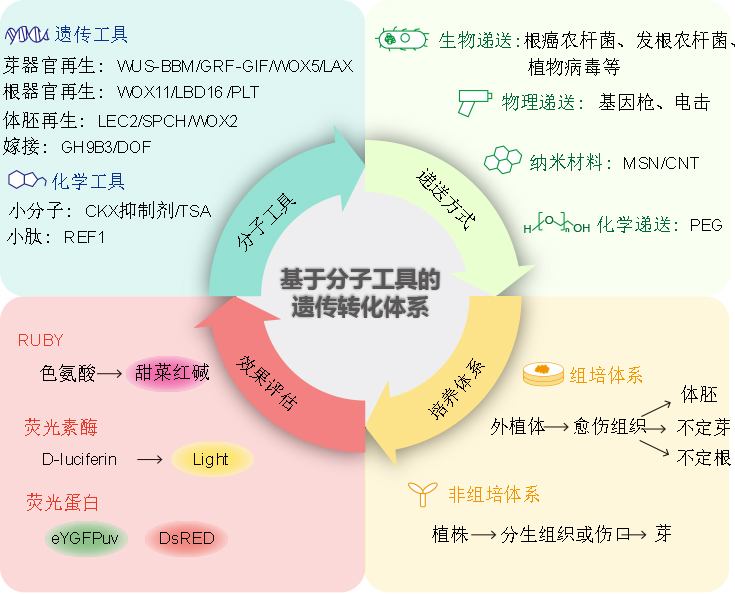
植物细胞全能性和多能性是植物再生的理论基础, 广泛应用于植物组织培养、遗传转化、扦插、嫁接等多种技术。近年来, 随着对植物再生分子机制尤其是关键转录因子、激素信号网络以及表观调控的深入解析, 一系列能够改变细胞命运的分子工具被开发出来, 为提高植物再生能力提供了新的解决方案。本文综述在芽再生、根再生、体细胞胚再生及嫁接这四个关键再生过程中发挥核心作用的分子工具以及化学工具, 探讨了工具递送方式、培养体系选择以及效果评估策略等实际应用中的关键考量, 展望了通过合理组合遗传与化学工具开发新型递送系统以及克服表观遗传障碍等未来研究方向, 为针对不同物种和再生目标定制高效再生方案提供理论指导与实践指导。
李子娟
,
翟宁
,
徐麟
. 植物再生分子工具开发的研究进展[J]. 植物学报, 2026
, 61(2)
: 213
-222
.
DOI: 10.11983/CBB25170
Totipotency and pluripotency of plant cells serve as the theoretical basis for plant regeneration, underpinning various techniques such as plant tissue culture, genetic transformation, cutting, and grafting. In recent years, advances in understanding the molecular mechanisms of plant regeneration—particularly key transcription factors, hormonal signaling networks and epigenetic factors—have led to the development of a series of molecular tools capable of manipulating cell fate, offering new strategies to enhance regenerative capacity. This review summarizes the molecular and chemical tools that play central roles in four key regenerative processes: shoot regeneration, root regeneration, somatic embryogenesis, and grafting. It also discusses practical considerations such as delivery methods for these tools, selection of culture systems, and strategies for efficacy evaluation. Furthermore, the review explores future directions, including the rational combination of genetic and chemical tools to develop novel delivery systems and overcome epigenetic barriers, thereby providing theoretical and practical guidance for designing efficient regeneration protocols tailored to different species and regeneration objectives.


 首页
首页