
糖基转移酶 CsUGT73B4和 CsUGT85K5在茶树响应低温胁迫中的分子机制
收稿日期: 2025-05-16
录用日期: 2025-10-11
网络出版日期: 2025-10-22
基金资助
山东现代农业产业技术体系建设专项(SDARS-19-05)
日照市岚山区农业农村局科技合作项目(233318)
Molecular Mechanisms of Glycosyltransferases CsUGT73B4 and CsUGT85K5 in Tea Plants in Response to Cold Stress
Received date: 2025-05-16
Accepted date: 2025-10-11
Online published: 2025-10-22
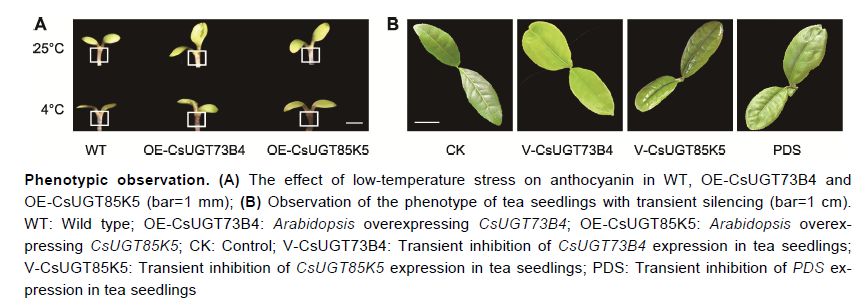
近年来, UGTs基因在植物响应非生物胁迫中的作用被逐渐揭示。基于转录组数据, 筛选出2个在低温胁迫下显著上调, 且与茶树( Camellia sinensis)花青苷合成相关的糖基转移酶基因 CsUGT73B4(CSS0039619)和 CsUGT85K5(CSS0047548)。为探究这2个基因在响应低温胁迫下调控茶树花青苷代谢的分子机制, 克隆了 CsUGT73B4和 CsUGT85K5并进行生物信息学分析, 通过拟南芥( Arabidopsis thaliana)过表达和茶树瞬时沉默实验验证其功能。结果显示, 低温胁迫下 CsUGT73B4/ CsUGT85K5基因的表达与花青苷积累呈正相关; 过表达拟南芥植株的花青苷含量和抗氧化酶活性显著提高, 丙二醛含量和相对电导率则显著下降; 在茶树中瞬时沉默 CsUGT73B4或 CsUGT85K5后, 花青苷含量及其合成相关基因的表达水平均显著下调。该研究初步探讨了茶树 CsUGT73B4和 CsUGT85K5基因的功能, 揭示了其通过调控花青苷代谢提高茶树抗寒性的分子机制, 为茶树抗寒分子育种提供了相关候选基因。
盖新月 , 王晓东 , 范延艮 , 李斌 , 傅晓东 , 孙平 , 黄晓琴 . 糖基转移酶 CsUGT73B4和 CsUGT85K5在茶树响应低温胁迫中的分子机制[J]. 植物学报, 2026 , 61(3) : 402 -415 . DOI: 10.11983/CBB25087
INTRODUCTION: Glycosyltransferases are key enzymes involved in various biological processes in plants. To date, glycosyltransferases have been classified into 138 families, among which the glycosyltransferase family I is the largest. This family primarily uses UDP-glucose as the glycosyl donor and is referred to as the UGT family. In recent years, the role of UGT genes in plant responses to abiotic stresses has gradually been revealed. However, currently, only a few UGT genes have been clearly identified as being involved in anthocyanin biosynthesis. RATIONALE: To explore the mechanisms of anthocyanin and its glycosylation-related genes in tea plants under low-temperature stress, this study used FudingDabai Tea as the experimental material. Based on the transcriptome sequencing data, two genes, CsUGT73B4 (CSS0039619) and CsUGT85K5 (CSS0047548), which significantly upregulate anthocyanin expression, were identified. We further investigated the changes of gene expression and explored their relationship with anthocyanin metabolism under low-temperature stress. Additionally, the functions of these two genes were verified through heterologous overexpression in Arabidopsis thaliana and gene silencing experiments. RESULTS: Under low-temperature stress, the expression of CsUGT73B4 and CsUGT85K5 genes was positively correlated with anthocyanin accumulation. In Arabidopsis thaliana plants overexpressing these genes, anthocyanin content and antioxidant enzyme activities (SOD, POD, and CAT) were significantly increased, while malondialdehyde (MDA) content and relative electrical conductivity were reduced. After transient silencing of CsUGT73B4 or CsUGT85K5 in tea plants, the anthocyanin content and the expression levels of its biosynthesis-related genes were significantly down-regulated. CONCLUSION: In summary, the CsUGT73B4 and CsUGT85K5 genes are involved in the response to low-temperature stress, regulate anthocyanin metabolism, and may enhance the cold tolerance of tea plants.
Key words: tea plant; low-temperature stress; glycosyltransferase; anthocyanin
|
蔡鸥, 赵婉琪, 孔淑鑫, 江帅君, 姚文静, 李龙, 黄菲艺, 林树燕 (2024). 植物茎秆呈色的调控机制. 分子植物育种 1-8. https://link.cnki.net/urlid/46.1068.S.20240604.1424.018.
|
|
曹艳 (2024). CsLAC29在茶树防御害虫取食中的功能研究. 硕士论文. 泰安: 山东农业大学. pp. 18-19.
|
|
代正罡, 张春, 邹华文, 吴忠义 (2023). 玉米UDP—糖基转移酶基因ZmUGT1的克隆与表达分析. 分子植物育种 1-9. https://link.cnki.net/urlid/46.1068.S.20230605.1404.006.
|
|
黄露露, 彭丽桃, 叶俊丽, 杨书珍 (2018). 糖基转移酶在果实品质形成过程中的作用研究进展. 食品与机械 34(04), 197-200.
|
|
柯燚, 高飞, 金韬, 郑丽 (2015). 温度对植物花青素苷合成影响研究进展. 中国农学通报 31(19), 101-105.
|
|
卢雯瑩, 赵磊, 李天奇, 崔鹤云, 廖平安 (2021). 蔷薇科植物果实花青苷积累研究进展. 生物技术通报 37, 234-245.
|
|
上官万福 (2020). 茶树栽培与茶园管理技术发展探究. 福建茶叶 42(3), 13.
|
|
王新超, 王璐, 郝心愿, 李娜娜, 丁长庆, 黄建燕, 杨亚军 (2022). 茶树抗寒机制研究进展与展望. 茶叶通讯 49(2), 139-148.
|
|
魏艳萍 (2024). ‘美红’苹果苗对低温胁迫的生理响应及基因表达分析. 硕士论文. 泰安: 山东农业大学. pp. 25.
|
|
夏英三, 李斌, 胡芳东, 刘晓 (2022). 日照茶区倒春寒记述的危害与对策. 落叶果树 54(4), 90-91.
|
|
谢兴斌 (2011). 苹果bHLH转录因子MdTTL1对低温诱导花青苷合成和果实着色的多途径调控. 博士论文. 泰安: 山东农业大学. pp. 30-31.
|
|
许倩, 张晨, 吴嘉维, 欧阳嘉 (2020). 花青素的生物合成研究进展. 林产化学与工业 40(3), 1-11.
|
|
杨小青, 黄晓琴, 韩晓阳, 刘腾飞, 岳晓伟, 伊冉 (2020). 外源物质对茶树耐寒及蔗糖代谢关键基因表达的影响. 植物学报 55, 21-30.
|
|
余劲夫, 李家儒 (2021). 植物中甾醇糖基转移酶的研究进展. 生物资源 43, 10-16.
|
|
张云洁, 潘怡辰, 王汝茜, 李集临, 张杰 (2014). 植物花青素生物合成途径相关基因的研究进展. 安徽农业科学 42, 12014—12016, 12080.
|
|
|
|
|
|
|
|
|
|
|
|
|
|
|
|
|
|
|
|
|
|
|
|
|
|
|
|
|
|
|
|
|
|
|
/
| 〈 |
|
〉 |

 首页
首页