
植物学报 ›› 2023, Vol. 58 ›› Issue (6): 998-1007.DOI: 10.11983/CBB22255 cstr: 32102.14.CBB22255
苏鲁方, 王萍, 李顺, 蔡燕, 郭丹丹, 刘琴, 刘小云*( )
)
收稿日期:2022-11-02
接受日期:2023-05-31
出版日期:2023-11-01
发布日期:2023-11-27
通讯作者:
* E-mail: liuxiaoyun@jhun.edu.cn
基金资助:
Lufang Su, Ping Wang, Shun Li, Yan Cai, Dandan Guo, Qin Liu, Xiaoyun Liu*()
Received:2022-11-02
Accepted:2023-05-31
Online:2023-11-01
Published:2023-11-27
Contact:
* E-mail: liuxiaoyun@jhun.edu.cn
摘要: 植物sirtuin蛋白家族是一类依赖β-烟酰胺腺嘌呤二核苷酸(β-NAD+)、分别催化非组蛋白和组蛋白赖氨酸上Nε-乙酰基和Nε-酰基(乙酰基、巴豆酰基、丁酰基和2-羟基异丁酰基)去除的酶, 具有调控非组蛋白活性和基因表达的功能。已证明sirtuin蛋白家族成员在水稻(Oryza sativa)、大豆(Glycine max)和番茄(Solanum lycopersicum)等植物的生长发育以及盐、冷、热和病原菌等胁迫响应中发挥重要的表观调控作用。该文对植物sirtuins的酶活性、催化底物、细胞定位和功能进行综述, 为理解其表观遗传调控机制及丰富新功能研究提供参考。
苏鲁方, 王萍, 李顺, 蔡燕, 郭丹丹, 刘琴, 刘小云. 植物sirtuin蛋白家族研究进展. 植物学报, 2023, 58(6): 998-1007.
Lufang Su, Ping Wang, Shun Li, Yan Cai, Dandan Guo, Qin Liu, Xiaoyun Liu. Research Progress in Sirtuin Protein Family in Plants. Chinese Bulletin of Botany, 2023, 58(6): 998-1007.
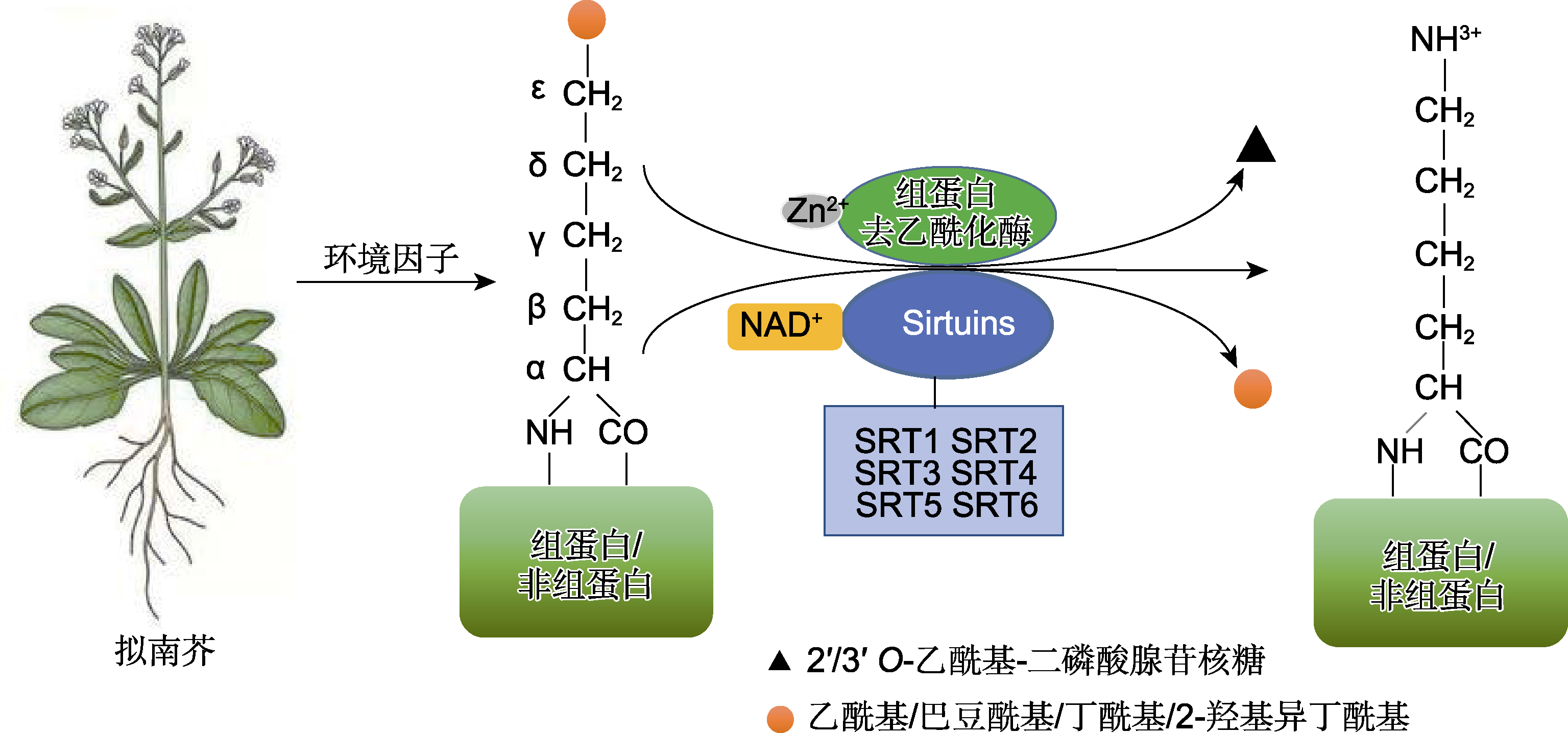
图1 蛋白质赖氨酸去酰基化过程(Narita et al., 2019)
Figure 1 The process of protein lysine diacylation (Narita et al., 2019)
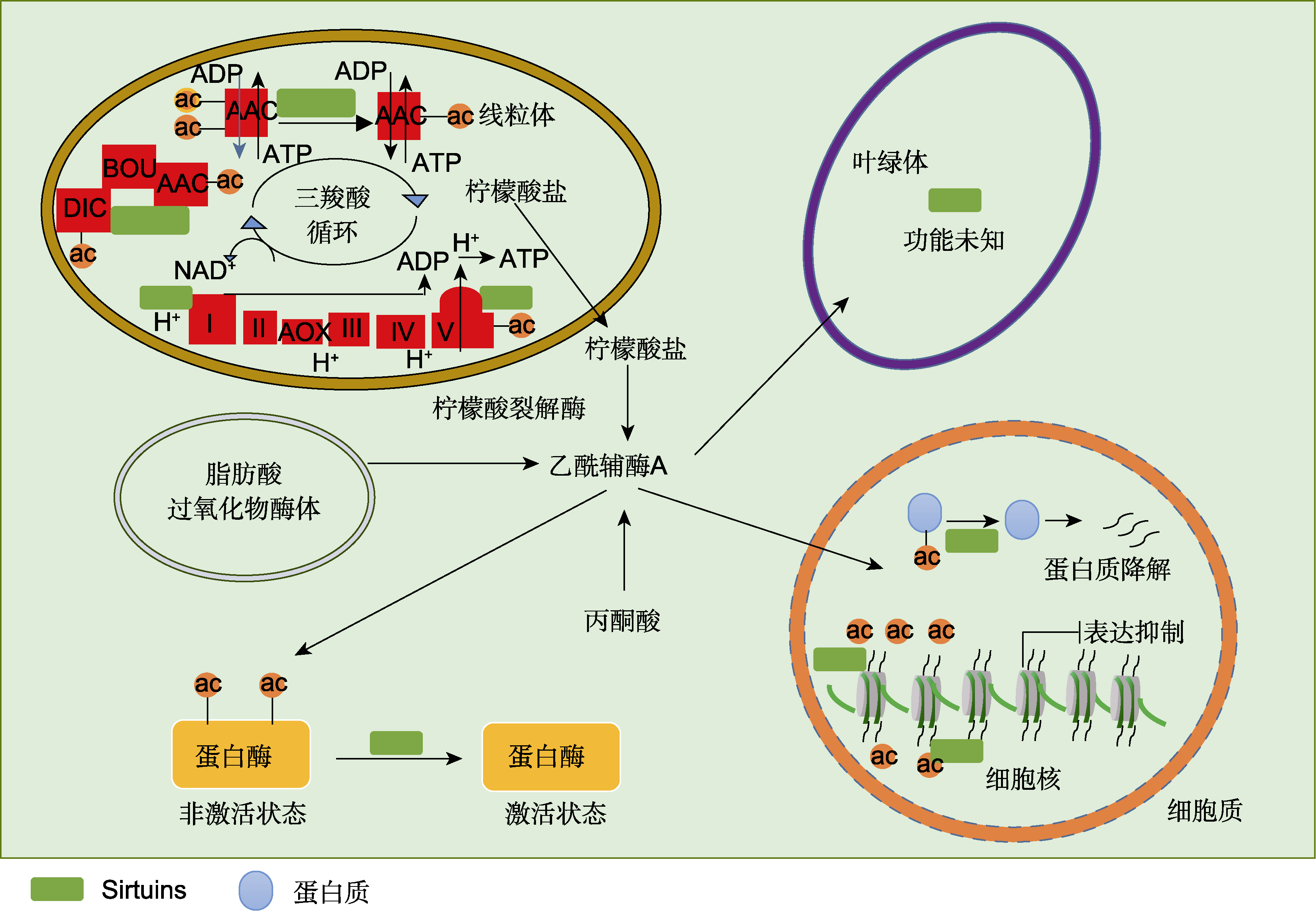
图2 植物sirtuins的功能
Figure 2 The functions of plant sirtuins
| 物种 | 蛋白名称 | 细胞定位 | 催化底物 | 酶活性 | 功能 | 参考文献 |
|---|---|---|---|---|---|---|
| 拟南芥 (Arabidopsis thaliana) | AtSRT1 | 细胞核 | H3K9ac和AtMBP1 | 去乙酰基 | 非生物胁迫响应和叶片发育 | Lee et al., |
| AtSRT2A | 线粒体 | ATP合酶和AAC1/2/3 | 去乙酰基 | 能量代谢 | K?nig et al., | |
| AtSRT2B | 细胞核 | H4K8 | 去乙酰基 | 盐胁迫响应 | Tang et al., | |
| 细胞核 | 组蛋白和H3K9ac | 去乙酰基 | 生长发育和病原菌胁迫响应 | Wang et al., | ||
| 线粒体 | ATP合酶和AAC1/2/3 | 去乙酰基 | 能量代谢 | K?nig et al., | ||
| 水稻 (Oryza sativa) | OsSRT1 | 细胞核 | H3K9ac、OsGAPDH1/ 2/5和Khib | 去乙酰基和去2-羟基异丁酰基 | 叶片衰老、种子发育、能量代谢和病原菌胁迫响应 | Zhong et al., |
| OsSRT2 | 细胞质 | OsGAPDH1 | 去乙酰基 | 能量代谢 | Lu et al., | |
| 线粒体 | H3K9ac | 去乙酰基 | 能量代谢 | Chung et al., | ||
| 细胞核 | 组蛋白和H3K9 | 去乙酰基、去巴豆酰基、去丁酰基和去2-羟基异丁酰基 | 黑暗、饥饿、淹水和病原菌胁迫响应 | Lu et al., | ||
| 大豆 (Glycine max) | GmSRT1 | 细胞质和线粒体 | H3组蛋白 | 去乙酰基 | - | Yang et al., |
| GmSRT2 | 细胞质和线粒体 | - | - | 冷、热和盐胁迫响应 | Yang et al., | |
| GmSRT3 | 细胞质和细胞核 | - | - | - | Yang et al., | |
| GmSRT4 | 细胞核 | - | - | 冷、热和盐胁迫响应 | Yang et al., | |
| 番茄(Solanum lycopersicum) | SlSRT1 | 细胞核 | - | - | 子叶、花和果实发育 | Zhao et al., |
| SlSRT2 | 细胞核和细胞质 | - | - | 子叶、叶、花和果实 发育 | Zhao et al., | |
| 葡萄(Vitis vinifera) | VvSRT1 | 细胞核和细胞质 | - | - | 根、叶、花和果实发育 | Cucurachi et al., |
| VvSRT2 | 细胞质和线粒体 | - | - | 叶、花和果实发育 | Cucurachi et al., | |
| 地线 (Marchantia polymorpha) | MpSIRT4 | 线粒体 | - | - | IAA和热胁迫响应 | Chu and Chen, |
| MpSIRT5 | 线粒体 | - | - | ABA响应 | Chu and Chen, | |
| MpSIRT6 | 细胞核和细胞质 | - | - | - | Chu and Chen, | |
| 三角褐指藻 (Phaeodacty- lum tricornutum) | PtSRT5 | 质体和细胞核 | PtACSL1 | 去乙酰基 | 脂肪酸合成 | Chen et al., |
| PtSRT3 | - | - | - | - | Chen et al., | |
| PtSRT2 | - | - | - | - | Chen et al., | |
| PtSRT4 | - | - | - | - | Chen et al., |
表1 植物sirtuins的分类和功能
Table 1 Classification and function of plant sirtuins
| 物种 | 蛋白名称 | 细胞定位 | 催化底物 | 酶活性 | 功能 | 参考文献 |
|---|---|---|---|---|---|---|
| 拟南芥 (Arabidopsis thaliana) | AtSRT1 | 细胞核 | H3K9ac和AtMBP1 | 去乙酰基 | 非生物胁迫响应和叶片发育 | Lee et al., |
| AtSRT2A | 线粒体 | ATP合酶和AAC1/2/3 | 去乙酰基 | 能量代谢 | K?nig et al., | |
| AtSRT2B | 细胞核 | H4K8 | 去乙酰基 | 盐胁迫响应 | Tang et al., | |
| 细胞核 | 组蛋白和H3K9ac | 去乙酰基 | 生长发育和病原菌胁迫响应 | Wang et al., | ||
| 线粒体 | ATP合酶和AAC1/2/3 | 去乙酰基 | 能量代谢 | K?nig et al., | ||
| 水稻 (Oryza sativa) | OsSRT1 | 细胞核 | H3K9ac、OsGAPDH1/ 2/5和Khib | 去乙酰基和去2-羟基异丁酰基 | 叶片衰老、种子发育、能量代谢和病原菌胁迫响应 | Zhong et al., |
| OsSRT2 | 细胞质 | OsGAPDH1 | 去乙酰基 | 能量代谢 | Lu et al., | |
| 线粒体 | H3K9ac | 去乙酰基 | 能量代谢 | Chung et al., | ||
| 细胞核 | 组蛋白和H3K9 | 去乙酰基、去巴豆酰基、去丁酰基和去2-羟基异丁酰基 | 黑暗、饥饿、淹水和病原菌胁迫响应 | Lu et al., | ||
| 大豆 (Glycine max) | GmSRT1 | 细胞质和线粒体 | H3组蛋白 | 去乙酰基 | - | Yang et al., |
| GmSRT2 | 细胞质和线粒体 | - | - | 冷、热和盐胁迫响应 | Yang et al., | |
| GmSRT3 | 细胞质和细胞核 | - | - | - | Yang et al., | |
| GmSRT4 | 细胞核 | - | - | 冷、热和盐胁迫响应 | Yang et al., | |
| 番茄(Solanum lycopersicum) | SlSRT1 | 细胞核 | - | - | 子叶、花和果实发育 | Zhao et al., |
| SlSRT2 | 细胞核和细胞质 | - | - | 子叶、叶、花和果实 发育 | Zhao et al., | |
| 葡萄(Vitis vinifera) | VvSRT1 | 细胞核和细胞质 | - | - | 根、叶、花和果实发育 | Cucurachi et al., |
| VvSRT2 | 细胞质和线粒体 | - | - | 叶、花和果实发育 | Cucurachi et al., | |
| 地线 (Marchantia polymorpha) | MpSIRT4 | 线粒体 | - | - | IAA和热胁迫响应 | Chu and Chen, |
| MpSIRT5 | 线粒体 | - | - | ABA响应 | Chu and Chen, | |
| MpSIRT6 | 细胞核和细胞质 | - | - | - | Chu and Chen, | |
| 三角褐指藻 (Phaeodacty- lum tricornutum) | PtSRT5 | 质体和细胞核 | PtACSL1 | 去乙酰基 | 脂肪酸合成 | Chen et al., |
| PtSRT3 | - | - | - | - | Chen et al., | |
| PtSRT2 | - | - | - | - | Chen et al., | |
| PtSRT4 | - | - | - | - | Chen et al., |
| [1] |
陈聪, 宋江波, 孟刚, 童晓玲, 代方银, 鲁成 (2014). 家蚕sirtuin家族基因的鉴定及系统发生与表达芯片分析. 中国农业科学 47, 2659-2670.
DOI |
| [2] |
陈威, 杨颖增, 陈锋, 周文冠, 舒凯 (2019). 表观遗传修饰介导的植物胁迫记忆. 植物学报 54, 779-785.
DOI |
| [3] |
Bheda P, Jing H, Wolberger C, Lin HN (2016). The substrate specificity of sirtuins. Annu Rev Biochem 85, 405-429.
DOI PMID |
| [4] |
Blander G, Guarente L (2004). The Sir2 family of protein deacetylases. Annu Rev Biochem 73, 417-435.
PMID |
| [5] |
Bourque S, Dutartre A, Hammoudi V, Blanc S, Dahan J, Jeandroz S, Pichereaux C, Rossignol M, Wendehenne D (2011). Type-2 histone deacetylases as new regulators of elicitor-induced cell death in plants. New Phytol 192, 127-139.
DOI PMID |
| [6] |
Bruscalupi G, Di Micco P, Failla CM, Pascarella G, Morea V, Saliola M, De Paolis A, Venditti S, Mauro ML (2023). Arabidopsis thaliana sirtuins control proliferation and glutamate dehydrogenase activity. Plant Physiol Biochem 194, 236-245.
DOI URL |
| [7] |
Cantó C, Auwerx J (2011). NAD+ as a signaling molecule modulating metabolism. Cold Spring Harb Symp Quant Biol 76, 291-298.
DOI PMID |
| [8] | Carabetta VJ, Cristea IM (2017). Regulation, function, and detection of protein acetylation in bacteria. J Bacteriol 199, e00107-17. |
| [9] |
Carrico C, Meyer JG, He WJ, Gibson BW, Verdin E (2018). The mitochondrial acylome emerges: proteomics, regulation by sirtuins, and metabolic and disease implications. Cell Metab 27, 497-512.
DOI PMID |
| [10] |
Chen B, Zang WW, Wang J, Huang YJ, He YH, Yan LL, Liu JJ, Zheng WP (2015). The chemical biology of sirtuins. Chem Soc Rev 44, 5246-5264.
DOI PMID |
| [11] |
Chen XY, Xu QT, Duan YH, Liu H, Chen XL, Huang JB, Luo CX, Zhou DX, Zheng L (2021). Ustilaginoidea virens modulates lysine 2-hydroxyisobutyrylation in rice flowers during infection. J Integr Plant Biol 63, 1801-1814.
DOI URL |
| [12] |
Chen Z, Luo L, Chen RF, Hu HH, Pan YF, Jiang HB, Wan X, Jin H, Gong YM (2018). Acetylome profiling reveals extensive lysine acetylation of the fatty acid metabolism pathway in the diatom Phaeodactylum tricornutum. Mol Cell Proteomics 17, 399-412.
DOI URL |
| [13] |
Chu JS, Chen Z (2018). Molecular identification of histone acetyltransferases and deacetylases in lower plant Marchantia polymorpha. Plant Physiol Biochem 132, 612-622.
DOI URL |
| [14] |
Chung PJ, Kim YS, Park SH, Nahm BH, Kim JK (2009). Subcellular localization of rice histone deacetylases in organelles. FEBS Let 583, 2249-2254.
DOI URL |
| [15] |
Cucurachi M, Busconi M, Morreale G, Zanetti A, Bavaresco L, Fogher C (2012). Characterization and differential expression analysis of complete coding sequences of Vitis vinifera L. sirtuin genes. Plant Physiol Biochem 54, 123-132.
DOI URL |
| [16] |
De Block M, Van Lijsebettens M (2011). Energy efficiency and energy homeostasis as genetic and epigenetic components of plant performance and crop productivity. Curr Opin Plant Biol 14, 275-282.
DOI PMID |
| [17] |
De Block M, Verduyn C, De Brouwer D, Cornelissen M (2005). Poly (ADP-ribose) polymerase in plants affects energy homeostasis, cell death and stress tolerance. Plant J 41, 95-106.
PMID |
| [18] |
Dutta A, Abmayr SM, Workman JL (2016). Diverse activities of histone acylations connect metabolism to chromatin function. Mol Cell 63, 547-552.
DOI PMID |
| [19] |
Fan W, Luo JY (2010). SIRT1 regulates UV-induced DNA repair through deacetylating XPA. Mol Cell 39, 247-258.
DOI PMID |
| [20] |
Fang CY, Zhang H, Wan J, Wu YY, Li K, Jin C, Chen W, Wang SC, Wang WS, Zhang HW, Zhang P, Zhang F, Qu LH, Liu XQ, Zhou DX, Luo J (2016). Control of leaf senescence by an MeOH-jasmonates cascade that is epigenetically regulated by OsSRT1 in rice. Mol Plant 9, 1366-1378.
DOI URL |
| [21] |
Fang Y, Tang S, Li XL (2019). Sirtuins in metabolic and epigenetic regulation of stem cells. Trends Endocrinol Metabol 30, 177-188.
DOI URL |
| [22] |
Feldman JL, Dittenhafer-Reed KE, Denu JM (2012). Sirtuin catalysis and regulation. J Biol Chem 287, 42419-42427.
DOI PMID |
| [23] |
Greiss S, Gartner A (2009). Sirtuin/Sir2 phylogeny, evolutionary considerations and structural conservation. Mol Cells 28, 407-415.
DOI PMID |
| [24] |
Guarente L (2011). The logic linking protein acetylation and metabolism. Cell Metab 14, 151-153.
DOI PMID |
| [25] |
Hashida SN, Takahashi H, Uchimiya H (2009). The role of NAD biosynthesis in plant development and stress responses. Ann Bot 103, 819-824.
DOI URL |
| [26] |
Huang LM, Sun QW, Qin FJ, Li C, Zhao Y, Zhou DX (2007). Down-regulation of a SILENT INFORMATION REGULATOR2-related histone deacetylase gene, OsSRT1, induces DNA fragmentation and cell death in rice. Plant Physiol 144, 1508-1519.
DOI URL |
| [27] |
Imai SI, Armstrong CM, Kaeberlein M, Guarente L (2000). Transcriptional silencing and longevity protein Sir2 is an NAD-dependent histone deacetylase. Nature 403, 795-800.
DOI |
| [28] |
Kaelin WG Jr, McKnight SL (2013). Influence of metabolism on epigenetics and disease. Cell 153, 56-69.
DOI PMID |
| [29] |
Kang M, Abdelmageed H, Lee S, Reichert A, Mysore KS, Allen RD (2013). AtMBP-1, an alternative translation product of LOS2, affects abscisic acid responses and is modulated by the E3 ubiquitin ligase AtSAP5. Plant J 76, 481-493.
DOI URL |
| [30] |
König AC, Hartl M, Pham PA, Laxa M, Boersema PJ, Orwat A, Kalitventseva I, Plöchinger M, Braun HP, Leister D, Mann M, Wachter A, Fernie AR, Finkemeier I (2014). The Arabidopsis class II sirtuin is a lysine deacetylase and interacts with mitochondrial energy metabolism. Plant Physiol 164, 1401-1414.
DOI URL |
| [31] | Lee IH, Cao L, Mostoslavsky R, Lombard DB, Liu J, Bruns NE, Tsokos M, Alt FW, Finkel T (2008). A role for the NAD-dependent deacetylase Sirt1 in the regulation of autophagy. Proc Natl Acad Sci USA 105, 3374-3379. |
| [32] |
Lee K, Park OS, Jung SJ, Seo PJ (2016). Histone deacetylation-mediated cellular dedifferentiation in Arabidopsis. J Plant Physiol 191, 95-100.
DOI URL |
| [33] | Li SC, Zheng WP (2018). Mammalian sirtuins SIRT4 and SIRT7. Prog Mol Biol Transl Sci 154, 147-168. |
| [34] |
Liu XY, Wei W, Zhu WJ, Su LF, Xiong ZY, Zhou M, Zheng Y, Zhou DX (2017). Histone deacetylase AtSRT1 links metabolic flux and stress response in Arabidopsis. Mol Plant 10, 1510-1522.
DOI URL |
| [35] |
Lu Y, Xu QT, Liu Y, Yu Y, Cheng ZY, Zhao Y, Zhou DX (2018). Dynamics and functional interplay of histone lysine butyrylation, crotonylation, and acetylation in rice under starvation and submergence. Genome Biol 19, 144.
DOI PMID |
| [36] |
Narita T, Weinert BT, Choudhary C (2019). Functions and mechanisms of non-histone protein acetylation. Nat Rev Mol Cell Biol 20, 156-174.
DOI |
| [37] |
O'Callaghan C, Vassilopoulos A (2017). Sirtuins at the crossroads of stemness, aging, and cancer. Aging Cell 16, 1208-1218.
DOI PMID |
| [38] | Rajabi N, Galleano I, Madsen AS, Olsen CA (2018). Targeting sirtuins: substrate specificity and inhibitor design. Prog Mol Biol Transl Sci 154, 25-69. |
| [39] |
Reed SM, Quelle DE (2015). p53 acetylation: regulation and consequences. Cancers 7, 30-69.
DOI URL |
| [40] |
Ringel AE, Tucker SA, Haigis MC (2018). Chemical and physiological features of mitochondrial acylation. Mol Cell 72, 610-624.
DOI PMID |
| [41] |
Sridha S, Wu KQ (2006). Identification of AtHD2C as a novel regulator of abscisic acid responses in Arabidopsis. Plant J 46, 124-133.
DOI URL |
| [42] | Sundaresan NR, Pillai VB, Wolfgeher D, Samant S, Vasudevan P, Parekh V, Raghuraman H, Cunningham JM, Gupta M, Gupta MP (2011). The deacetylase SIRT1 promotes membrane localization and activation of AKT and PDK1 during tumorigenesis and cardiac hypertrophy. Sci Signal 4, ra46. |
| [43] |
Tang WS, Zhong L, Ding QQ, Dou YN, Li WW, Xu ZS, Zhou YB, Chen J, Chen M, Ma YZ (2022). Histone deacetylase AtSRT2 regulates salt tolerance during seed germination via repression of vesicle-associated membrane protein 714 (VAMP714) in Arabidopsis. New Phytol 234, 1278-1293.
DOI URL |
| [44] |
Vall-Llaura N, Torres R, Lindo-García V, Muñoz P, Munné-Bosch S, Larrigaudière C, Teixidó N, Giné- Bordonaba J (2021). PbSRT1 and PbSRT2 regulate pear growth and ripening yet displaying a species-specific regulation in comparison to other Rosaceae spp. Plant Sci 308, 110925.
DOI URL |
| [45] |
Wang CZ, Gao F, Wu JG, Dai JL, Wei H, Li Y (2010). Arabidopsis putative deacetylase AtSRT2 regulates basal defense by suppressing PAD4, EDS5 and SID2 expression. Plant Cell Physiol 51, 1291-1299.
DOI URL |
| [46] |
Yamamori T, DeRicco J, Naqvi A, Hoffman TA, Mattagajasingh I, Kasuno K, Jung SB, Kim CS, Irani K (2010). SIRT1 deacetylates APE1 and regulates cellular base excision repair. Nucleic Acids Res 38, 832-845.
DOI PMID |
| [47] |
Yang C, Shen WJ, Chen HF, Chu LT, Xu YC, Zhou XC, Liu CL, Chen CM, Zeng JH, Liu J, Li QF, Gao CJ, Charron JB, Luo M (2018). Characterization and subcellular localization of histone deacetylases and their roles in response to abiotic stresses in soybean. BMC Plant Biol 18, 226.
DOI PMID |
| [48] |
Zhang F, Wang LK, Ko EE, Shao K, Qiao H (2018). Histone deacetylases SRT1 and SRT2 interact with ENAP1 to mediate ethylene-induced transcriptional repression. Plant Cell 30, 153-166.
DOI URL |
| [49] |
Zhang H, Lu Y, Zhao Y, Zhou DX (2016). OsSRT1 is involved in rice seed development through regulation of starch metabolism gene expression. Plant Sci 248, 28-36.
DOI PMID |
| [50] |
Zhang H, Zhao Y, Zhou DX (2017). Rice NAD+-dependent histone deacetylase OsSRT1 represses glycolysis and regulates the moonlighting function of GAPDH as a transcriptional activator of glycolytic genes. Nucleic Acids Res 45, 12241-12255.
DOI PMID |
| [51] | Zhao LM, Lu JX, Zhang JX, Wu PY, Yang SG, Wu KQ (2015). Identification and characterization of histone deacetylases in tomato (Solanum lycopersicum). Front Plant Sci 5, 760. |
| [52] |
Zhao S, Zhang XR, Li HT (2018). Beyond histone acetylation-writing and erasing histone acylations. Curr Opin Struct Biol 53, 169-177.
DOI URL |
| [53] |
Zhao SM, Xu W, Jiang WQ, Yu W, Lin Y, Zhang TF, Yao J, Zhou L, Zeng YX, Li H, Li YX, Shi J, An WL, Hancock SM, He FC, Qin LX, Chin J, Yang PY, Chen X, Lei QY, Xiong Y, Guan KL (2010). Regulation of cellular metabolism by protein lysine acetylation. Science 327, 1000-1004.
DOI PMID |
| [54] |
Zheng WP (2020). Review: the plant sirtuins. Plant Sci 293, 110434.
DOI URL |
| [55] |
Zhong XC, Zhang H, Zhao Y, Sun QW, Hu YF, Peng H, Zhou DX (2013). The rice NAD+-dependent histone deacetylase OsSRT1 targets preferentially to stress- and metabolism-related genes and transposable elements. PLoS One 8, e66807.
DOI URL |
| [1] | 肖治术, 范宗骥, 于桂清, 范明亮. 油麻藤属(Mucuna)植物的传粉和种子传播研究进展: 现状与展望[J]. , 2027, 51(动植物互作): 0-. |
| [2] | 刘志祥, 黎凤兰, 黄晓磊. 昆虫虫瘿生态系统的复杂性及成瘿机制研究进展[J]. , 2027, 51(动植物互作): 0-. |
| [3] | 曹伊菲, 苏涛, 曹敏, 汪海燕, 杨洁. 新生代被子植物叶脉密度演化的驱动因素研究:气候适应与植食压力[J]. , 2027, 51(动植物互作): 0-. |
| [4] | 陈欣蕊, 宋维峰, 王燚, 王浩, 孙诗瑶, 王彩江, 蔡世鹏, 任红, 何玉陶, 潘珉, 曹光秀, 严毅, 谢志勇, 王行. 滇池湖滨带典型挺水植物氮磷重吸收特征及其适应策略[J]. , 2026, 50(预发表): 0-. |
| [5] | 何青, 袁旭东, 任博申, 冯治洋, 鲁梦珍, 林巧玲, 姜庆虎, 杨林森, 余辉亮, 姚辉, 杨敬元, 刘峰, 江明喜. 一年蓬(Erigeron annuus)入侵对亚高山泥炭湿地植物群落结构与多样性的影响[J]. 植物生态学报, 2026, 50(预发表): 0-. |
| [6] | 柯嘉雯, 程张浩, 高雪夷, 徐云剑, 王毅. 镉污染下的植物响应:从吸收、转运到应答与缓解机制[J]. 植物生态学报, 2026, 50(预发表): 1-. |
| [7] | 赵掷艺, 黄伟权, 胡婧妍, 王义越, 虞梦婕, 吴玉环. 泥炭沼泽湿地植物残体分解及微生物作用机理研究进展[J]. , 2026, 50(预发表): 0-. |
| [8] | 胡光明, 欧旭, 龙文兴. 热带云雾林宿主树皮粗糙度对附生维管植物多样性与孢子定殖的影响[J]. 植物生态学报, 2026, 50(预发表): 1-. |
| [9] | 段建林, 孟晟, 陈仁利, 熊林峰, 卢春洋, 席念勋. 全球变化因子多样性对菌根植物性状的影响[J]. , 2026, 50(预发表): 0-. |
| [10] | 杨梅花, 张子嘉, 乔栋, 冯俊娜, 庞子杰, 钱龙, 刘志晖, 蔡娜娜, 胡中民, 杨国姣. 海南热带森林乔木群落调查和多样性数据集[J]. 植物生态学报, 2026, 50(预发表): 0-. |
| [11] | 郝晨阳, 高少羽, 程跃华, 扎西尼玛, 徐波, 杨扬. 横断山区高山冰缘植物毡毛雪莲紧实深色头状花序的生态功能[J]. 生物多样性, 2026, 34(5): 25489-. |
| [12] | 郭蓉, 吴旭东, 张雨, 康瑞红, 王一凡, 王占军, 蒋齐, 俞鸿千, 马琨. 荒漠草原土壤丛枝菌根真菌群落对降水变化的响应[J]. 生物多样性, 2026, 34(5): 26028-. |
| [13] | 尹翔正, 姜海燕, 张俊, 罗春生, 张元明. 极端干旱区荒漠灌木叶际细菌群落多样性特征[J]. 生物多样性, 2026, 34(4): 25485-. |
| [14] | 李劲, 程铭昊, 张溢, 刘峰, 姜庆虎, 叶基荣, 陈展, 张于光. 不同海拔巴山冷杉林土壤微生物多样性及植物-微生物跨界生态网络关系[J]. 生物多样性, 2026, 34(4): 25276-. |
| [15] | 张晋越, 卞宝乐, 唐泰然, 农文豪, 朱书峰, 卢新民. 植物-根际微生物互作及对昆虫胁迫的响应[J]. 生物多样性, 2026, 34(4): 25334-. |
| 阅读次数 | ||||||
|
全文 |
|
|||||
|
摘要 |
|
|||||
 首页
首页