Precision Engineering of Strigolactone Receptor Aids Rice in Antiviral Defense

  • Jinhua Yang 1 ,
  • Bing Wang , 1, *
Expand
  • 1 State Key Laboratory of Seed Innovation, Institute of Genetics and Developmental Biology, Chinese Academy of Sciences , Beijing 100101, China

Received date: 2026-03-01

  Accepted date: 2026-04-10

  Online published: 2026-05-20

Abstract

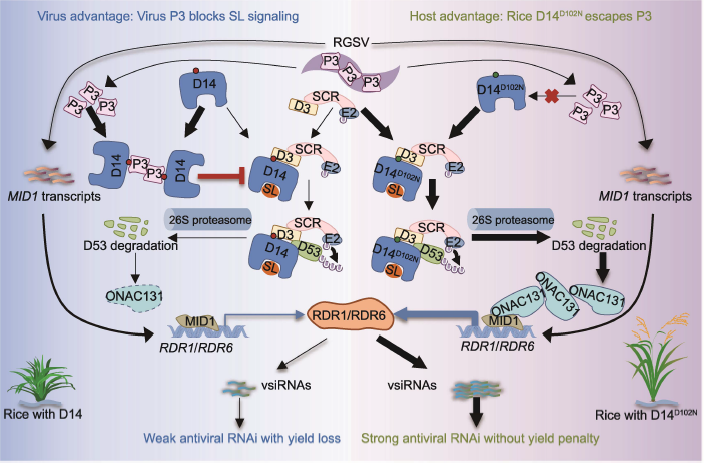
The RNA interference (RNAi) pathway acts as a conserved and broad-spectrum antiviral defense mechanism in plants, whereas viruses deploy effector proteins to counter host defense. Strigolactones (SLs) are a new class of phytohormones that regulate plant architecture, stress resilience, arbuscular mycorrhizal symbiosis, and parasitic diseases, but their antiviral mechanisms remain unclear. Recent research reveals that SL signaling is a pivotal regulatory node in the arms race between viruses and plants. SLs induce the expression of the transcription factor ONAC131, which acts synergistically with the virus-responsive protein MID1 to enhance antiviral RNAi. However, the rice grassy stunt virus (RGSV) deploys the P3 effector to dampen SL perception by disrupting the interaction between the SL receptor D14 and D3, thereby weakening the antiviral defense of rice. Precise editing of D14 remarkably enhances resistance to RGSV without yield penalty. This work reveals a novel mechanism whereby the SL signaling pathway and the RNAi pathway cooperate to counter viral invasion. It also provides a precise target for antiviral breeding in crops and represents a major breakthrough in the field of plant virology. In light of this, this paper summarizes the research progress on the antiviral RNAi pathway and SL signaling pathway, highlighting the regulatory functions of SL and other phytohormone signaling pathways in the offensive and defensive interactions between plants and viruses. Looking ahead, it offers new insights for the targeted breeding of antiviral crops by identifying key genes in hormone signaling hubs.
Cite this article

Jinhua Yang , Bing Wang . Precision Engineering of Strigolactone Receptor Aids Rice in Antiviral Defense[J]. Chinese Bulletin of Botany, 2026 , 61(3) : 357 -368 . DOI: 10.3724/CBB-2026-0044

AbeS, SadoA, TanakaK, KisugiT, AsamiK, OtaS, KimHI, YoneyamaK, XieXN, OhnishiT, SetoY, YamaguchiS, AkiyamaK, YoneyamaK, NomuraT (2014). Carlactone is converted to carlactonoic acid by MAX1 in Arabidopsis and its methylester can directly interact with AtD14 in vitro. Proc Natl Acad Sci USA 111, 18084-18089.

AhlquistP (2002). RNA—dependent RNA polymerases, viruses, and RNA silencing. Science 296, 1270-1273.

AkiyamaK, MatsuzakiKI, HayashiH (2005). Plant sesquiterpenes induce hyphal branching in arbuscular mycorrhizal fungi. Nature 435, 824-827.

AlderA, JamilM, MarzoratiM, BrunoM, VermathenM, BiglerP, GhislaS, BouwmeesterH, BeyerP, Al—BabiliS (2012). The path from β—carotene to carlactone, a strigolactone—like plant hormone. Science 335, 1348-1351.

AliyariR, DingSW (2009). RNA—based viral immunity initiated by the Dicer family of host immune receptors. Immunol Rev 227, 176-188.

BanXW, QinL, YanJJ, WuJX, LiQJ, SuX, HaoYR, HuQL, KouLQ, YanZY, XinPY, ZhangYQ, DongLM, BouwmeesterH, YuH, YuQH, HuangSW, LinT, XieQ, ChenYH, ChuJF, CuiX, LiJY, WangB (2025). Manipulation of a strigolactone transporter in tomato confers resistance to the parasitic weed broomrape. Innovation 6, 100815.

BaulcombeD (2004). RNA silencing in plants. Nature 431, 356-363.

BrewerPB, YoneyamaK, FilardoF, MeyersE, ScaffidiA, FrickeyT, AkiyamaK, SetoY, DunEA, CremerJE, KerrSC, WatersMT, FlemattiGR, MasonMG, WeillerG, YamaguchiS, NomuraT, SmithSM, YoneyamaK, BeveridgeCA (2016). LATERAL BRANCHING OXIDOREDUCTASE acts in the final stages of strigolactone biosynthesis in Arabidopsis. Proc Natl Acad Sci USA 113, 6301-6306.

CarbonellA, CarringtonJC (2015). Antiviral roles of plant ARGONAUTES. Curr Opin Plant Biol 27, 111-117.

ChenHM, XueL, ChintamananiS, GermainH, LinHQ, CuiHT, CaiR, ZuoJR, TangXY, LiX, GuoHW, ZhouJM (2009). ETHYLENE INSENSITIVE3 and ETHYLENE INSENSITIVE3—LIKE1 repress SALICYLIC ACID INDUCTION DEFICIENT2 expression to negatively regulate plant innate immunity in Arabidopsis. Plant Cell 21, 2527-2540.

Chen J, Zhao YX, Luo XJ, Hong H, Yang TQ, Huang S, Wang CL, Chen HY, Qian X, Feng MF, Chen ZQ, Dong YX, Ma ZC, Li J, Zhu M, He SY, Dinesh—Kumar SP, Tao XR (2023). NLR surveillance of pathogen interference with hormone receptors induces immunity. Nature 613, 145-152.

ChiC, XuXC, WangMQ, ZhangH, FangPP, ZhouJ, XiaXJ, ShiK, ZhouYH, YuJQ (2021). Strigolactones positively regulate abscisic acid—dependent heat and cold tolerance in tomato. Hortic Res 8, 237.

CookCE, WhichardLP, TurnerB, WallME, EgleyGH (1966). Germination of witchweed (Striga lutea Lour.): isolation and properties of a potent stimulant. Science 154, 1189-1190.

DuMM, ZhaoJH, TzengDTW, LiuYY, DengL, YangTX, ZhaiQZ, WuFM, HuangZ, ZhouM, WangQM, ChenQ, ZhongSL, LiCB, LiCY (2017). MYC2 orchestrates a hierarchical transcriptional cascade that regulates jasmonate—mediated plant immunity in tomato. Plant Cell 29, 1883-1906.

DuanCG, FangYY, ZhouBJ, ZhaoJH, HouWN, ZhuH, DingSW, GuoHS (2012). Suppression of Arabidopsis ARGONAUTE1—mediated slicing, transgene—induced RNA silencing, and DNA methylation by distinct domains of the Cucumber mosaic virus 2b protein. Plant Cell 24, 259-274.

GlickE, ZrachyaA, LevyY, MettA, GidoniD, BelausovE, CitovskyV, GafniY (2008). Interaction with host SGS3 is required for suppression of RNA silencing by tomato yellow leaf curl virus V2 protein. Proc Natl Acad Sci USA 105, 157-161.

Gobena D, Shimels M, Rich PJ, Ruyter—Spira C, Bouwmeester H, Kanuganti S, Mengiste T, Ejeta G (2017). Mutation in sorghum LOW GERMINATION STIMULANT 1 alters strigolactones and causes Striga resistance. Proc Natl Acad Sci USA 114, 4471-4476.

Gomez—RoldanV, FermasS, BrewerPB, Puech—PagèsV, DunEA, PillotJP, LetisseF, MatusovaR, DanounS, PortaisJC, BouwmeesterH, BécardG, BeveridgeCA, RameauC, RochangeSF (2008). Strigolactone inhibition of shoot branching. Nature 455, 189-194.

Gu HY , Chen F , Lin RC , Qi XQ , Yang SH , Chen ZD , Chen XW , Ding ZJ , Xiao LT , Zuo JR , Jiang LW , Bai YF , Chong K , Wang L (2025). Achievements and advances of plant sciences research in China in 2024. Chin Bull Bot 60, 151-171. (in Chinese with English abstract)

顾红雅, 陈凡, 林荣呈, 漆小泉, 杨淑华, 陈之端, 陈学伟, 丁兆军, 萧浪涛, 左建儒, 姜里文, 白永飞, 种康, 王雷 (2025). 2024年中国植物科学重要研究进展. 植物学报 60, 151-171.

GuoHY, SongXG, XieCM, HuoY, ZhangFJ, ChenXY, GengYF, FangRX (2013). Rice yellow stunt rhabdovirus protein 6 suppresses systemic RNA silencing by blocking RDR6—mediated secondary siRNA synthesis. Mol Plant Microbe Interact 26, 927-936.

HuQL, LiuHH, HeYJ, HaoYR, YanJJ, LiuSM, HuangXH, YanZY, ZhangDH, BanXW, ZhangH, LiQQ, ZhangJK, XinPY, JingYH, KouLQ, SangDJ, WangYH, WangYC, MengXB, FuXD, ChuJF, WangB, LiJY (2024). Regulatory mechanisms of strigolactone perception in rice. Cell 187, 7551-7567.

ItoS, BraguyJ, WangJY, YodaA, FiorilliV, TakahashiI, JamilM, FelembanA, MiyazakiS, MazzarellaT, ChenGTE, ShinozawaA, BalakrishnaA, BerqdarL, RajanC, AliS, HaiderI, SasakiY, YajimaS, AkiyamaK, LanfrancoL, ZurbriggenMD, NomuraT, AsamiT, Al—BabiliS (2022). Canonical strigolactones are not the major determinant of tillering but important rhizospheric signals in rice. Sci Adv 8, eadd1278.

JiangL, LiuX, XiongGS, LiuHH, ChenFL, WangL, MengXB, LiuGF, YuH, YuanYD, YiW, ZhaoLH, MaHL, HeYZ, WuZS, MelcherK, QianQ, XuHE, WangYH, LiJY (2013). DWARF 53 acts as a repressor of strigolactone signaling in rice. Nature 504, 401-405.

JiangX, YangYS, LiY, WangYZ, RodamilansB, JiWQ, WuXX, GarcíaJA, WuXY, ChengXF (2025). Plant viruses convergently target NPR1 with various strategies to suppress salicylic acid—mediated antiviral immunity. J Integr Plant Biol 67, 1395-1412.

KalliolaM, JakobsonL, DavidssonP, PennanenV, WaszczakC, YarmolinskyD, ZamoraO, PalvaET, KariolaT, KollistH, BroschéM (2020). Differential role of MAX2 and strigolactones in pathogen, ozone, and stomatal responses. Plant Direct 4, e00206.

LeeWS, FuSF, LiZ, MurphyAM, DobsonEA, GarlandL, ChaluvadiSR, LewseyMG, NelsonRS, CarrJP (2016). Salicylic acid treatment and expression of an RNA—dependent RNA polymerase 1 transgene inhibit lethal symptoms and meristem invasion during tobacco mosaic virus infection in Nicotiana benthamiana. BMC Plant Biol 16, 15.

Li C, Dong L, Durairaj J, Guan JC, Yoshimura M, Quinodoz P, Horber R, Gaus K, Li J, Setotaw YB, Qi J, De Groote H, Wang Y, Thiombiano B, Floková K, Walmsley A, Charnikhova TV, Chojnacka A, Correia de Lemos S, Ding Y, Skibbe D, Hermann K, Screpanti C, De Mesmaeker A, Schmelz EA, Menkir A, Medema M, Van Dijk ADJ, Wu J, Koch KE, Bouwmeester HJ (2023). Maize resistance to witchweed through changes in strigolactone biosynthesis. Science 379, 94-99.

LiCS, HaiderI, WangJY, QuinodozP, SuarezDuran HG, MéndezLR, HorberR, FiorilliV, VottaC, LanfrancoL, Correiade Lemos SM, JouffroyL, MoegleB, MieschL, DeMesmaeker A, MedemaMH, Al—BabiliS, DongLM, BouwmeesterHJ (2024). OsCYP706C2 diverts rice strigolactone biosynthesis to a noncanonical pathway branch. Sci Adv 10, eadq3942.

Li LL, Zhang HH, Yang ZH, Wang C, Li SS, Cao C, Yao TS, Wei ZY, Li YJ, Chen JP, Sun ZT (2022). Independently evolved viral effectors convergently suppress DELLA protein SLR1—mediated broad—spectrum antiviral immunity in rice. Nat Commun 13, 6920.

LiS, ZhangZX, ZhouCY, LiSF (2021). RNA—dependent RNA polymerase 1 delays the accumulation of viroids in infected plants. Mol Plant Pathol 22, 1195-1208.

LiSH, JooY, CaoDC, LiR, LeeG, HalitschkeR, BaldwinG, BaldwinIT, WangM (2020). Strigolactone signaling regulates specialized metabolism in tobacco stems and interactions with stem—feeding herbivores. PLoS Biol 18, e3000830.

Li SJ , Gao J , Li JY , Wang YH (2015). Advances in regulating rice tillers by strigolactones. Chin Bull Bot 50, 539-548. (in Chinese with English abstract)

黎舒佳, 高谨, 李家洋, 王永红 (2015). 独脚金内酯调控水稻分蘖的研究进展. 植物学报 50, 539-548.

Li WX, Ding SW (2001). Viral suppressors of RNA silencing. Curr Opin Biotechnol 12, 150-154.

LinH, WangRX, QianQ, YanMX, MengXB, FuZM, YanCY, JiangB, SuZ, LiJY, WangYH (2009). DWARF27, an iron—containing protein required for the biosynthesis of strigolactones, regulates rice tiller bud outgrowth. Plant Cell 21, 1512-1525.

LiuCZ, YuQS, JinYF, MaW, LiJ, SongTX, HanM, QianY, XueQ, KeLY, DongYX, HouCC, WuXN, LiuYL, WangJZ, JiangLW, GongZZ, DengHT, XieDX, HeSY, LuZJ, SongSS, QiTC (2026). An uORF—encoded mobile peptide sparks systemic stomatal immunity. Cell 189, 1407-1422.

LiuJH, WuXY, FangY, LiuY, BelloEO, LiY, XiongRY, LiYZ, FuZQ, WangAM, ChengXF (2023). A plant RNA virus inhibits NPR1 sumoylation and subverts NPR1—mediated plant immunity. Nat Commun 14, 3580.

LlaveC (2010). Virus—derived small interfering RNAs at the core of plant—virus interactions. Trends Plant Sci 15, 701-707.

MatusovaR, RaniK, VerstappenFWA, FranssenMCR, BealeMH, BouwmeesterHJ (2005). The strigolactone germination stimulants of the plant—parasitic Striga and Orobanche spp. are derived from the carotenoid pathway. Plant Physiol 139, 920-934.

MiSJ, CaiT, HuYG, ChenYM, HodgesE, NiFR, WuL, LiS, ZhouHY, LongCZ, ChenS, HannonGJ, QiYJ (2008). Sorting of small RNAs into Arabidopsis argonaute complexes is directed by the 5′ terminal nucleotide. Cell 133, 116-127.

MolnarA, MelnykCW, BassettA, HardcastleTJ, DunnR, BaulcombeDC (2010). Small silencing RNAs in plants are mobile and direct epigenetic modification in recipient cells. Science 328, 872-875.

Mori N, Nomura T, Akiyama K (2020). Identification of two oxygenase genes involved in the respective biosynthetic pathways of canonical and non—canonical strigolactones in Lotus japonicus. Planta 251, 40.

MostofaMG, LiWQ, NguyenKH, FujitaM, TranLSP (2018). Strigolactones in plant adaptation to abiotic stresses: an emerging avenue of plant research. Plant Cell Environ 41, 2227-2243.

NasirF, TianL, ShiSH, ChangCL, MaLN, GaoYZ, TianCJ (2019). Strigolactones positively regulate defense against Magnaporthe oryzae in rice (Oryza sativa). Plant Physiol Biochem 142, 106-116.

Niu CB, Bouwmeester HJ, Li CS (2025). Drivers of strigolactone diversity: P450s in strigolactone biosynthesis. J Integr Plant Biol doi: 10.1111/jipb.70091.

Qi LL, Yan J, Li YN, Jiang HL, Sun JQ, Chen Q, Li HX, Chu JF, Yan CY, Sun XH, Yu YJ, Li CB, Li CY (2012). Arabidopsis thaliana plants differentially modulate auxin biosynthesis and transport during defense responses to the necrotrophic pathogen Alternaria brassicicola. New Phytol 195, 872-882.

Scaffidi A, Waters MT, Sun YK, Skelton BW, Dixon KW, Ghisalberti EL, Flematti GR, Smith SM (2014). Strigolactone hormones and their stereoisomers signal through two related receptor proteins to induce different physiological responses in Arabidopsis. Plant Physiol 165, 1221-1232.

SchwachF, VaistijFE, JonesL, BaulcombeDC (2005). An RNA—dependent RNA polymerase prevents meristem invasion by potato virus X and is required for the activity but not the production of a systemic silencing signal. Plant Physiol 138, 1842-1852.

Seto Y, Yamaguchi S (2014). Strigolactone biosynthesis and perception. Curr Opin Plant Biol 21, 1-6.

ShabekN, TicchiarelliF, MaoHB, HindsTR, LeyserO, ZhengN (2018). Structural plasticity of D3—D14 ubiquitin ligase in strigolactone signaling. Nature 563, 652-656.

ShiJY, MeiC, GeFY, HuQL, BanXW, XiaR, XinPY, ChengSJ, ZhangGH, NieJW, ZhangSQ, MaXW, WangY, ChuJF, ChenYH, WangB, WuWH, LiJY, XieQ, YuFF (2025). Resistance to Striga parasitism through reduction of strigolactone exudation. Cell 188, 1955-1966.

SongXG, LuZF, YuH, ShaoGN, XiongJS, MengXB, JingYH, LiuGF, XiongGS, DuanJB, YaoXF, LiuCM, LiHQ, WangYH, LiJY (2017). IPA1 functions as a downstream transcription factor repressed by D53 in strigolactone signaling in rice. Cell Res 27, 1128-1141.

Sun YC, Guo HJ, Yuan EL, Ge F (2018). Elevated CO 2 increases R gene—dependent resistance of Medicago truncatula against the pea aphid by up—regulating a heat shock gene. New Phytol 217, 1696-1711.

TanXH, WangDP, ZhangXW, ZhengS, JiaXJ, LiuH, LiuZL, YangH, DaiHL, ChenX, QianZX, WangR, MaML, ZhangP, YuN, WangET (2025). A pair of LysM receptors mediates symbiosis and immunity discrimination in Marchantia. Cell 188, 1330-1348.

TongX, LiuSY, ZouJZ, ZhaoJJ, ZhuFF, ChaiLX, WangY, HanCG, WangXB (2021). A small peptide inhibits siRNA amplification in plants by mediating autophagic degradation of SGS3/RDR6 bodies. EMBO J 40, e108050.

Umehara M, Hanada A, Yoshida S, Akiyama K, Arite T, Takeda—Kamiya N, Magome H, Kamiya Y, Shirasu K, Yoneyama K, Kyozuka J, Yamaguchi S (2008). Inhibition of shoot branching by new terpenoid plant hormones. Nature 455, 195-200.

UraguchiD, KuwataK, HijikataY, YamaguchiR, ImaizumiH, AmS, RakersC, MoriN, AkiyamaK, IrleS, McCourtP, KinoshitaT, OoiT, TsuchiyaY (2018). A femtomolar—range suicide germination stimulant for the parasitic plant Striga hermonthica. Science 362, 1301-1305.

WakabayashiT, HamanaM, MoriA, AkiyamaR, UenoK, OsakabeK, OsakabeY, SuzukiH, TakikawaH, MizutaniM, SugimotoY (2019). Direct conversion of carlactonoic acid to orobanchol by cytochrome P450 CYP722C in strigolactone biosynthesis. Sci Adv 5, eaax9067.

WakabayashiT, IshiwaS, ShidaK, MotonamiN, SuzukiH, TakikawaH, MizutaniM, SugimotoY (2021). Identification and characterization of sorgomol synthase in sorghum strigolactone biosynthesis. Plant Physiol 185, 902-913.

WakabayashiT, NakayamaM, KitanoY, HommaM, MiuraK, TakikawaH, MizutaniM, SugimotoY (2025). Discovery of strigol synthase from cotton (Gossypium hirsutum): the enzyme behind the first identified germination stimulant for Striga. Plants People Planet 7, 354-359.

Wakabayashi T, Shida K, Kitano Y, Takikawa H, Mizutani M, Sugimoto Y (2020). CYP722C from Gossypium arboreum catalyzes the conversion of carlactonoic acid to 5—deoxystrigol. Planta 251, 97.

WangHZ, LiXM, ZhaiKR, RhodesJ, SangT, ZhaoJW, GaoY, MaSW, SongBB, PanQ, HuMJ, XinPY, ChuJF, WangPC, ZipfelC, ZhouJM (2026). A regulatory network promotes apoplastic alkalinization to prime plant immunity in tissues distal to site of infection. Cell 189, 1389-1406.

WangJY, ChenGTE, BraguyJ, Al—BabiliS (2024). Distinguishing the functions of canonical strigolactones as rhizospheric signals. Trends Plant Sci 29, 925-936.

WangL, WangB, YuH, GuoHY, LinT, KouLQ, WangAQ, ShaoN, MaHY, XiongGS, LiXQ, YangJ, ChuJF, LiJY (2020). Transcriptional regulation of strigolactone signaling in Arabidopsis. Nature 583, 277-281.

Waters MT, Gutjahr C, Bennett T , Nelson DC (2017). Strigolactone signaling and evolution. Annu Rev Plant Biol 68, 291-322.

WuDW, QiTC, LiWX, TianHX, GaoH, WangJJ, GeJ, YaoRF, RenCM, WangXB, LiuYL, KangL, DingSW, XieDX (2017a). Viral effector protein manipulates host hormone signaling to attract insect vectors. Cell Res 27, 402-415.

WuJG, YangRX, YangZR, YaoSZ, ZhaoSS, WangY, LiPC, SongXW, JinL, ZhouT, LanY, XieLH, ZhouXP, ChuCC, QiYJ, CaoXF, LiY (2017b). ROS accumulation and antiviral defence control by microRNA528 in rice. Nat Plants 3, 16203.

Wu YS, Zhao SS, Liu N, Wu FL, Huang ST, Li DY, Li BY, Miao YT, Guan HX, Wu M, Zhang S, Li Y, Zhang J, Wu JG (2025). A virulence protein activates SERK4 and degrades RNA polymerase IV protein to suppress rice antiviral immunity. Dev Cell 60, 2348-2362.

YangGY, WuM, ZhangS, HuangYC, LiuYX, YuXY, HuJY, MiL, GanP, WuYS, ZouJ, ZhangBG, HuQ, HuJ, YaoRF, ZhongBJ, HuangXB, XieHT, JiYH, LiY, ZhangJ, YanLM, DingSW, ZhaoSS, WuJG (2026). Editing strigolactone hormone receptor for robust antiviral silencing in rice. Cell 189, 2054-2072.

YangZR, HuangY, YangJL, YaoSZ, ZhaoK, WangDH, QinQQ, BianZ, LiY, LanY, ZhouT, WangH, LiuC, WangWM, QiYJ, XuZH, LiY (2020). Jasmonate signaling enhances RNA silencing and antiviral defense in rice. Cell Host Microbe 28, 89-103.

YaoRF, MingZH, YanLM, LiSH, WangF, MaS, YuCT, YangM, ChenL, ChenLH, LiYW, YanC, MiaoD, SunZY, YanJB, SunYN, WangL, ChuJF, FanSL, HeW, DengHT, NanFJ, LiJY, RaoZH, LouZY, XieDX (2016). DWARF14 is a non—canonical hormone receptor for strigolactone. Nature 536, 469-473.

Yao RF , Xie DX (2024). Activation and termination of strigolactone signal perception in rice. Chin Bull Bot 59, 873-877. (in Chinese with English abstract)

姚瑞枫, 谢道昕 (2024). 水稻独脚金内酯信号感知的激活和终止. 植物学报 59, 873-877.

Yu DQ, Fan BF, MacFarlane SA, Chen ZX (2003). Analysis of the involvement of an inducible Arabidopsis RNA—dependent RNA polymerase in antiviral defense. Mol Plant Microbe Interact 16, 206-216.

Yuan HM, Liu WC, Lu YT (2017). CATALASE2 coordinates SA—mediated repression of both auxin accumulation and JA biosynthesis in plant defenses. Cell Host Microbe 21, 143-155.

YuanK, ZhangH, YuCJ, LuoN, YanJJ, ZhengS, HuQL, ZhangDH, KouLQ, MengXB, JingYH, ChenMJ, BanXW, YanZY, LuZF, WuJ, ZhaoY, LiangY, WangYH, XiongGS, ChuJF, WangET, LiJY, WangB (2023). Low phosphorus promotes NSP1—NSP2 heterodimerization to enhance strigolactone biosynthesis and regulate shoot and root architecture in rice. Mol Plant 16, 1811-1831.

ZhangBG, ZouJ, MaBN, DongCY, ZhangX, LiN, DuanXH, LiuRZ, ZhaoSS, ZhangS, WuJG (2026). A viral strategy to hijack the miR156—SPL—ICS1 module suppresses salicylic acid—based immunity in rice. J Integr Plant Biol doi: 10.1111/jipb.70174.

Zhang C, Wei Y, Xu L, Wu KC, Yang L, Shi CN, Yang GY, Chen D, Yu FF, Xie Q, Ding SW, Wu JG (2020). A bunyavirus—inducible ubiquitin ligase targets RNA polymerase IV for degradation during viral pathogenesis in rice. Mol Plant 13, 836-850.

ZhangHH, WangFM, SongWQ, YangZH, LiLL, MaQ, TanXX, WeiZY, LiYJ, LiJM, YanF, ChenJP, SunZT (2023). Different viral effectors suppress hormone—mediated antiviral immunity of rice coordinated by OsNPR1. Nat Commun 14, 3011.

ZhangJY, WangB, XuHR, LiuWD, YuJW, WangQX, YuH, WeiJW, DaiR, ZhouJH, HeYH, ZouD, YangJH, BanXW, HuQL, MengXB, LiuYX, WangBL, HuB, WangMY, XinPY, ChuJF, LiCS, Garrido—OterR, YuP, vanDijk ADJ, DongLM, BouwmeesterH, GaoS, HuangAC, ChuCC, LiJY, BaiY (2025). Root microbiota regulates tiller number in rice. Cell 188, 3152-3166.

ZhangYX, vanDijk ADJ, ScaffidiA, FlemattiGR, HofmannM, CharnikhovaT, VerstappenF, HepworthJ, vander Krol S, LeyserO, SmithSM, ZwanenburgB, Al—BabiliS, Ruyter—SpiraC, BouwmeesterHJ (2014). Rice cytochrome P450 MAX1 homologs catalyze distinct steps in strigolactone biosynthesis. Nat Chem Biol 10, 1028-1033.

ZhangZH, ChenH, HuangXH, XiaR, ZhaoQZ, LaiJB, TengKL, LiY, LiangLM, DuQS, ZhouXP, GuoHS, XieQ (2011). BSCTV C2 attenuates the degradation of SAMDC1 to suppress DNA methylation—mediated gene silencing in Arabidopsis. Plant Cell 23, 273-288.

Zhao LH, Zhou XE, Wu ZS, Yi W, Xu Y, Li SL, Xu TH, Liu Y, Chen RZ, Kovach A, Kang YY, Hou L, He YZ, Xie C, Song WL, Zhong DF, Xu YC, Wang YH, Li JY, Zhang CH, Melcher K, Xu HE (2013). Crystal structures of two phytohormone signal—transducing α/β hydrolases: karrikin—signaling KAI2 and strigolactone—signaling DWARF14. Cell Res 23, 436-439.

Zheng LJ, Zhang C, Shi CN, Yang ZR, Wang Y, Zhou T, Sun F, Wang H, Zhao SS, Qin QQ, Qiao R, Ding ZM, Wei CH, Xie LH, Wu JG, Li Y (2017). Rice stripe virus NS3 protein regulates primary miRNA processing through association with the miRNA biogenesis factor OsDRB1 and facilitates virus infection in rice. PLoS Pathog 13, e1006662.

Zhou AQ, Kane A, Wu S, Wang KB, Santiago M, Ishiguro Y, Yoneyama K, Palayam M, Shabek N, Xie XN, Nelson DC, Li YR (2025). Evolution of interorganismal strigolactone biosynthesis in seed plants. Science 387, eadp0779.

ZhouF, LinQB, ZhuLH, RenYL, ZhouKN, ShabekN, WuFQ, MaoHB, DongW, GanL, MaWW, GaoH, ChenJ, YangC, WangD, TanJJ, ZhangX, GuoXP, WangJL, JiangL, LiuX, ChenWQ, ChuJF, YanCY, UenoK, ItoS, AsamiT, ChengZJ, WangJ, LeiCL, ZhaiHQ, WuCY, WangHY, ZhengN, WanJM (2013). D14—SCF D3—dependent degradation of D53 regulates strigolactone signaling . Nature 504, 406-410.

Outlines

/
