
AI-driven Innovation of Ion Stress-tolerant Germplasm: Progress and Challenges
Received date: 2025-09-30
Accepted date: 2026-01-09
Online published: 2026-01-12
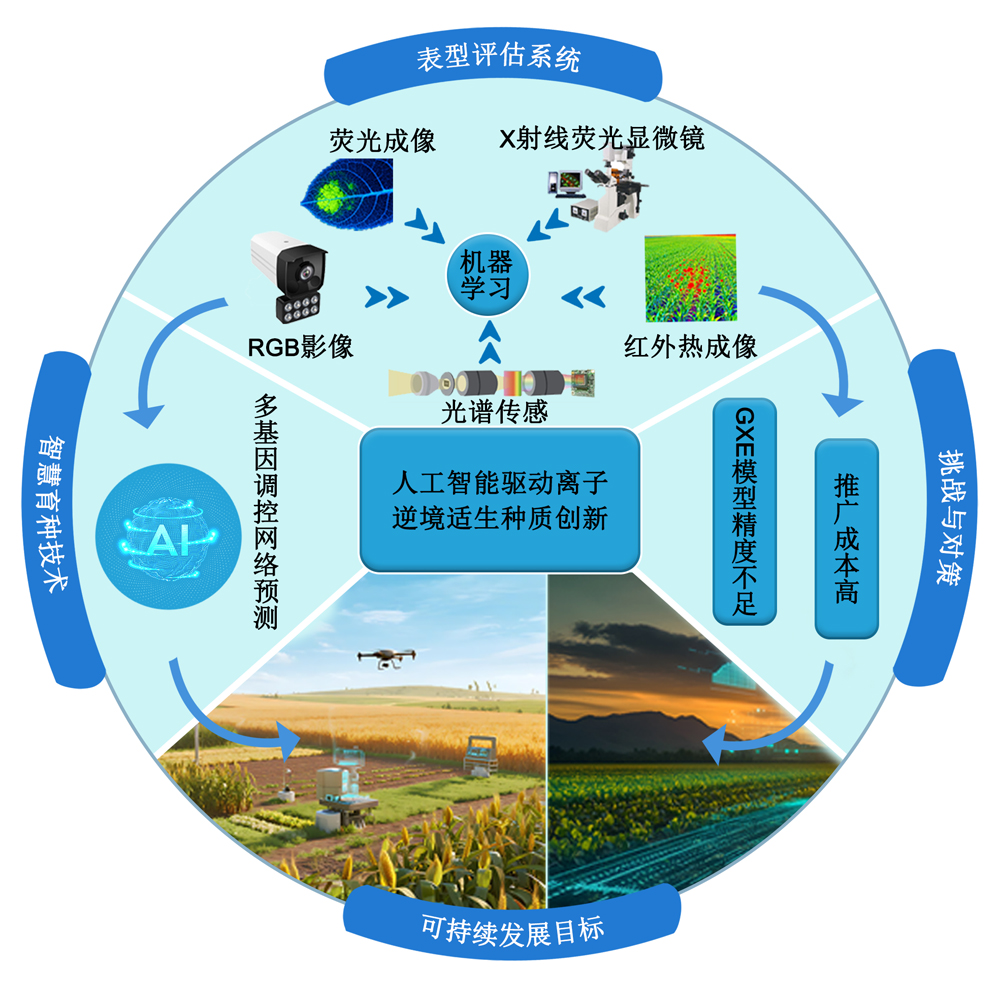
Global climate change and intensive human activities have led to increasing degradation of arable land due to ionic stress, such as salinization and heavy metal contamination, posing a huge threat to world food security. The rapid development of artificial intelligence (AI) technology offers a new approach for germplasm innovation for stress adaptation. This review systematically summarizes key advances and applications of AI in germplasm innovation for ionic stress tolerance. In the field of phenomics, multi-dimensional phenotyping systems integrate technologies including red-green-blue imaging, spectral sensing, fluorescence imaging, thermal infrared imaging, and X-ray fluorescence spectrometer. These are coupled with machine learning, deep learning, and multi-source data fusion to enable early, accurate, and non-invasive identification of ionic stress responses. In the field of smart breeding, machine learning accelerates gene discovery, along with pangenomics to elucidate genetic diversity. AI-driven prediction of multi-gene regulatory networks and genomic selection have significantly improved breeding efficiency. However, challenges such as insufficient data standardization and sharing, limited prediction accuracy of genotype-environment interaction (G×E) models, and high technology promotion costs are still constraining the large-scale application of the AI-enabled technologies. We expect that future efforts with focus on data integration, algorithm optimization, and technology popularization will allow AI to play a greater role in the remediation of degraded farmland and in achieving sustainable agricultural development.
Huili Yan , Yating Qin , Yunzhuan Zhou , Huai Zhang , Binfeng Li , Nanja Gongbao , Shengyan Zhang , Wenxiu Xu , Xiaoyan Song , Zhenyan He . AI-driven Innovation of Ion Stress-tolerant Germplasm: Progress and Challenges[J]. Chinese Bulletin of Botany, 2026 , 61(4) : 588 -597 . DOI: 10.11983/CBB25177
|
|
|
|
|
|
|
|
|
|
|
|
|
|
|
|
|
|
|
|
|
|
|
|
|
|
|
|
|
|
|
|
|
林梵宇, 尹希杰, 梁毓娜, 黄杰超 (2020). 微区XRF技术分析无机元素在植物中的原位分布. 植物学报 55, 733-739.
|
|
|
|
|
|
|
|
|
|
|
|
|
|
|
|
|
|
|
|
|
|
|
|
|
|
|
|
|
|
|
|
|
|
|
|
|
|
|
/
| 〈 |
|
〉 |

 Home
Home