
Research on the Development and Construction of AI-driven Smart Farming
Received date: 2025-09-29
Accepted date: 2025-12-06
Online published: 2025-12-09
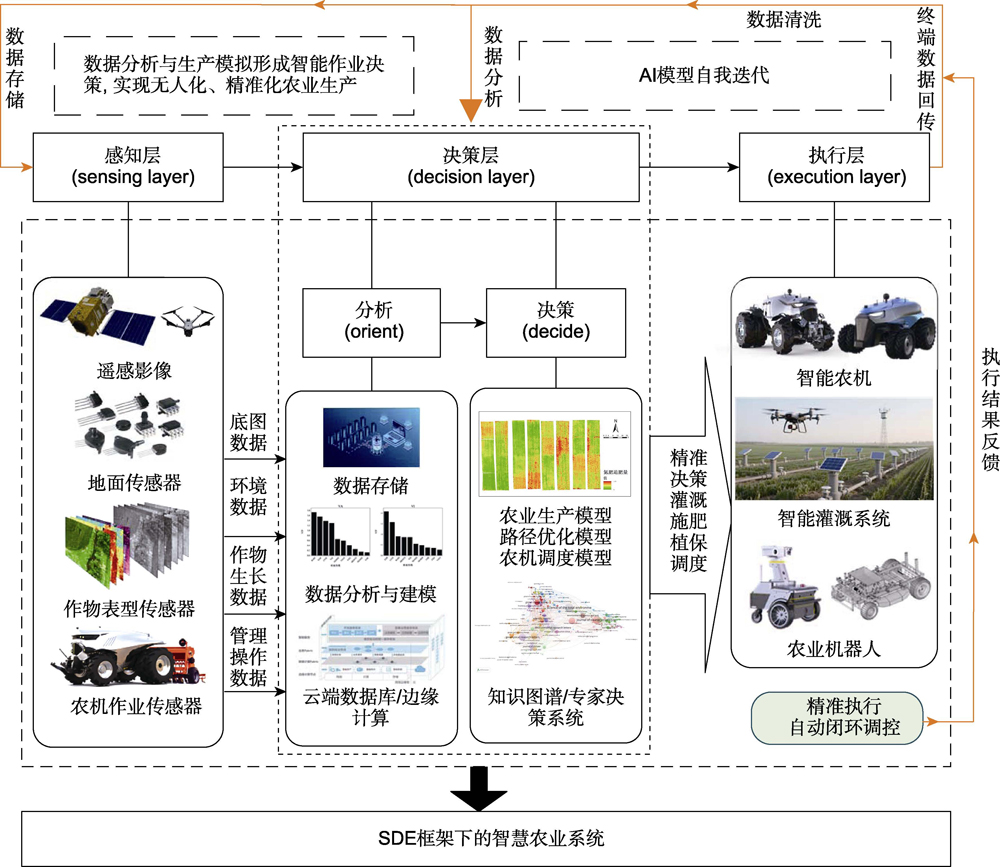
Smart agriculture, as a core direction of modern agricultural development, is driving the transformation of agricultural production from experience-driven to data-driven, and from manual operations to intelligent and automated systems. This paper systematically reviews the applications of artificial intelligence (AI) in smart agriculture and the current status, trends, and challenges of smart cultivation, constructing a “sensing-decision-execution-management” closed-loop framework to elucidate its role and value across the entire agricultural process. The sensing layer leverages multi-source sensors, imaging technologies, and the Internet of Things (IoT) to achieve precise monitoring of crops and environmental conditions; the decision layer integrates data-driven algorithms and crop growth models to enable intelligent prediction and optimization of fertilization, irrigation, and pest and disease management; the execution layer employs unmanned agricultural machinery, drones, and robots to perform high-precision autonomous operations; and the management layer utilizes cloud-edge collaboration and digital twins to realize visualized and sustainable farm management. Although smart agriculture is developing rapidly, challenges remain in data assimilation and standardization, and the level of equipment intelligence and environmental adaptability still needs improvement. Moreover, with the massive acquisition and utilization of agricultural data, issues of data security and privacy protection have become increasingly prominent, posing significant challenges to the sustainable development of smart agriculture. The paper highlights that the core goal of smart cultivation is to increase yield, improve quality, reduce costs, and promote green development, while further advancing multi-source sensing integration, intelligent decision-making loops, autonomous operations, and low-carbon farming. The findings provide a reference for the theoretical framework of smart agriculture and offer technical support for the practical implementation of agricultural IoT, AI, and digital agriculture, playing a significant role in promoting efficient, intelligent, and sustainable agricultural production.
Ting Tao , Wei Zhang , Wei Zeng , Congcong Zheng , Shuqin Gao , Xiaobo Zhang , Xiangtai Jiang , Yuru Li , Chuanhao Chang , Lingyu Shao , Yucheng Zhang . Research on the Development and Construction of AI-driven Smart Farming[J]. Chinese Bulletin of Botany, 2026 , 61(4) : 549 -714 . DOI: 10.11983/CBB25172
|
|
|
|
|
|
|
|
|
|
|
陈国辉, 郭艳玲, 张宁 (2004). 传感器在温室环境检测系统中的应用. 林业机械与木工设备 32(4), 33-35.
|
|
|
|
陈红川 (2015). “互联网+”背景下现代农业发展路径研究. 广东农业科学 42(16), 143-147.
|
|
崔立业 (2025). 数字化技术在农田水利精准灌溉中的应用与实践. 工程技术与质量管理 3(5), 80-82.
|
|
|
|
|
|
董胜, 袁朝辉, 谷超, 杨芳 (2017). 基于多学科技术融合的智能农机控制平台研究综述. 农业工程学报 33(8), 1-11.
|
|
|
|
|
|
|
|
|
|
顾生浩, 卢宪菊, 王勇健, 郭新宇 (2021). 数字孪生系统在农业生产中的应用探讨. 中国农业科技导报 23(10), 82-89.
|
|
管博伦, 张立平, 朱静波, 李闰枚, 孔娟娟, 汪焱, 董伟 (2023). 农业病虫害图像数据集构建关键问题及评价方法综述. 智慧农业(中英文) 5(3), 17-34.
|
|
韩佳伟, 杨信廷 (2025). 农产品智慧供应链: 内涵、关键技术与未来方向. 智慧农业(中英文) 7(3), 1-16.
|
|
韩佳伟, 朱文颖, 张博, 赵春江, 杨信廷 (2022). 装备与信息协同促进现代智慧农业发展研究. 中国工程科学 24, 55-63.
|
|
何清, 李宁, 罗文娟, 史忠植 (2014). 大数据下的机器学习算法综述. 模式识别与人工智能 27, 327-336.
|
|
|
|
|
|
黄思翰, 陈建鹏, 徐哲, 阎艳, 王国新 (2025). 基于大语言模型和机器视觉的智能制造系统人机自主协同作业方法. 机械工程学报 61(3), 130-141.
|
|
|
|
|
|
|
|
|
|
康孟珍, 王秀娟, 华净, 王浩宇, 王飞跃 (2019). 平行农业: 迈向智慧农业的智能技术. 智能科学与技术学报 1, 107-117.
|
|
孔甜甜, 王炯, 王珂 (2025). 人工智能技术在智慧农业中的应用. 乡村科技 16(13), 150-153.
|
|
|
|
|
|
|
|
|
|
|
|
李德仁, 李明 (2014). 无人机遥感系统的研究进展与应用前景. 武汉大学学报(信息科学版) 39, 505-513, 540.
|
|
李莉, 李民赞, 刘刚, 张漫, 汪懋华 (2022). 中国大田作物智慧种植目标、关键技术与区域模式. 智慧农业(中英文) 4(4), 26-34.
|
|
李小玲 (2025). 智慧农业领域人工智能大模型的应用研究. 中国农机装备 (6), 81-83.
|
|
梁晨光 (2020). 基于数字孪生的稻田环境监测系统研究及实现. 硕士论文. 长沙: 湖南农业大学. pp. 1-45.
|
|
刘海启 (2019). 以精准农业驱动农业现代化加速现代农业数字化转型. 中国农业资源与区划 40, 1—6, 73.
|
|
刘正国, 韩玮, 高照, 张子杰, 刘建立, 李晓鹏 (2024). 基于数字图像处理的水稻生长特征识别研究进展. 中国稻米 30(4), 7—11, 16.
|
|
|
|
罗锡文, 谷秀艳, 胡炼, 赵润茂, 岳孟东, 何杰, 黄培奎, 汪沛 (2025). 大田无人化智慧农场农田边界识别技术研究现状与展望. 农业机械学报 56(2), 1-18.
|
|
|
|
|
|
潘从文 (2024). 农田信息采集技术在精准灌溉中的应用. 农业工程技术 44(14), 42-43.
|
|
|
|
渠纯纯, 孙文秀, 李臻, 王喜庆, 何志祝 (2023). 植物柔性传感器研究进展与展望. 农业工程学报 39(8), 32-43.
|
|
|
|
|
|
施印炎, 辛亚鹏, 汪小旵, 郑恩来, 沈成, 张昭 (2025). 基于多层感知机模型的稻麦双变量精准施肥机排肥策略. 农业工程学报 41(10), 51-60.
|
|
孙凝晖, 张玉成, 王竑晟, 刘子辰, 陈海华, 谭光明 (2021). 农业模拟器: 用智能技术打通黑土地保护的数据流. 中国科学院院刊 36, 1165-1174.
|
|
|
|
|
|
|
|
王儒敬 (2024). 农业传感器: 研究进展、挑战与展望. 智慧农业(中英文) 6, 1-17.
|
|
王志宏, 杨震 (2017). 人工智能技术研究及未来智能化信息服务体系的思考. 电信科学 33(5), 2017134.
|
|
王忠静, 陈江, 刘晋龙, 张思齐, 朱现坡 (2025). 精准灌溉的节水内涵及其节水率计算方法. 灌溉排水学报 44(6), 1-10.
|
|
|
|
|
|
吴小伟, 茹煜, 周宏平 (2010). 无人机喷洒技术的研究. 农机化研究 32(7), 224-228.
|
|
习近平 (2023). 加快建设农业强国 推进农业农村现代化. 求是 (6), 4-17.
|
|
夏宇欣, 凌宇飞, 冯源, 顾元坤, 朱海滨, 许方甫, 李光彦, 高辉, 魏海燕, 张洪程, 胡群 (2025). 水稻智能化无人化育插秧技术研究进展. 中国稻米 31(4), 51-56.
|
|
|
|
|
|
|
|
于丰华, 许童羽, 郭忠辉, 白驹驰, 相爽, 国斯恩, 金忠煜, 李世隆, 王世宽, 刘美含, 惠尹宣 (2024). 水稻智慧无人农场关键技术研究现状与展望. 智慧农业(中英文) 6(6), 1-22.
|
|
曾愿晓 (2025). 人工智能赋能智慧农业——高质量推进路径与挑战. 中国农机装备 (6), 72-74.
|
|
|
|
章林忠, 丁玲玲, 蔡雪珍, 宁井铭, 方从兵 (2019). 基于近红外高光谱图像技术的栗果品质无损检测. 安徽农业大学学报 46, 160-166.
|
|
章强 (2025). 农业大模型驱动智慧农业——技术、应用与趋势. 扬州职业大学学报 29, 40-44, 50.
|
|
张玉成, 张晓博, 高树琴, 郑聪聪, 张景尧, 文亚, 李禄军, 王卓, 李铁, 赵洪龙 (2025). “伏羲农场”: 智慧农业技术集成创新的实践探索与思考. 中国科学院院刊 40, 301-309.
|
|
|
|
赵柄婷, 华传海, 叶晨洋, 熊育春, 钱涛, 程涛, 姚霞, 郑恒彪, 朱艳, 曹卫星, 江冲亚 (2025). 水稻生产遥感监测与智慧决策研究进展. 智慧农业(中英文) 7(2), 57-72.
|
|
赵春江 (2019). 智慧农业发展现状及战略目标研究. 智慧农业 1, 1-7.
|
|
赵春江, 李静晨, 吴华瑞, 杨雨森 (2024). 基于大语言模型推理的数字孪生平台蔬菜作物生长模型研究. 智慧农业(中英文) 6(6), 63-71.
|
|
郑永军, 陈炳太, 吕昊暾, 康峰, 江世界 (2020). 中国果园植保机械化技术与装备研究进展. 农业工程学报 36(20), 110-124.
|
|
周健, 苟彦梅 (2025). 无人机高光谱影像在农业长势监测中的应用. 智慧农业导刊 5(14), 37-40.
|
/
| 〈 |
|
〉 |

 Home
Home