Function of WRI1 in Heat Stress of Arabidopsis Seedlings

  • Xuya Gu 1 ,
  • Zhangman Lin 1 ,
  • Siyuan Hu 1 ,
  • Xuening Li 1 ,
  • Xiaolin Qin 1 ,
  • Zhengxi Wu 1 ,
  • Nuo Li 1 ,
  • Mingyin Feng 1 ,
  • Ruihua Huang , 1, *
Expand
  • 1 Key Lab of Bioengineering for Plant Development, School of Life Sciences , South China Normal University, Guangzhou 510631, China

Received date: 2025-05-13

  Accepted date: 2025-09-02

  Online published: 2025-09-03

Abstract

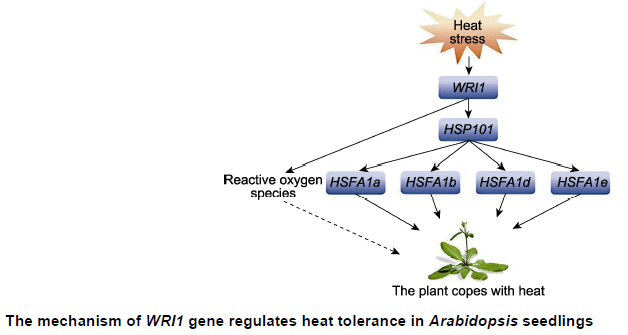
INTRODUCTION: Heat stress severely impairs plant growth and crop productivity. WRINKLED1 (WRI1), an AP2/EREBP-class transcription factor in Arabidopsis thaliana, orchestrates carbon partitioning between glycolysis and fatty acid biosynthesis, playing pivotal roles in development and stress adaptation. Elucidating its molecular function under high-temperature stress is critical for improving thermotolerance in crops. RATIONALE: While WRI1’s metabolic regulatory function has been elucidated, its role in heat response remains unexplored. To decipher the molecular mechanism of WRI1-mediated thermotolerance, we integrated genetic approaches (wild type, wri1-4, and WRI1-OE (overexpression)) with qRT-PCR and phenotyping under controlled heat stress. RESULTS: In this study, histochemical GUS staining of pWRI1::GUS transgenic lines demonstrated constitutive WRI1 expression throughout Arabidopsis seedlings, with significantly enhanced transcription in cotyledons under heat stress (HS) (P <0.05). Prolonged HS induced gradual transcriptional attenuation, though the transcription levels remained elevated than under the optimal temperature (22°C). qRT-PCR confirmed thermo-responsive WRI1 upregulation (peak:1 h HS, 3-fold induction), followed by threshold-dependent decline, indicating acute early-phase responsiveness. Endogenous immunoassays revealed reduced WRI1 protein accumulation under HS, suggesting HS-impaired protein stability or post-translational regulatory mechanisms. Thermotolerance phenotyping of WT, wri1-4, and WRI1-OE lines showed superior HS survival rate in WRI1-OE, with acquired thermotolerance exceeding basal thermotolerance across genotypes, confirming WRI1-mediated positive thermoregulation. The survival rate of WRI1-OE seedlings reached approximately 75%–85%, whereas that of wild type and complementary lines was less than 10%. We found that WRI1-OE reduced reactive oxygen species (ROS) accumulation, where direct transcriptional regulation of HSF/ HSP genes (e.g., HSFA2, HSP101) was excluded by qRT-PCR. Nevertheless, differential gene expression across genotypes indicated WRI1’s auxiliary role in thermotolerance via ROS scavenging and indirect proteostasis maintenance. CONCLUSION: This study proved WRI1 as a master regulator of thermotolerance, functioning through synergistic activation of chaperone networks ( HSFA2-HSPs) and ROS scavenging. The discovery of its cross-pathway coordination mechanism provides novel insights into plant thermal adaptation, and positions WRI1 as a potentially useful target for breeding climate-resilient crops.
Cite this article

Xuya Gu , Zhangman Lin , Siyuan Hu , Xuening Li , Xiaolin Qin , Zhengxi Wu , Nuo Li , Mingyin Feng , Ruihua Huang . Function of WRI1 in Heat Stress of Arabidopsis Seedlings[J]. Chinese Bulletin of Botany, 2026 , 61(3) : 428 -436 . DOI: 10.11983/CBB25085

BaniwalSK, BhartiK, ChanKY, FauthM, GanguliA, KotakS, MishraSK, NoverL, PortM, ScharfKD, TrippJ, WeberC, ZielinskiD, vonKoskull—Döring P (2004). Heat stress response in plants: a complex game with chaperones and more than twenty heat stress transcription factors. J Biosci 29, 471-487.

CernacA, AndreC, Hoffmann—BenningS, BenningC (2006). WRI1 is required for seed germination and seedling establishment. Plant Physiol 141, 745-757.

ChristouA, FilippouP, ManganarisGA, FotopoulosV (2014). Sodium hydrosulfide induces systemic thermotolerance to strawberry plants through transcriptional regulation of heat shock proteins and aquaporin. BMC Plant Biol 14, 42.

FeiWJ, YangSQ, HuJ, YangF, QuGY, PengD, ZhouB (2020). Research advances of WRINKLED1 (WRI1) in plants. Funct Plant Biol 47, 185-194.

FocksN, BenningC (1998). wrinkled1: a novel, low—seed—oil mutant of Arabidopsis with a deficiency in the seed—specific regulation of carbohydrate metabolism. Plant Physiol 118, 91-101.

HuangRH, WenMR, FengBJ, WuPZ, ZhongXQ, YangYF, LiuMH, LiHQ, YangCW, PengCL, ZhangSC (2025). SIZ1 SUMOylates and stabilizes WRI1 to safeguard seed filling and fatty acid biosynthesis under high—temperature stress. Plant Cell 37, koaf085.

JinLF, ZhouLX, CaoHX, YangYD (2022). Progress on WRI1 regulation of plant oil biosynthesis. Chin J Oil Crop Sci 44, 687-698. (in Chinese)

金龙飞, 周丽霞, 曹红星, 杨耀东 (2022). WRI1调控植物油脂合成的研究进展. 中国油料作物学报 44, 687-698.

KotakS, LarkindaleJ, LeeU, vonKoskull—Döring P, VierlingE, ScharfKD (2007). Complexity of the heat stress response in plants. Curr Opin Plant Biol 10, 310-316.

LiuJP (2016). Molecular mechanism underlying ethylene stimulation of latex production in rubber tree (Hevea brasiliensis). Trees 30, 1913-1921.

MillerG, MittlerR (2006). Could heat shock transcription factors function as hydrogen peroxide sensors in plants. Ann Bot 98, 279-288.

MittlerR, FinkaA, GoloubinoffP (2012). How do plants feel the heat? Trends Biochem Sci 37, 118-125.

PengL, WanX, HuangK, PeiLS, XiongJ, LiXY, WangJ (2019). AtPUB48 E3 ligase plays a crucial role in the thermotolerance of Arabidopsis. Biochem Biophys Res Commun 509, 281-286.

QiHH, CaiXX, YangHW, WangJM, LiuZB, YangY (2016). Primary analysis of the function of Arabidopsis thaliana AtHHR3 to response heat stress. J Sichuan Univ (Nat Sci Edn) 53, 1141-1146. (in Chinese)

齐辉辉, 蔡潇潇, 杨虹伟, 王健美, 刘志斌, 杨毅 (2016). 拟南芥AtHHR3响应热胁迫应答的初步分析. 四川大学学报(自然科学版) 53, 1141-1146.

Roldán—ArjonaT, ArizaRR (2009). Repair and tolerance of oxidative DNA damage in plants. Mutat Res 681, 169-179.

ScharfKD, BerberichT, EbersbergerI, NoverL (2012). The plant heat stress transcription factor (Hsf) family: structure, function and evolution. Biochim Biophys Acta 1819, 104-119.

SlimenIB, NajarT, GhramA, DabbebiH, BenMrad M, AbdrabbahM (2014). Reactive oxygen species, heat stress and oxidative—induced mitochondrial damage. Int J Hyperthermia 30, 513-523.

SnellP, GrimbergÅ, CarlssonAS, HofvanderP (2019). WRINKLED1 is subject to evolutionary conserved negative autoregulation. Front Plant Sci 10, 387.

WangWX, VinocurB, ShoseyovO, AltmanA (2004). Role of plant heat—shock proteins and molecular chaperones in the abiotic stress response. Trends Plant Sci 9, 244-252.

YangXY, HuangCY, WuJF, HuangYJ, ZhangQX (2016a). Bioinformatic analysis of the WRI1 genes in plant. Mol Plant Breed 14, 1140-1151. (in Chinese)

杨先友, 黄春颖, 吴建峰, 黄有军, 张启香 (2016a). 植物WRI1基因生物信息学分析. 分子植物育种 14, 1140-1151.

YangXY, HuangYJ, ZhangT, HuangCY (2016b). Advances on transcriptional activator AtWRI1 of Arabidopsis. Biotechnol Bull 32(6), 13-18. (in Chinese)

杨先友, 黄有军, 张通, 黄春颖 (2016b). 拟南芥转录激活因子AtWRI1研究进展. 生物技术通报 32(6), 13-18.

ZhouTJ, ChenZM, ChenXL, ZuoM, JiangJ, HuS (2021). Interpreting IPCC AR6: future global climate based on projection under scenarios and on near—term information. Adv Clim Change Res 17, 652-663. (in Chinese)

周天军, 陈梓明, 陈晓龙, 左萌, 江洁, 胡帅 (2021). IPCC AR6报告解读: 未来的全球气候——基于情景的预估和近期信息. 气候变化研究进展 17, 652-663.

Outlines

/

〈 〉
