
Comparative Analysis of Transcriptome of Adventitious Roots Under Different Hydroponic Conditions of Lycium barbarum
Received date: 2025-04-25
Accepted date: 2025-09-02
Online published: 2025-09-03
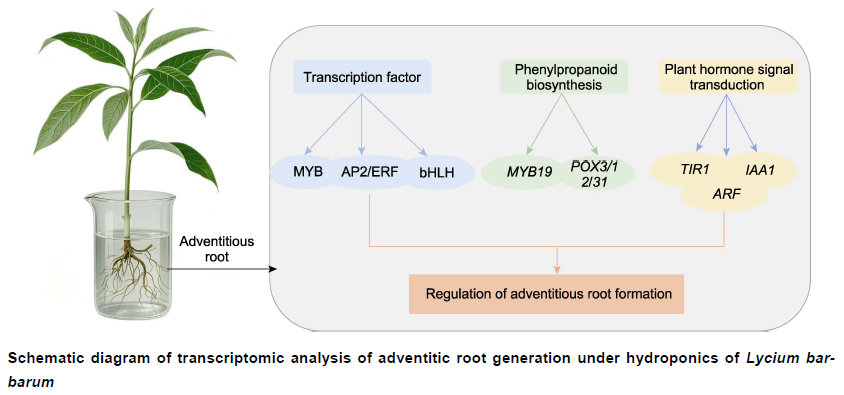
INTRODUCTION: Lycium barbarum is an important economic forest tree species, and its cutting propagation efficiency is closely related to the formation of adventitious roots. However, the molecular mechanism of adventitious root formation is not clear, which restricts the large-scale breeding and efficient utilization of Lycium barbarum. RATIONALE: In order to explore the transcriptome differences in adventitious root formation of L. barbarum, three wolfberry genotypes with different root-forming abilities were used as experimental materials. A hydroponic experiment was conducted to analyze the transcriptional differences during adventitious root formation. RESULTS: Transcriptome sequencing identified 6 448 differentially expressed genes (DEGs), with the L-vs-H group having the highest number of DEGs at 4 413, including 2 583 upregulated and 1 830 downregulated genes. A total of 281 transcription factors were identified, mainly from the MYB, AP2/ERF, and bHLH families, with distinct expression patterns. GO enrichment analysis revealed that 1 714 DEGs were enriched in 32 GO terms. KEGG enrichment analysis indicated that DEGs were mainly enriched in the phenylpropanoid biosynthesis and plant hormone signal transduction pathways. Among these, MYB19 (Lba07g01820) is a core gene in the phenylpropanoid pathway, and TIR1 (Lba08g00069) is a core gene in the plant hormone signal transduction pathway. Both genes play crucial roles in adventitious root formation in wolfberry. qRT-PCR validated the reliability of the transcriptome data. CONCLUSION: In this study, the transcriptional regulatory network of adventitious root formation in L. barbarum was analyzed, which provided new insights into the root development mechanism of woody plants, revealed the molecular mechanism of adventitious root formation in L. barbarum, and laid an important theoretical foundation for genetic improvement and efficient breeding of L. barbarum and other woody plants.
Key words: wolfberry; hydroponics; adventitious root formation; transcriptomics; key genes
Gaier Yang , Xuan Zhang , Jiadong Wang , Bo Zhang , Linyuan Duan , Xiang Li . Comparative Analysis of Transcriptome of Adventitious Roots Under Different Hydroponic Conditions of Lycium barbarum[J]. Chinese Bulletin of Botany, 2026 , 61(3) : 462 -474 . DOI: 10.11983/CBB25077
|
|
|
|
|
|
|
|
|
扈嘉鑫, 陈宇熙, 余敏芬, 郑炳松, 闫道良 (2024). 植物不定根生成的生理及分子调控机制研究进展. 分子植物育种 22, 6151-6159.
|
|
如克亚·加帕尔, 孙玉敬, 钟烈州, 沈妍, 叶兴乾 (2013). 枸杞植物化学成分及其生物活性的研究进展. 中国食品学报 13(8), 161-172.
|
|
|
|
|
|
|
|
李魁鹏 (2014). 杂种落叶松组培不定根诱导及生根相关AP2—like基因的克隆与表达研究. 硕士论文. 北京: 中国林业科学研究院. pp. 1-134.
|
|
|
|
|
|
|
|
|
|
师雄 (2020). 转录因子HY5调控拟南芥不定根和愈伤组织形成以及芽再生的研究. 硕士论文. 西安: 陕西师范大学. pp. 1-91.
|
|
|
|
|
|
孙雪莲, 杨楚童, 胡亚楠, 邹显花 (2021). 植物扦插生根机理的研究进展. 农学学报 11(10), 33-40.
|
|
|
|
王嘉栋, 赵佳慧, 马西梅, 杨改儿, 段淋渊, 姚文孔, 尹晓, 李翔 (2024). 不同枸杞扦插及水培生根能力比较分析. 经济林研究 42, 140-149.
|
|
王雨心, 李金洋, 胡婷婷 (2024). 枸杞子化学成分和药理作用研究进展. 广州化工 52(24), 1-4.
|
|
魏斯佳 (2024). 柑橘不定根发生过程的基因转录动态与关键基因挖掘. 硕士论文. 武汉: 华中农业大学. pp. 1-71.
|
|
吴卫倩, 胡子建, 沈诗雅, 张贵芳, 林金星, 张曦 (2026). 植物不定根再生与扦插生根相关激素调控研究进展. 植物研究 46, 13-24.
|
|
许智宏, 张宪省, 苏英华, 胡玉欣, 徐麟, 王佳伟 (2019). 植物细胞全能性和再生. 中国科学: 生命科学 49, 1282-1300.
|
|
袁姜莲, 李炎, 罗义维, 轩亚辉, 何宁佳 (2025). 不同桑树品种扦插生长情况及其生根能力评价. 西南大学学报 (自然科学版) 47(2), 61-69.
|
|
张鹏迪, 吕艳娥, 张仁雪, 王慧, 吕晋慧 (2025). 外源激素对沙枣嫩枝扦插生根及生理生化的影响. 东北林业大学学报 53(4), 79-87.
|
|
|
|
章怡兰, 林雪, 吴仪, 李梦佳, 张晟婕, 路梅, 饶玉春, 王跃星 (2020). 水稻根系遗传育种研究进展. 植物学报 55, 382-393.
|
|
|
|
赵敏, 刘坤, 王毅, 胡青, 邸多隆, 裴栋, 陆斌 (2024). 油橄榄压条不定根发生的转录组分析. 西部林业科学 53(3), 68-77.
|
|
|
/
| 〈 |
|
〉 |

 Home
Home