
Salicylic Acid-mediated Plant Immune Responses: From Metabolism and Perception to Immune Activation
Received date: 2025-08-16
Accepted date: 2025-09-02
Online published: 2025-09-02
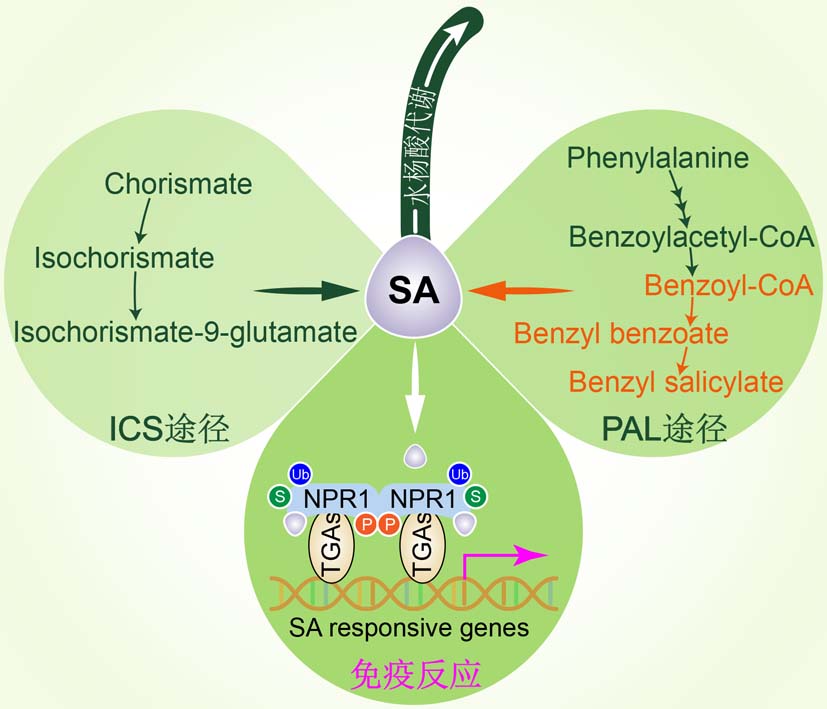
Salicylic acid (SA) is a natural phenolic compound in plants that plays a crucial regulatory role in plant immune responses. Plants primarily synthesize SA through two pathways: the isochorismate synthase (ICS) pathway and the phenylalanine ammonia-lyase (PAL) pathway. The synthesized SA is perceived by receptors such as nonexpressor of pathogenesis-related genes 1 (NPR1), which subsequently activate immune responses. In Brassicaceae species like Arabidopsis thaliana, SA is mainly synthesized via the ICS pathway, whereas monocots and non-Brassicaceae dicots predominantly rely on the PAL pathway. For a long time, understanding of SA biosynthesis via the PAL pathway has been incomplete, hindering research on SA-mediated immunity in crops and significantly limiting progress in crop disease-resistant breeding. Recently, three research groups from China independently elucidated the PAL-mediated SA biosynthesis pathway in crops. Building on these breakthroughs, this review summarizes recent advances in the study of SA-mediated plant immune responses. We primarily focus on the biosynthetic pathways of SA within plants, the mechanisms by which SA is perceived and activates immune responses, and discuss current challenges and future directions in SA-mediated immunity research. We hope this review provides new insights and perspectives for both theoretical studies and practical applications in crop disease-resistant breeding.
Zhu Xiaobo , Wang Liyin , Chen Xuewei . Salicylic Acid-mediated Plant Immune Responses: From Metabolism and Perception to Immune Activation[J]. Chinese Bulletin of Botany, 2025 , 60(5) : 679 -692 . DOI: 10.11983/CBB25149
| [1] | Baek D, Pathange P, Chung JS, Jiang JF, Gao LQ, Oikawa A, Hirai MY, Saito K, Pare PW, Shi HZ (2010). A stress-inducible sulphotransferase sulphonates salicylic acid and confers pathogen resistance in Arabidopsis. Plant Cell Environ 33, 1383-1392. |
| [2] | Canet JV, Dobón A, Fajmonová J, Tornero P (2012). The BLADE-ON-PETIOLE genes of Arabidopsis are essential for resistance induced by methyl jasmonate. BMC Plant Biol 12, 199. |
| [3] | Cao H, Bowling SA, Gordon AS, Dong XN (1994). Characterization of an Arabidopsis mutant that is nonresponsive to inducers of systemic acquired resistance. Plant Cell 6, 1583-1592. |
| [4] | Castelló MJ, Medina-Puche L, Lamilla J, Tornero P (2018). NPR1 paralogs of Arabidopsis and their role in salicylic acid perception. PLoS One 13, e0209835. |
| [5] | Chen F, D’Auria JC, Tholl D, Ross JR, Gershenzon J, Noel JP, Pichersky E (2003). An Arabidopsis thaliana gene for methylsalicylate biosynthesis, identified by a biochemical genomics approach, has a role in defense. Plant J 36, 577-588. |
| [6] | Chen Y, Shen H, Wang MY, Li Q, He ZH (2013). Salicyloyl-aspartate synthesized by the acetyl-amido synthetase GH3.5 is a potential activator of plant immunity in Arabidopsis. Acta Bioch Bioph Sin 45, 827-836. |
| [7] | Chen ZX, Silva H, Klessig DF (1993). Active oxygen species in the induction of plant systemic acquired resistance by salicylic acid. Science 262, 1883-1886. |
| [8] | Chern M, Bai W, Ruan DL, Oh T, Chen XW, Ronald PC (2014). Interaction specificity and coexpression of rice NPR1 homologs 1 and 3 (NH1 and NH3), TGA transcription factors and negative regulator of resistance (NRR) proteins. BMC Genomics 15, 461. |
| [9] | Choi HW, Klessig DF (2016). DAMPs, MAMPs, and NAMPs in plant innate immunity. BMC Plant Biol 16, 232. |
| [10] | Dean JV, Delaney SP (2008). Metabolism of salicylic acid in wild-type, ugt74f1 and ugt74f2 glucosyltransferase mutants of Arabidopsis thaliana. Physiol Plant 132, 417-425. |
| [11] | Delaney TP, Friedrich L, Ryals JA (1995). Arabidopsis signal transduction mutant defective in chemically and biologically induced disease resistance. Proc Natl Acad Sci USA 92, 6602-6606. |
| [12] | Ding YL, Sun TJ, Ao K, Peng YJ, Zhang YX, Li X, Zhang YL (2018). Opposite roles of salicylic acid receptors NPR1 and NPR3/NPR4 in transcriptional regulation of plant immunity. Cell 173, 1454-1467. |
| [13] | Fang X, Xie Y, Yuan Y, Long Q, Zhang L, Abid G, Zhang WQ (2025). The role of salicylic acid in plant defense responses against biotic stresses. Plant Horm 1, e004. |
| [14] | Fu ZQ, Dong XN (2013). Systemic acquired resistance: turning local infection into global defense. Ann Rev Plant Biol 64, 839-863. |
| [15] | Gaffney T, Friedrich L, Vernooij B, Negrotto D, Nye G, Uknes S, Ward E, Kessmann H, Ryals J (1993). Requirement of salicylic acid for the induction of systemic acquired resistance. Science 261, 754-756. |
| [16] | He J, Liu YQ, Yuan DY, Duan MJ, Liu YL, Shen ZJ, Yang CY, Qiu ZY, Liu DM, Wen PZ, Huang J, Fan DJ, Xiao SZ, Xin YY, Chen XN, Jiang L, Wang HY, Yuan LP, Wan JM (2020). An R2R3 MYB transcription factor confers brown planthopper resistance by regulating the phenylalanine ammonia-lyase pathway in rice. Proc Natl Acad Sci USA 117, 271-277. |
| [17] | Huang S, Zhu SW, Kumar P, MacMicking JD (2021). A phase-separated nuclear GBPL circuit controls immunity in plants. Nature 594, 424-429. |
| [18] | Huang WJ, Wang YR, Li X, Zhang YL (2020). Biosynthesis and regulation of salicylic acid and N-hydroxypipecolic acid in plant immunity. Mol Plant 13, 31-41. |
| [19] | Huang XX, Zhu GQ, Liu Q, Chen L, Li YJ, Hou BK (2018). Modulation of plant salicylic acid-associated immune responses via glycosylation of dihydroxybenzoic acids. Plant Physiol 176, 3103-3119. |
| [20] | Jin HS, Choi SM, Kang MJ, Yun SH, Kwon DJ, Noh YS, Noh B (2018). Salicylic acid-induced transcriptional reprogramming by the HAC-NPR1-TGA histone acetyltransferase complex in Arabidopsis. Nucleic Acids Res 46, 11712-11725. |
| [21] | Jones JDG, Dangl JL (2006). The plant immune system. Nature 444, 323-329. |
| [22] | Kotera Y, Komori H, Tasaki K, Takagi K, Imano S, Katou S (2023). The peroxisomal β-oxidative pathway and benzyl alcohol O-benzoyltransferase HSR201 cooperatively contribute to the biosynthesis of salicylic acid. Plant Cell Physiol 64, 758-770. |
| [23] | Kumar S, Zavaliev R, Wu QL, Zhou Y, Cheng J, Dillard L, Powers J, Withers J, Zhao JS, Guan ZQ, Borgnia MJ, Bartesaghi A, Dong XN, Zhou P (2022). Structural basis of NPR1 in activating plant immunity. Nature 605, 561-566. |
| [24] | Lee HJ, Park YJ, Seo PJ, Kim JH, Sim HJ, Kim SG, Park CM (2015). Systemic immunity requires SnRK2.8-mediated nuclear import of NPR1 in Arabidopsis. Plant Cell 27, 3425-3438. |
| [25] | León J, Shulaev V, Yalpani N, Lawton MA, Raskin I (1995). Benzoic acid 2-hydroxylase, a soluble oxygenase from tobacco, catalyzes salicylic acid biosynthesis. Proc Natl Acad Sci USA 92, 10413-10417. |
| [26] | Li Q, Zhou MX, Chhajed S, Yu FH, Chen SX, Zhang YP, Mou ZL (2023). N-hydroxypipecolic acid triggers systemic acquired resistance through extracellular NAD(P). Nat Commun 14, 6848. |
| [27] | Lim GH (2023). Regulation of salicylic acid and N-hydroxy- pipecolic acid in systemic acquired resistance. Plant Pathol J 39, 21-27. |
| [28] | Liu YN, Sun TJ, Sun YL, Zhang YJ, Radoji?i? A, Ding YL, Tian HN, Huang XC, Lan JM, Chen SY, Orduna AR, Zhang KW, Jetter R, Li X, Zhang YL (2020). Diverse roles of the salicylic acid receptors NPR1 and NPR3/ NPR4 in plant immunity. Plant Cell 32, 4002-4016. |
| [29] | Liu YN, Xu L, Wu MS, Wang JJ, Qiu D, Lan JM, Lu JX, Zhang Y, Li X, Zhang YL (2025). Three-step biosynthesis of salicylic acid from benzoyl-CoA in plants. Nature doi: 10.1038/s41586-41025-09185-41587. |
| [30] | Mackelprang R, Okrent RA, Wildermuth MC (2017). Preference of Arabidopsis thaliana GH3.5 acyl amido synthetase for growth versus defense hormone acyl substrates is dictated by concentration of amino acid substrate aspartate. Phytochemistry 143, 19-28. |
| [31] | Manohar M, Tian MY, Moreau M, Park SW, Choi HW, Fei ZJ, Friso G, Asif M, Manosalva P, von Dahl CC, Shi K, Ma SS, Dinesh-Kumar SP, O'Doherty I, Schroeder FC, van Wijk KJ, Klessig DF (2015). Identification of multiple salicylic acid-binding proteins using two high throughput screens. Front Plant Sci 5, 777. |
| [32] | Meng L, Yang HP, Yang JL, Wang YP, Ye TT, Xiang L, Chan Z, Wang YP (2024). Tulip transcription factor TgWRKY75 activates salicylic acid and abscisic acid biosynthesis to synergistically promote petal senescence. J Exp Bot 75, 2435-2450. |
| [33] | Mou ZL, Fan WH, Dong XN (2003). Inducers of plant systemic acquired resistance regulate NPR1 function through redox changes. Cell 113, 935-944. |
| [34] | Noutoshi Y, Okazaki M, Kida T, Nishina Y, Morishita Y, Ogawa T, Suzuki H, Shibata D, Jikumaru Y, Hanada A, Kamiya Y, Shirasu K (2012). Novel plant immune-priming compounds identified via high-throughput chemical screening target salicylic acid glucosyltransferases in Arabidopsis. Plant Cell 24, 3795-3804. |
| [35] | Pajerowska-Mukhtar KM, Wang W, Tada Y, Oka N, Tucker CL, Fonseca JP, Dong XN (2012). The HSF-like transcription factor TBF1 is a major molecular switch for plant growth-to-defense transition. Curr Biol 22, 103-112. |
| [36] | Park SW, Kaimoyo E, Kumar D, Mosher S, Klessig DF (2007). Methyl salicylate is a critical mobile signal for plant systemic acquired resistance. Science 318, 113-116. |
| [37] | Peng YJ, Yang JF, Li X, Zhang YL (2021). Salicylic acid: biosynthesis and signaling. Ann Rev Plant Biol 72, 761-791. |
| [38] | Pieterse CMJ, Van der Does D, Zamioudis C, Leon-Reyes A, Van Wees SCM (2012). Hormonal modulation of plant immunity. Ann Rev Cell Dev Biol 28, 489-521. |
| [39] | Rekhter D, Lüdke D, Ding YL, Feussner K, Zienkiewicz K, Lipka V, Wiermer M, Zhang YL, Feussner I (2019). Isochorismate-derived biosynthesis of the plant stress hormone salicylic acid. Science 365, 498-502. |
| [40] | Saleh A, Withers J, Mohan R, Marqués J, Gu YN, Yan SP, Zavaliev R, Nomoto M, Tada Y, Dong XN (2015). Posttranslational modifications of the master transcriptional regulator NPR1 enable dynamic but tight control of plant immune responses. Cell Host Microbe 18, 169-182. |
| [41] | Seguel A, Jelenska J, Herrera-Vásquez A, Marr SK, Joyce MB, Gagesch KR, Shakoor N, Jiang SC, Fonseca A, Wildermuth MC, Greenberg JT, Holuigue L (2018). PROHIBITIN3 forms complexes with ISOCHORISMATE SYNTHASE1 to regulate stress-induced salicylic acid biosynthesis in Arabidopsis. Plant Physiol 176, 2515-2531. |
| [42] | Shen MZ, Lim CJ, Park J, Kim JE, Baek D, Nam J, Lee SY, Pardo JM, Kim WY, Mackey D, Yun DJ (2020). HOS15 is a transcriptional corepressor of NPR1-mediated gene activation of plant immunity. Proc Natl Acad Sci USA 117, 30805-30815. |
| [43] | Silverman P, Seskar M, Kanter D, Schweizer P, Metraux JP, Raskin I (1995). Salicylic acid in rice (biosynthesis, conjugation, and possible role). Plant Physiol 108, 633-639. |
| [44] | Skelly MJ, Furniss JJ, Grey H, Wong KW, Spoel SH (2019). Dynamic ubiquitination determines transcriptional activity of the plant immune coactivator NPR1. eLife 8, e47005. |
| [45] | Slaymaker DH, Navarre DA, Clark D, del Pozo O, Martin GB, Klessig DF (2002). The tobacco salicylic acid-binding protein 3 (SABP3) is the chloroplast carbonic anhydrase, which exhibits antioxidant activity and plays a role in the hypersensitive defense response. Proc Natl Acad Sci USA 99, 11640-11645. |
| [46] | Spoel SH, Dong XN (2024). Salicylic acid in plant immunity and beyond. Plant Cell 36, 1451-1464. |
| [47] | Sun TJ, Zhang YX, Li Y, Zhang Q, Ding YL, Zhang YL (2015). ChIP-seq reveals broad roles of SARD1 and CBP60g in regulating plant immunity. Nat Commun 6, 10159. |
| [48] | Tada Y, Spoel SH, Pajerowska-Mukhtar K, Mou ZL, Song JQ, Wang C, Zuo JR, Dong XN (2008). Plant immunity requires conformational charges of NPR1 via S-nitrosylation and thioredoxins. Science 321, 952-956. |
| [49] | Tan ST, Abas M, Verstraeten I, Glanc M, Molnár G, Hajny J, Lasák P, Pet?ík I, Russinova E, Petrá?ek J, Novák O, Pospí?il J, Friml J (2020). Salicylic acid targets protein phosphatase 2A to attenuate growth in plants. Curr Biol 30, 381-395. |
| [50] | Torrens-Spence MP, Bobokalonova A, Carballo V, Glinkerman CM, Pluskal T, Shen A, Weng JK (2019). PBS3 and EPS1 complete salicylic acid biosynthesis from isochorismate in Arabidopsis. Mol Plant 12, 1577-1586. |
| [51] | Ullah C, Chen YH, Ortega MA, Tsai CJ (2023). The diversity of salicylic acid biosynthesis and defense signaling in plants: knowledge gaps and future opportunities. Curr Opin Plant Biol 72, 102349. |
| [52] | Vlot AC, Dempsey DA, Klessig DF (2009). Salicylic acid, a multifaceted hormone to combat disease. Ann Rev Phytopathol 47, 177-206. |
| [53] | Wang D, Weaver ND, Kesarwani M, Dong XN (2005). Induction of protein secretory pathway is required for systemic acquired resistance. Science 308, 1036-1040. |
| [54] | Wang W, Withers J, Li H, Zwack PJ, Rusnac DV, Shi H, Liu LJ, Yan SP, Hinds TR, Guttman M, Dong XN, Zheng N (2020). Structural basis of salicylic acid perception by Arabidopsis NPR proteins. Nature 586, 311-316. |
| [55] | Wang YK, Miao HY, Qiu JH, Liu MH, Jin GC, Zhang WX, Song SY, Fan PX, Xin XF, Hu JP, Li R, Pan RH (2025a). Species- and organ-specific contribution of peroxisomal cinnamate: CoA ligases to benzoic and salicylic acid biosynthesis. Plant Cell 37, koae329. |
| [56] | Wang YK, Song SY, Zhang WX, Deng QW, Feng YL, Tao M, Kang MN, Zhang Q, Yang LJ, Wang XY, Zhu CG, Wang XW, Zhu WX, Zhu YX, Cao PF, Chen J, Pan JH, Feng S, Chen XY, Dai HX, Song SY, Yang JH, Zhao TL, Cao FB, Tao Z, Shen XX, Last RL, Hu JP, Yu JQ, Fan PX, Pan RH (2025b). Deciphering phenylalanine-derived salicylic acid biosynthesis in plants. Nature doi: 10.1038/s41586-41025-09280-41589. |
| [57] | Wildermuth MC, Dewdney J, Wu G, Ausubel FM (2001). Isochorismate synthase is required to synthesize salicylic acid for plant defence. Nature 414, 562-565. |
| [58] | Wu N, Qin L, Peng ZH, Xia ST (2022). Research progress of mobile signal Pip/NHP in systemic acquired resistance. Chin Bull Bot 57, 412-421. (in Chinese) |
| 吴楠, 覃磊, 彭志红, 夏石头 (2022). 系统获得性抗性移动信号Pip/NHP研究进展. 植物学报 57, 412-421. | |
| [59] | Wu Y, Zhang D, Chu JY, Boyle P, Wang Y, Brindle ID, De Luca V, Després C (2012). The Arabidopsis NPR1 protein is a receptor for the plant defense hormone salicylic acid. Cell Rep 1, 639-647. |
| [60] | Xu L, Zhao HY, Ruan WY, Deng MJ, Wang F, Peng JR, Luo J, Chen ZX, Yi KK (2017). ABNORMAL INFLORESCENCE MERISTEM1 functions in salicylic acid biosynthesis to maintain proper reactive oxygen species levels for root meristem activity in rice. Plant Cell 29, 560-574. |
| [61] | Yalpani N, Leon J, Lawton MA, Raskin I (1993). Pathway of salicylic acid biosynthesis in healthy and virus-inoculated tobacco. Plant Physiol 103, 315-321. |
| [62] | Yamasaki K, Motomura Y, Yagi Y, Nomura H, Kikuchi S, Nakai M, Shiina T (2013). Chloroplast envelope localization of EDS5, an essential factor for salicylic acid biosynthesis in Arabidopsis thaliana. Plant Signal Behav 8, e23603. |
| [63] | Yang Y, Xu R, Ma CJ, Vlot AC, Klessig DF, Pichersky E (2008). Inactive methyl indole-3-acetic acid ester can be hydrolyzed and activated by several esterases belonging to the AtMES esterase family of Arabidopsis. Plant Physiol 147, 1034-1045. |
| [64] | Ye HT, Hou QQ, Lv HT, Shi H, Wang D, Chen YJ, Xu TS, Wang M, He M, Yin JJ, Lu X, Tang YY, Zhu XB, Zou LJ, Chen XW, Li JY, Wang B, Wang J (2024). D53 represses rice blast resistance by directly targeting phenylalanine ammonia lyases. J Integr Plant Biol 66, 1827-1830. |
| [65] | Yokoo S, Inoue S, Suzuki N, Amakawa N, Matsui H, Nakagami H, Takahashi A, Arai R, Katou S (2018). Comparative analysis of plant isochorismate synthases reveals structural mechanisms underlying their distinct biochemical properties. Biosci Rep 38, BSR20171457. |
| [66] | Zavaliev R, Dong XN (2024). NPR1, a key immune regulator for plant survival under biotic and abiotic stresses. Mol Cell 84, 131-141. |
| [67] | Zavaliev R, Mohan R, Chen TY, Dong XN (2020). Formation of NPR1 condensates promotes cell survival during the plant immune response. Cell 182, 1093-1108. |
| [68] | Zhang J, Dong SM, Wang W, Zhao JH, Chen XW, Guo HS, He GC, He ZH, Kang ZS, Peng YL, Wang GL, Zhou XP, Wang YC, Zhou JM (2019). Plant immunity and sustainable control of pests in China: advances, opportunities and challenges. Sci Sin Vitae 49, 1479-1507. (in Chinese) |
| 张杰, 董莎萌, 王伟, 赵建华, 陈学伟, 郭惠珊, 何光存, 何祖华, 康振生, 李毅, 彭友良, 王国梁, 周雪平, 王源超, 周俭民 (2019). 植物免疫研究与抗病虫绿色防控: 进展、机遇与挑战. 中国科学: 生命科学 49, 1479-1507. | |
| [69] | Zhang KW, Halitschke R, Yin CX, Liu CJ, Gan SS (2013). Salicylic acid 3-hydroxylase regulates Arabidopsis leaf longevity by mediating salicylic acid catabolism. Proc Natl Acad Sci USA 110, 14807-14812. |
| [70] | Zhang YJ, Zhao L, Zhao JZ, Li YJ, Wang JB, Guo R, Gan SS, Liu CJ, Zhang KW (2017). S5H/DMR6 encodes a salicylic acid 5-hydroxylase that fine-tunes salicylic acid homeostasis. Plant Physiol 175, 1082-1093. |
| [71] | Zhang YL, Tessaro MJ, Lassner M, Li X (2003). Knockout analysis of Arabidopsis transcription factors TGA2, TGA5, and TGA6 reveals their redundant and essential roles in systemic acquired resistance. Plant Cell 15, 2647-2653. |
| [72] | Zhao Y, Zhu XB, Chen XW, Zhou JM (2022). From plant immunity to crop disease resistance. J Genet Genomics 49, 693-703. |
| [73] | Zhou XG, Liao HC, Chern M, Yin JJ, Chen YF, Wang JP, Zhu XB, Chen ZX, Yuan C, Zhao W, Wang J, Li WT, He M, Ma BT, Wang JC, Qin P, Chen WL, Wang YP, Liu JL, Qian YW, Wang WM, Wu XJ, Li P, Zhu LH, Li SG, Ronald PC, Chen XW (2018). Loss of function of a rice TPR-domain RNA-binding protein confers broad-spectrum disease resistance. Proc Natl Acad Sci USA 115, 3174-3179. |
| [74] | Zhu B, Zhang YJ, Gao R, Wu ZH, Zhang W, Zhang C, Zhang PH, Ye C, Yao LB, Jin Y, Mao H, Tou PY, Huang P, Zhao JZ, Zhao Q, Liu CJ, Zhang KW (2025). Complete biosynthesis of salicylic acid from phenylalanine in plants. Nature doi: org/10.1038/s41586-41025-09175-41589. |
| [75] | Zhu XB, Li WT, He M, Wang J, Yu ZL, Chen XW (2020). Broad spectrum resistance in main crops: recent advances and future directions. Bull Nat Nat Sci Found China 34, 401-410. (in Chinese) |
| 朱孝波, 李伟滔, 贺闽, 王静, 于振良, 陈学伟 (2020). 作物广谱抗病研究现状与关键科学问题. 中国科学基金 34, 401-410. | |
| [76] | Zhu XB, Yin JJ, Liang SH, Liang RH, Zhou XG, Chen ZX, Zhao W, Wang J, Li WT, He M, Yuan C, Miyamoto K, Ma BT, Wang JC, Qin P, Chen WL, Wang YP, Wang WM, Wu XJ, Yamane H, Zhu LH, Li SG, Chen XW (2016). The multivesicular bodies (MVBs)-localized AAA ATPase LRD6-6 inhibits immunity and cell death likely through regulating MVBs-mediated vesicular trafficking in rice. PLoS Genet 12, e1006311. |
/
| 〈 |
|
〉 |

 Home
Home