
Received date: 2025-04-27
Accepted date: 2025-07-08
Online published: 2025-07-21
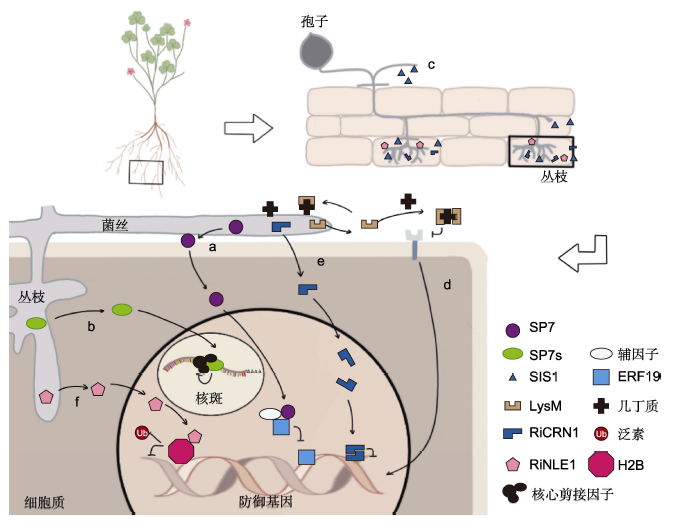
Arbuscular mycorrhizal fungi (AMF) can form symbiotic relationships with approximately 80% of terrestrial plants. Through their unique arbuscular structures within roots, they establish close contact with host cells to create a bidirectional nutrient exchange interface. This mutualistic mechanism not only enhances plant stress resistance but also reshapes ecosystem nutrient cycling. Like pathogenic fungi, the cell walls of AMF are primarily composed of chitin and β-glucans, which are key molecular patterns capable of triggering host plant immune responses. How AMF effectively evades host plant immunity remains unclear. Effector proteins secreted by pathogenic fungi have been found to play a crucial role in suppressing plant immune responses. During arbuscular mycorrhizal symbiosis, numerous effector proteins are also induced, which may similarly inhibit plant immunity and facilitate fungal colonization. This article reviewed and summarized current research on AMF effector proteins as well as discussed the future research directions and challenges. Studying effector proteins will help elucidate the regulatory mechanisms underlying the establishment and maintenance of AMF symbiosis, deepen our understanding of host-fungal interactions, and aid in selecting optimal fungal strains and plant varieties for enhanced symbiotic efficiency, thereby promoting sustainable agricultural development.
Yuexuan Zhang , Peng Wang . Research Progress on Effectors of Arbuscular Mycorrhizal Fungi[J]. Chinese Bulletin of Botany, 2026 , 61(3) : 519 -528 . DOI: 10.11983/CBB25079
|
|
|
|
|
|
|
|
|
|
|
|
|
|
|
|
|
|
|
|
|
|
|
|
|
|
|
|
|
|
|
胡江, 孙淑斌, 徐国华 (2007). 植物中丛枝菌根形成的信号途径研究进展. 植物学通报 24, 703-713.
|
|
|
|
|
|
|
|
|
|
|
|
|
|
|
|
|
|
|
|
刘栋 (2021). 既主内政, 又辖外交——以PHR为中心的基因网络调控植物—菌根真菌的共生. 植物学报 56, 647-650.
|
|
|
|
|
|
|
|
|
|
|
|
|
|
|
|
|
|
|
|
|
|
|
|
|
|
|
|
|
|
|
|
|
|
|
|
|
|
|
|
|
|
|
|
|
|
|
|
|
|
|
|
|
|
|
/
| 〈 |
|
〉 |

 Home
Home