转录因子在植物响应UV-B辐射中的调控作用
The Regulatory Roles of the Transcription Factors in Plant's Response to UV-B Radiation
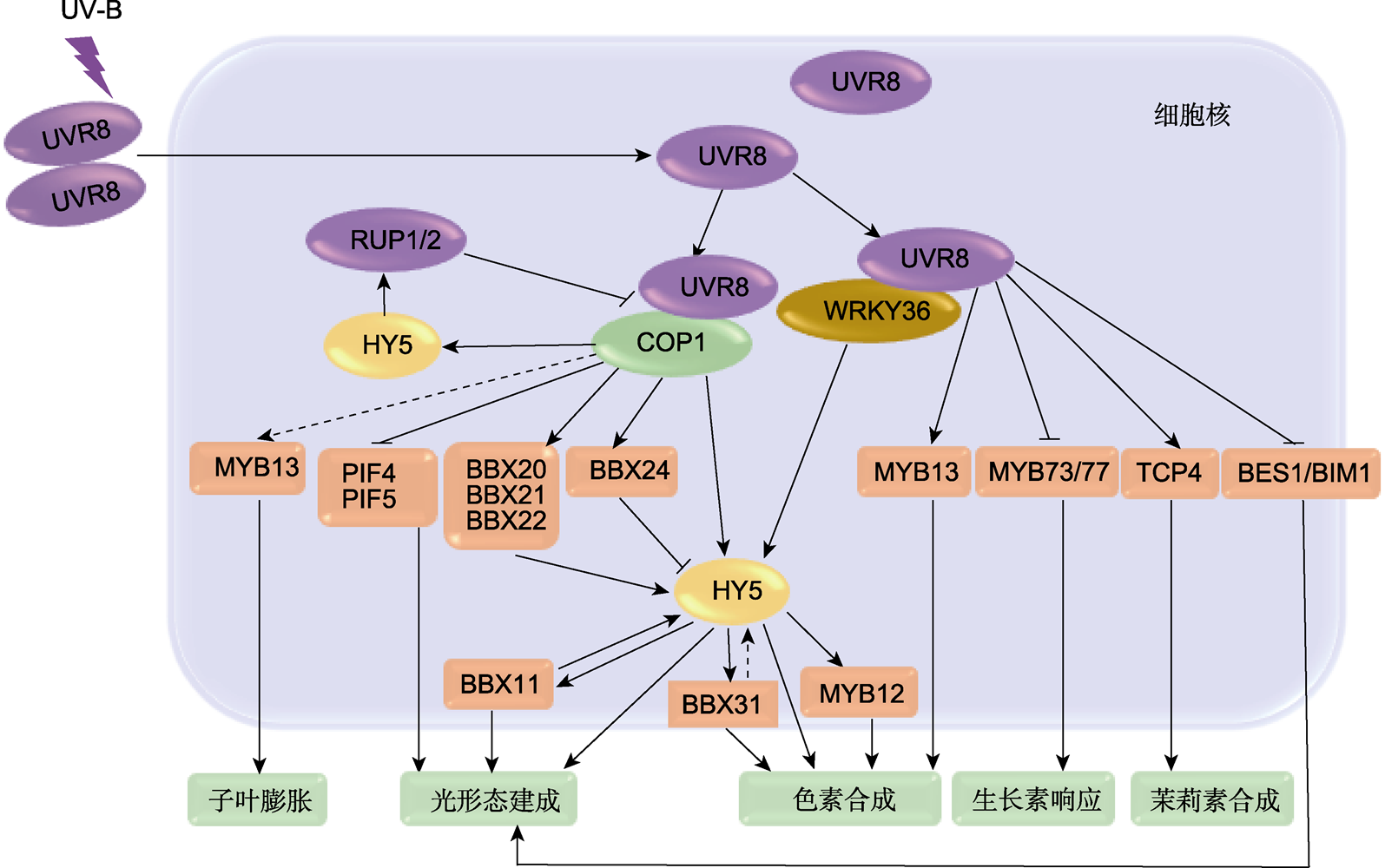
紫外线B (UV-B)激活其受体UVR8后, UVR8解聚为单体进入细胞核, 进而引发下游信号通路。UVR8直接与E3泛素连接酶COP1作用, 释放COP1降解底物HY5以及BBX20-22、BBX24、PIF4和PIF5转录因子。同时, UVR8与转录因子WRKY36相互作用增强和稳定HY5的转录活性, HY5启动下游转录因子BBX11、BBX31和MYB12, 从而调控植物色素合成与光形态建成。UVR8可抑制MYB73/MYB77和BES1/BIM1的DNA结合活性, 也可促进MYB13和TCP4对下游基因的激活, 从而调控下游信号通路。实线箭头和实线T型分别表示激活和抑制; 虚线表示有待实验验证。
Upon ultraviolet-B (UV-B) irradiation, its receptor UVR8 gets activated and subsequently depolymerizes into monomers, which then are translocated into the nucleus, instigating the downstream signaling pathways. UVR8 directly interacts with the E3 ubiquitin ligase COP1, resulting in the release of HY5, as well as the transcription factors BBX20-22, 24, PIF4 and PIF5 that would otherwise be degraded by COP1. On the other hand, UVR8 interacts with the transcription factor WRKY36 to potentiate and stabilize the transcriptional activity of HY5. HY5 triggers the downstream transcription factors BBX11, BBX31 and MYB12, orchestrating the regulation of plant pigment biosynthesis and photomorphogenesis. Moreover, UVR8 can inhibit the DNA-binding activities of MYB73/MYB77 and BES1/BIM1, and also promote the activation of downstream gene initiation by MYB13 and TCP4, thereby regulating the downstream signaling pathways. Solid arrows and T-lines represent activation and repression, respectively; the dotted lines represent that to be verified.